Ancient city of the legendary Silk Road and for Bridget and me, Khiva was next on our Uzbekistan itinerary. The Silk Road was a huge network of trade routes which connected Europe and Asia from the second century BCE to the mid 15th century.
Now a UNESCO World Heritage site which is often considered to be an ‘open-air museum’ Khiva was once an important trading hub and ancient Silk Road oasis city. It was the last watering stop for desert caravans before crossing into Persia. Khiva is located in the Khorazm region of western Uzbekistan and only about 25 miles from the border with Turkmenistan.
Getting to Khiva
The closest airport is Urgench so due to the distance involved in getting there, Bridget, myself and the rest of the Explore group had an early flight from Tashkent.
After reclaiming our bags, we loaded them onto our waiting bus and settled into our seats. As we began the 40-minute drive from Urgench to Khiva, our guide, Sanjar, shared some local history. He explained that modern Urgench was established roughly four centuries ago, though the region itself has been a melting pot of diverse cultures and faiths for millennia. In fact, Genghis Khan’s Mongol hordes conquered the historic capital of the region back in the 13th century. They occupied the area for 150 years, leaving a permanent stamp of Mongol culture on this fascinating corner of Uzbekistan.
Khiva in local dialect is pronounced ‘hay-wah’ which means ‘tasty water’. There is a legend that one of Noah’s sons found water and said ‘ hay wah’. (Although nowadays it is not so tasty for tourists… we were advised nor to drink the tap water due to its salty taste).
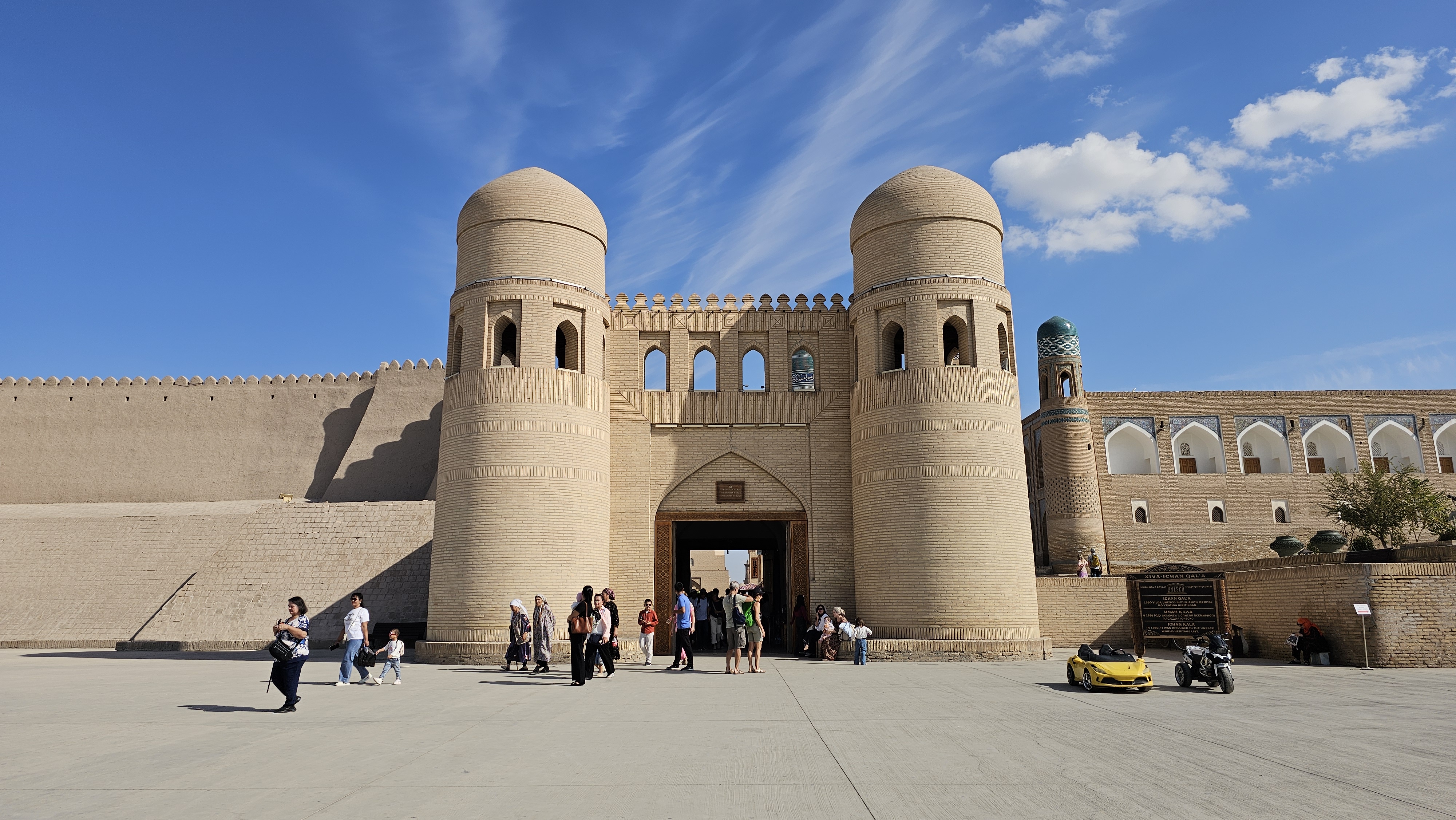
Our bus parked outside the ancient Khiva city walls and our luggage was then taken by cart as we simultaneously walked through the main city gate into Itchan Kala, the name of the inner city.
We were staying for 2 nights in the Hotel Feruzkhan which was previously a historic madrasa, an Islamic school or college. This was one of several in Khiva, all beautifully restored and preserved with the rooms located around a large inner courtyard.
When everyone was ready, Sanjar led the group, in perfect 24 degree temperatures, to begin exploring the ancient city.
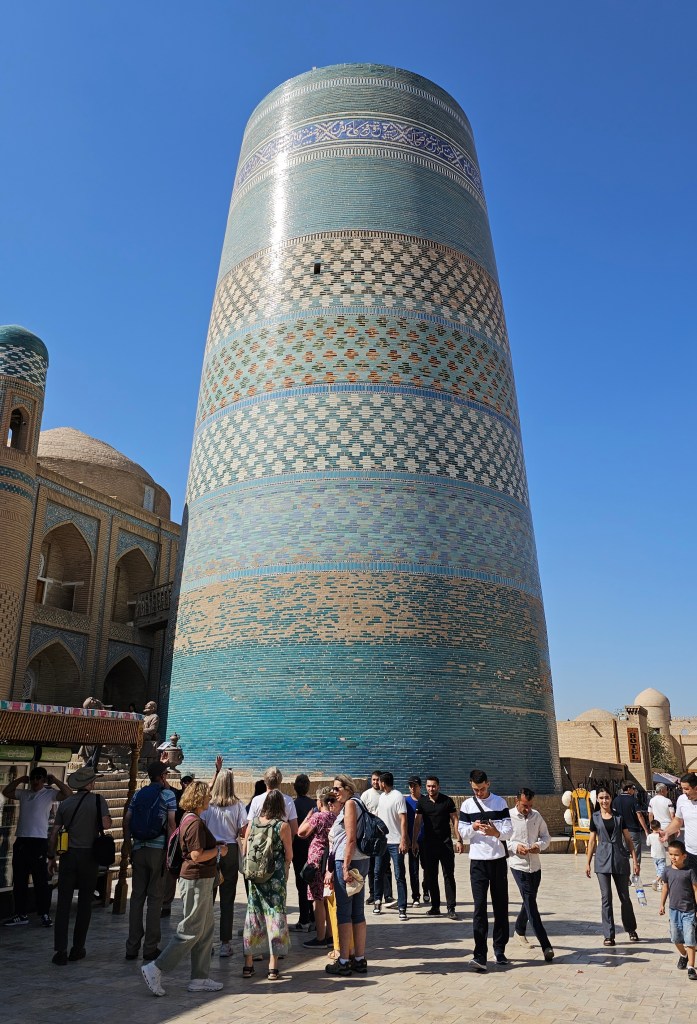
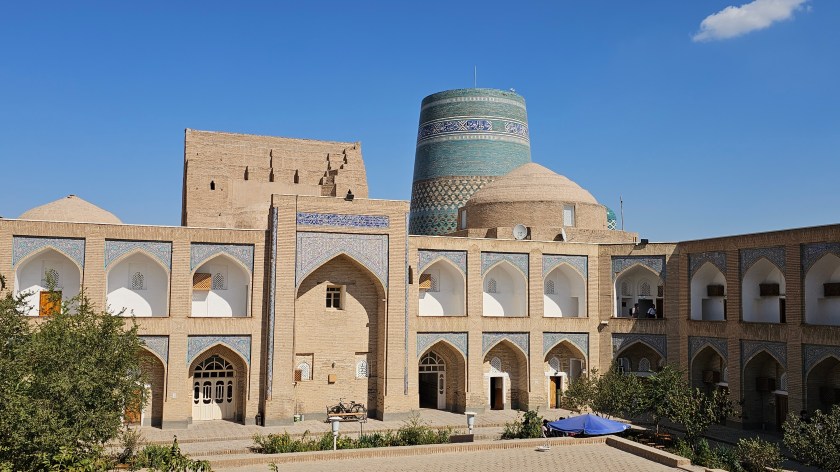
We started at Kalta Minor, the ‘blue tower’ where Sanjar explained that historically the purpose of the tower was a Silk Road landmark. Traders often travelled at night which was less dangerous, not only due to the heat of the day but also because of the risk of attack or kidnapping by pirates and nomadic tribes. The tower had a light at the top, like a lighthouse.
Commissioned by Muhammad Amin Khan, construction began in 1852 with a wild ambition: to build the tallest minaret in the entire Islamic world, with a planned height of up to 110 metres. However, when the Khan tragically died in battle in 1855, the grand project ground to an abrupt halt. Today, it stands permanently frozen at just 29 metres tall—earning it the nickname “Short Minaret”. Despite being unfinished, it is a historic masterpiece and remains the only minaret in the world completely covered from top to bottom in exquisite turquoise, blue, and green glazed tiles.
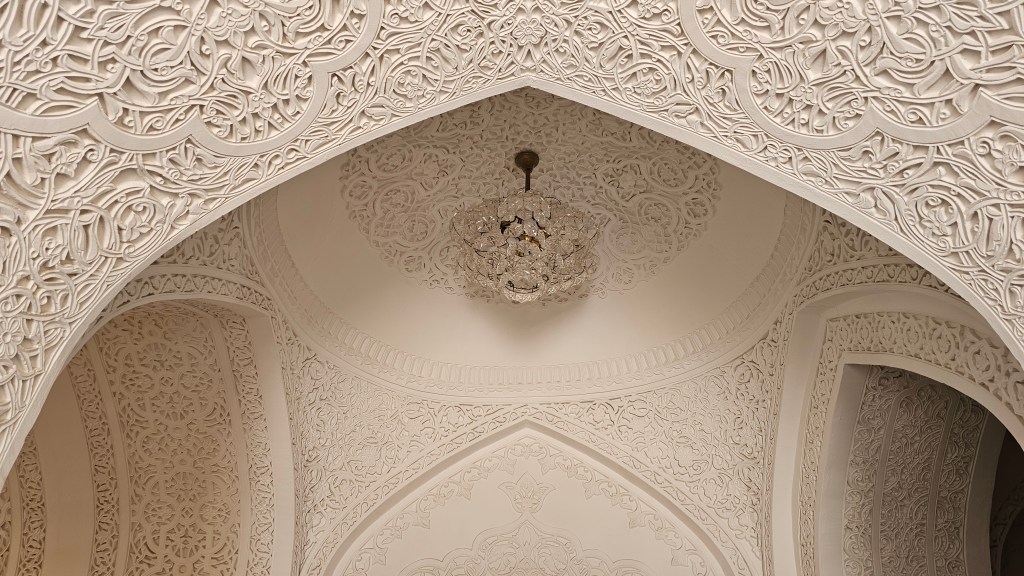
Nestled beside the Kalta Minor is the Orient Star Hotel, another spectacular example of Khiva’s unique architecture. Like the place we were staying, this building originally served as an Islamic school before being repurposed for travellers. The contrast inside is beautiful—the minimalist, striking white walls are adorned with deep, 19th-century carved reliefs, preserving the historic elegance of the building’s scholarly past.
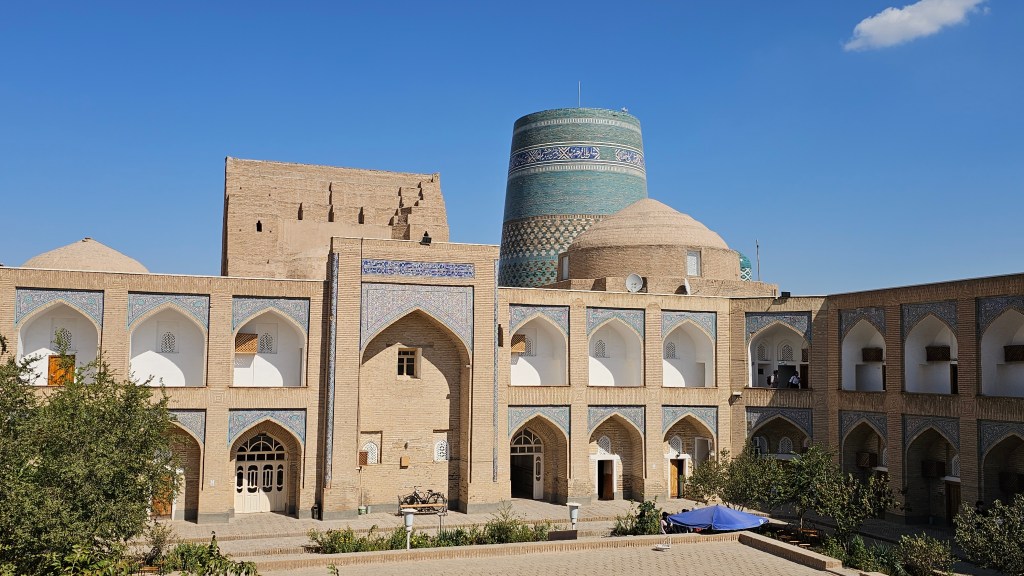
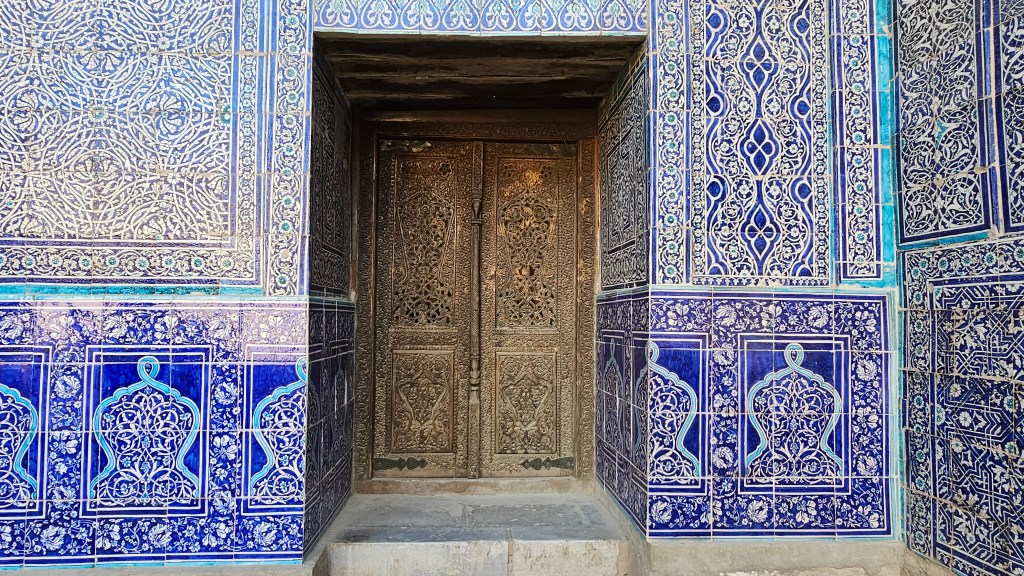
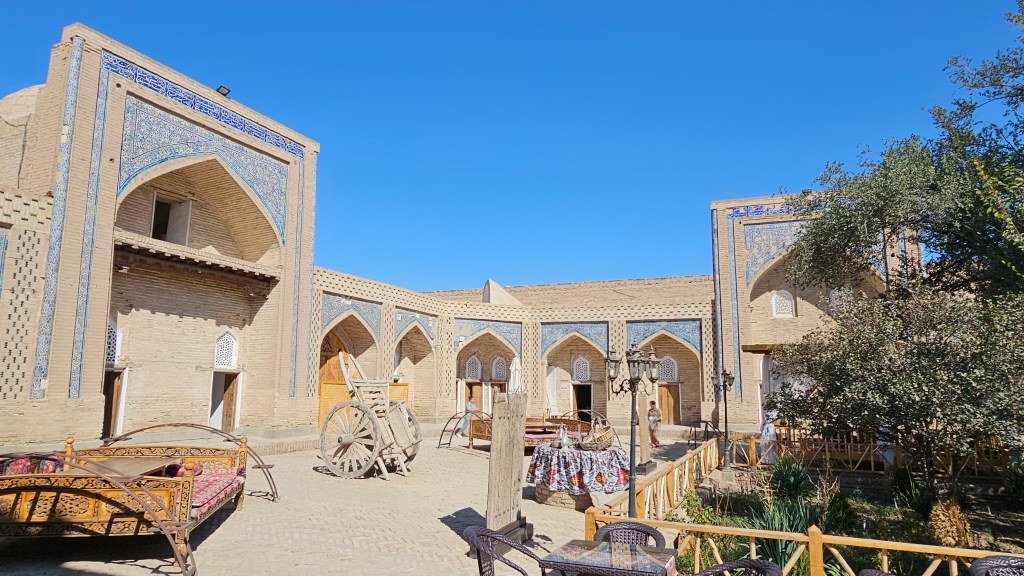
Inside the courtyard of the Orient Star, Sanjar explained the building features an ingenious natural cooling system built into its towers, which literally traps the high-altitude desert breeze and forces it downward to keep the courtyard perfectly chilled. Surrounding this central space are the old student cells—now hotel rooms—each with its own compact, beautifully carved wooden door looking out over the square.
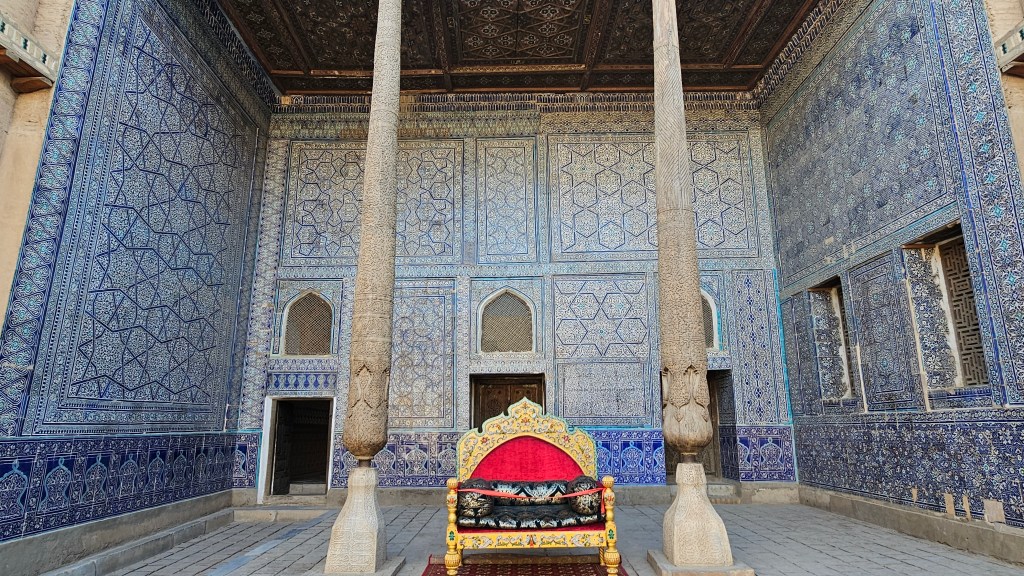
Kunya-Ark Citadel
To see how the rulers of Khiva actually lived, we headed to the Kunya-Ark Citadel, a massive fortress-within-a-fortress nestled right against the city’s ancient mud-brick walls. Built in the 12th century and continually expanded, this was the secure nerve centre of Khiva. It housed everything the royal court needed to survive a siege: a mint for coining money, open-air throne rooms, stable yards, a grand mosque, and even its own high-security prison.
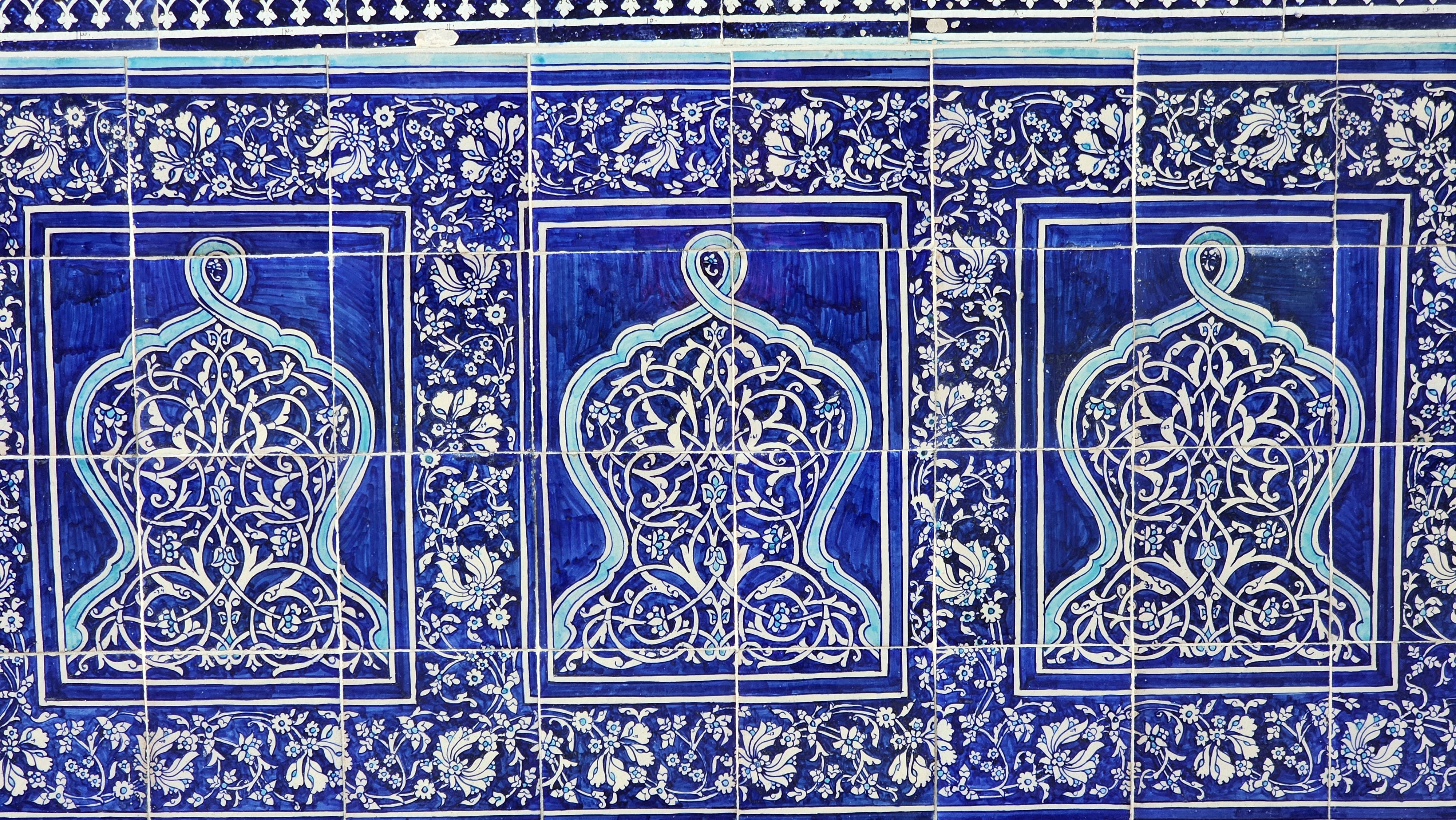
Tiles decorate the summer mosque with intricate patterns.
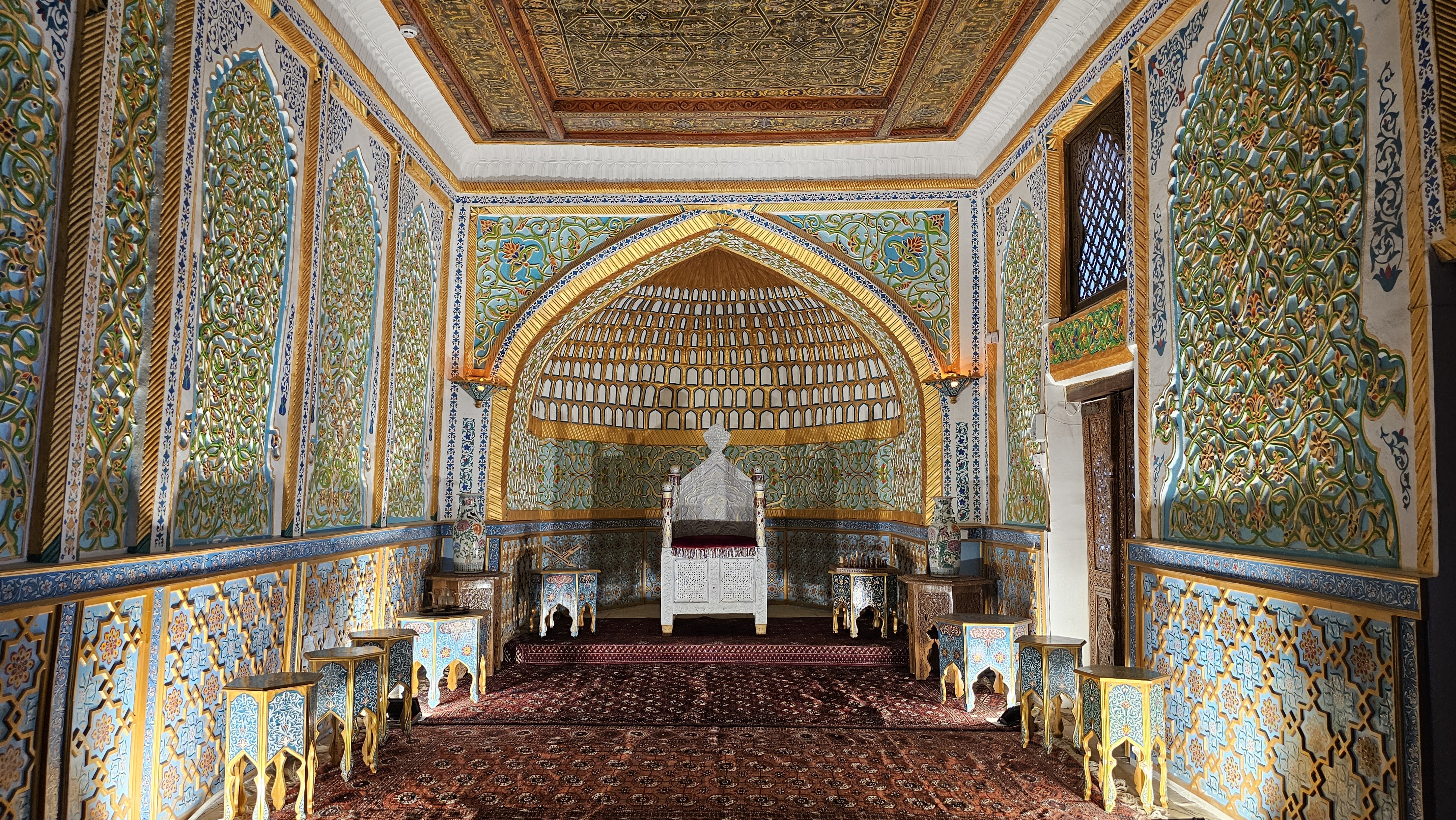
This isn’t the original throne… the original silver-gilded and wood-carved throne was made in 1816 and was embossed with verses from the Quran. It was later removed and is now in a Russian museum.
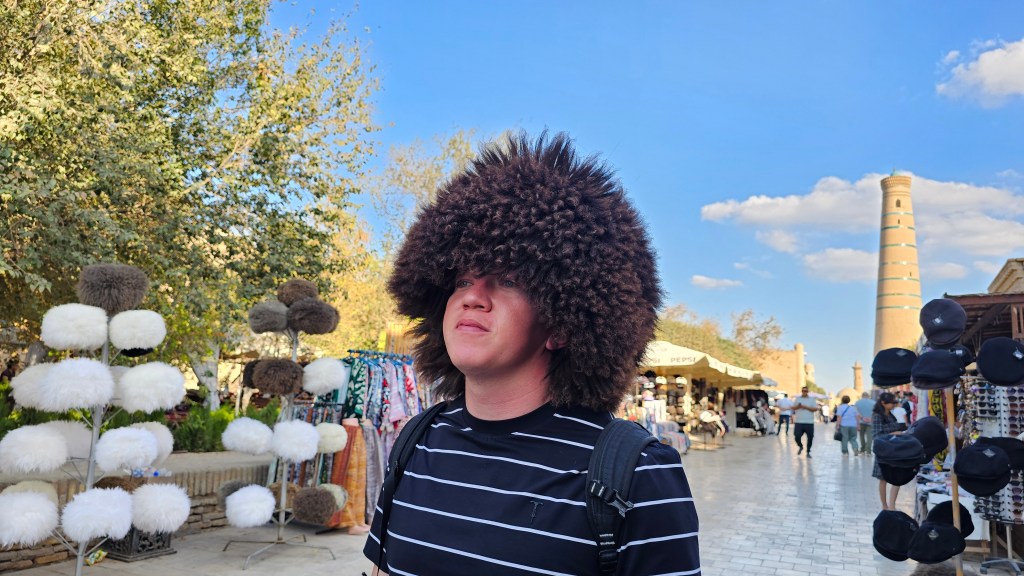
Chugurma’s are huge woolley hats made from sheep’s wool. As Sanjar modelled one he explained that they were traditionally worn as helmets. The skin of the sheep was left attached as it provided a tough protection inside the hat. Soldiers wore black chugurmas, normal people had brown ones and white was for intelligent people!
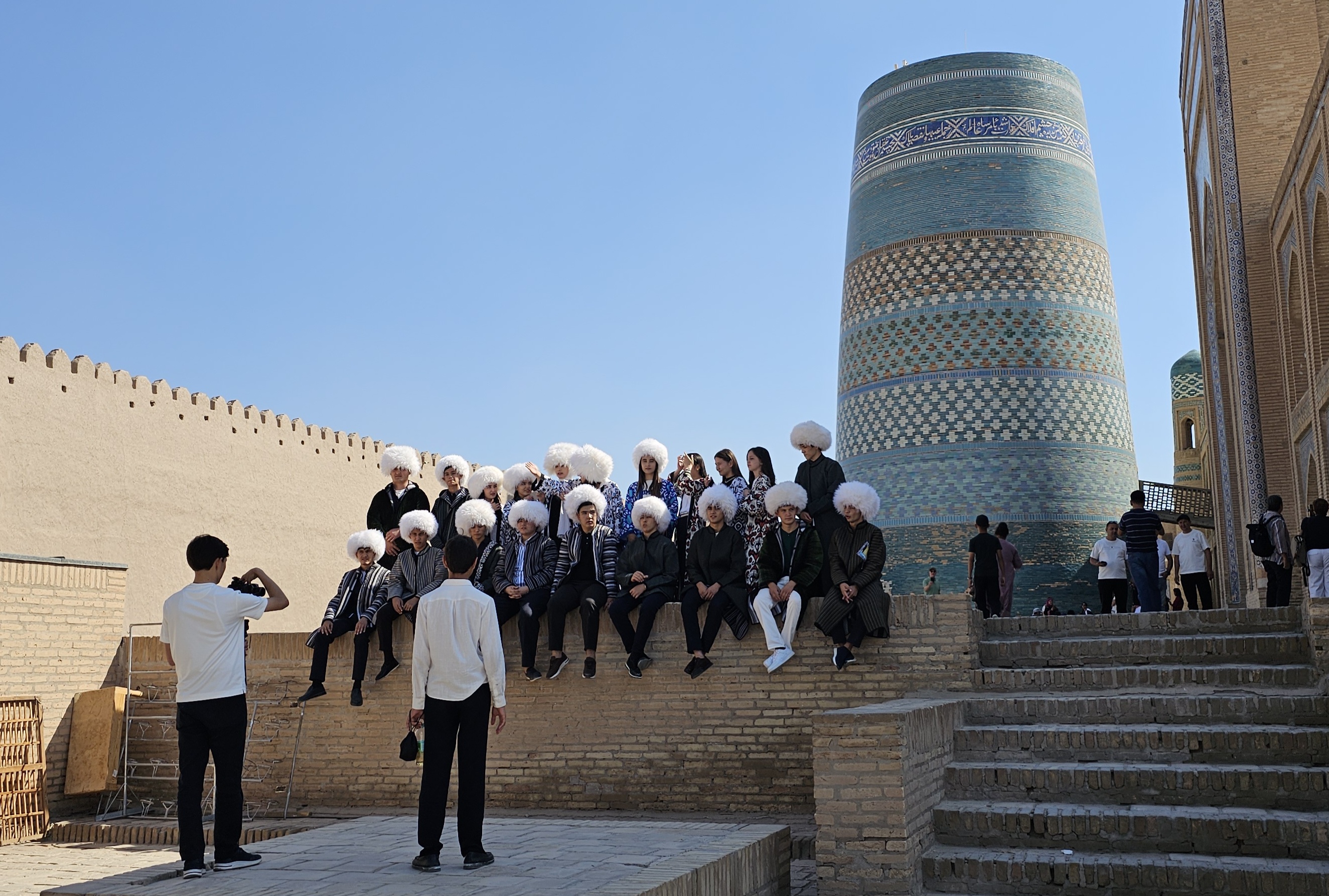
Earlier we had seen a group of what we assumed to be graduates, all wearing white chugurmas and having their official photographs taken.
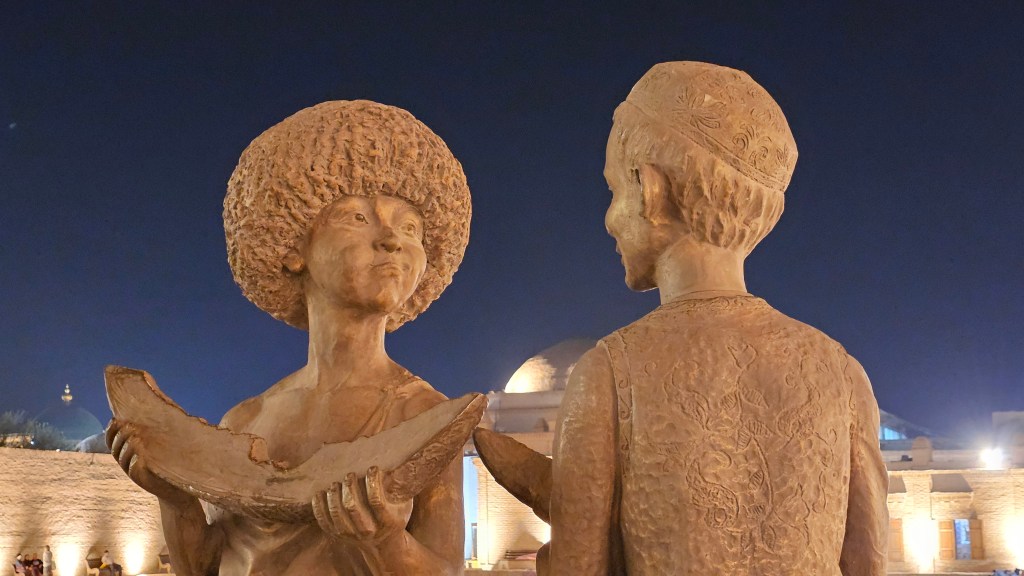
Later in the evening, we came across a statue also with a chugurma being worn.
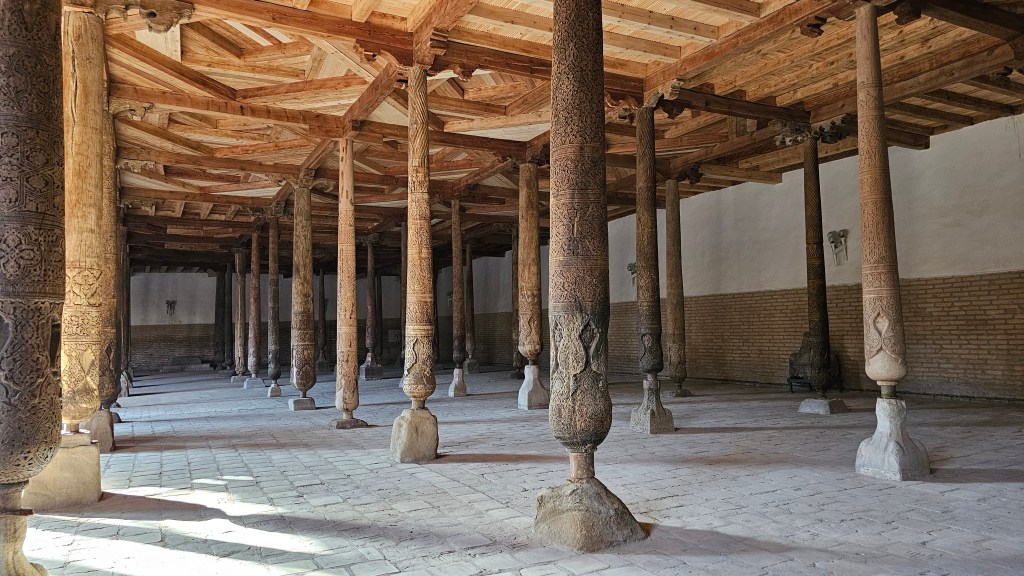
Juma Mosque
Juma Mosque (Friday Mosque) is a 10th to 18th century mosque which is located in the middle of Itchan Kala, on the road connecting the west gate and the east gate within the walls of the city.
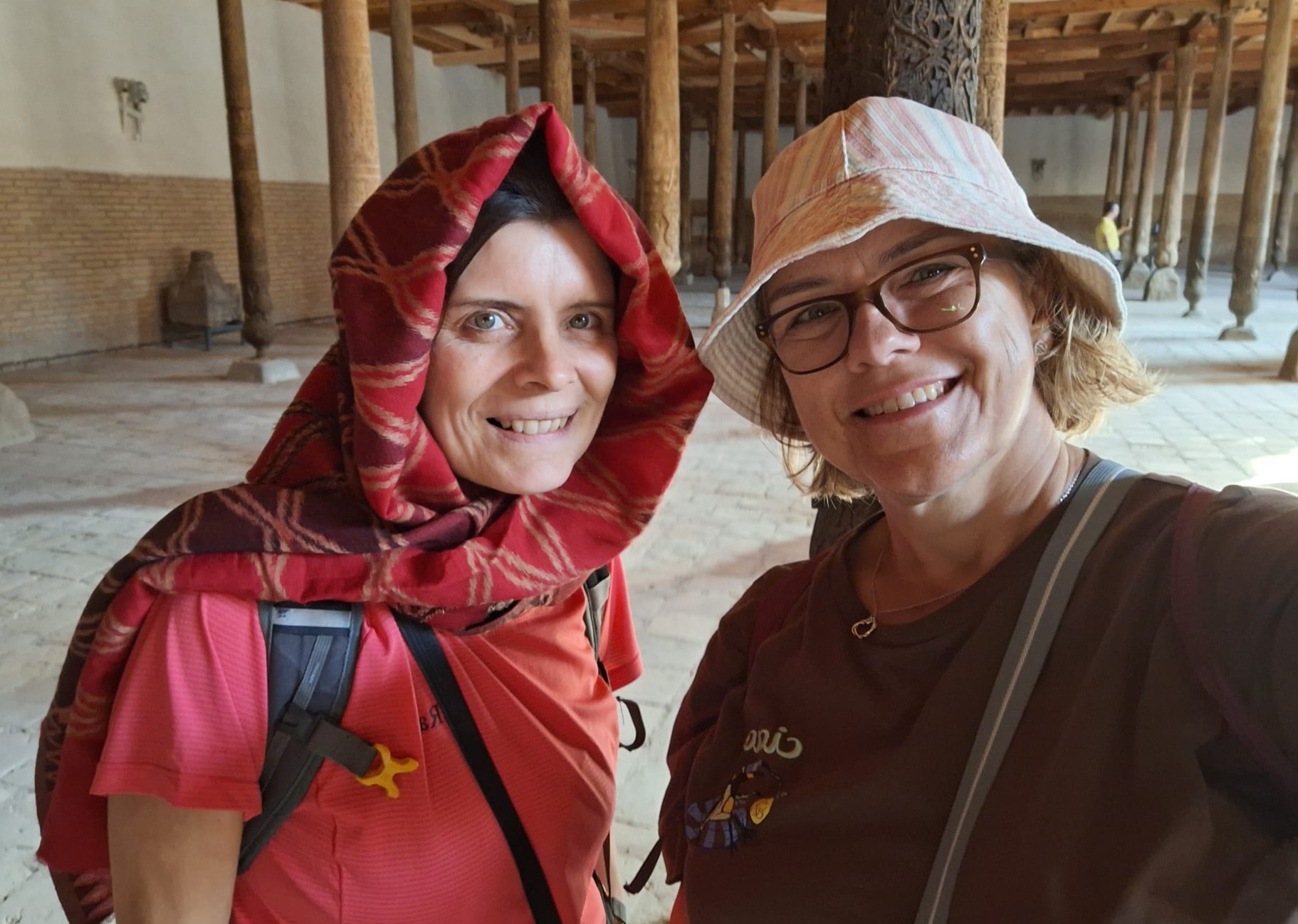
To enter, women had to wear head coverings and either scarfs or hats were allowed.
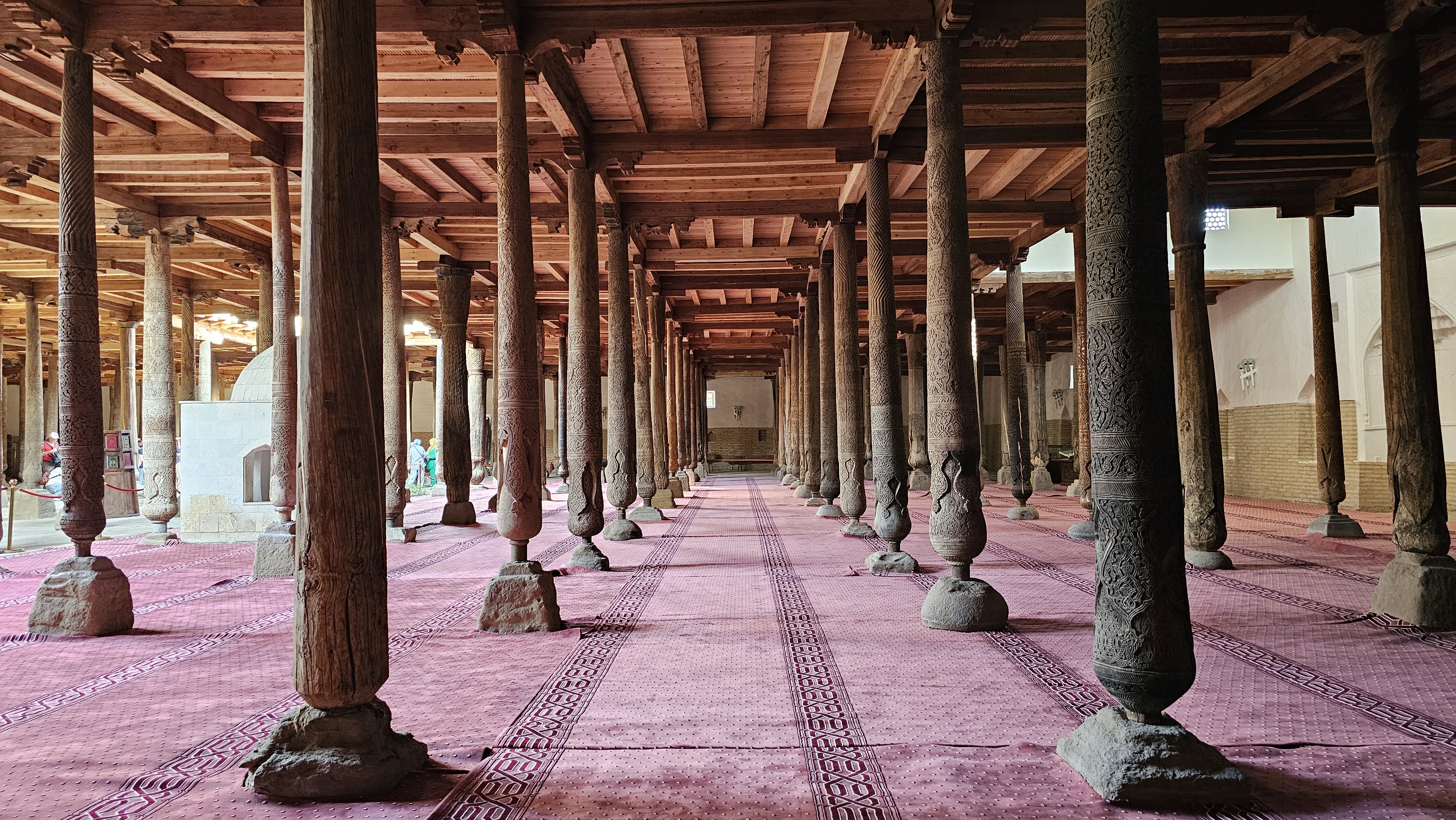
The above carpeted section was reserved for active prayers.
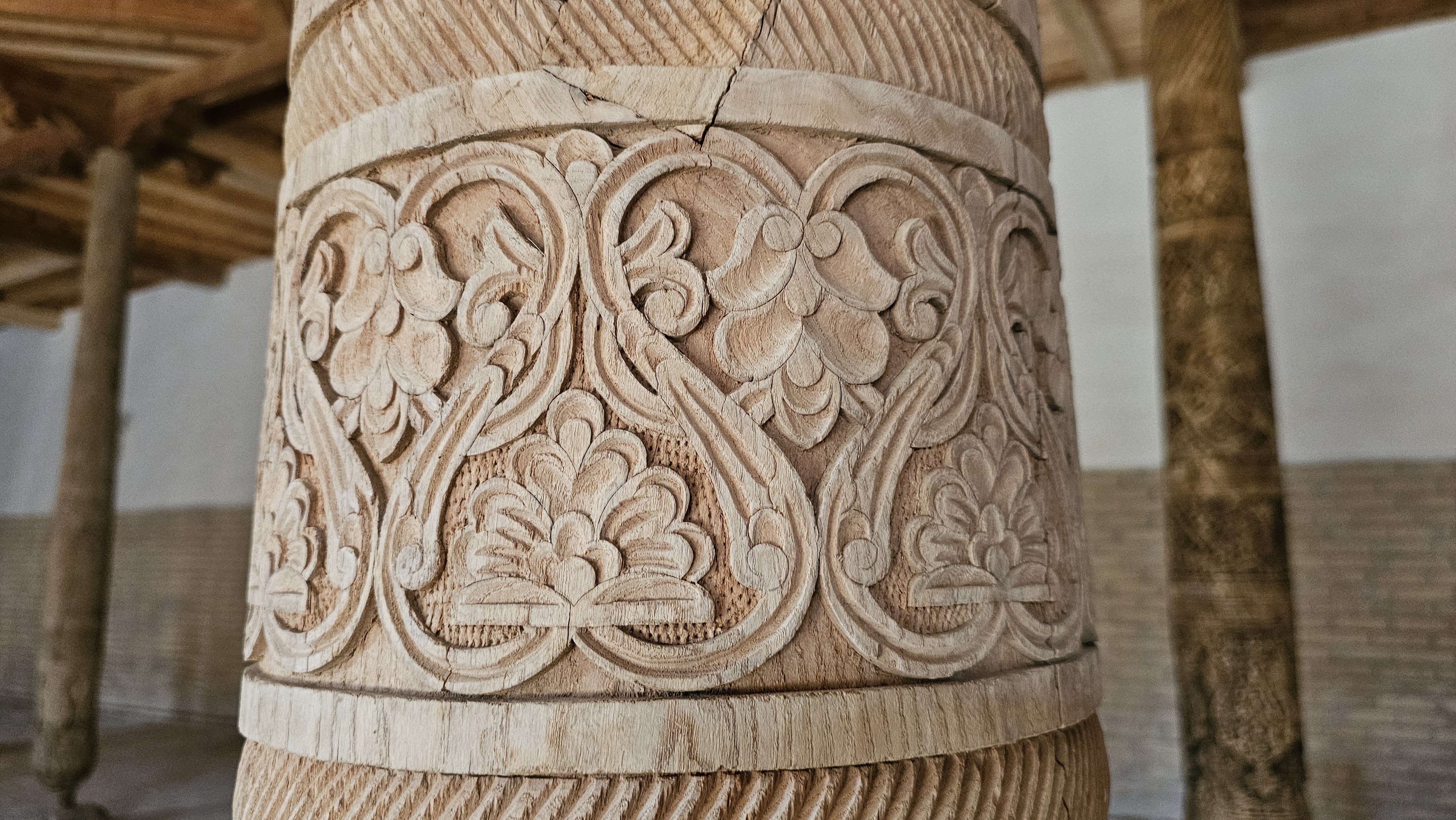
This one-story brick building has a flat roof which is supported by 212 wooden columns in 17 rows each of which is intricately carved.
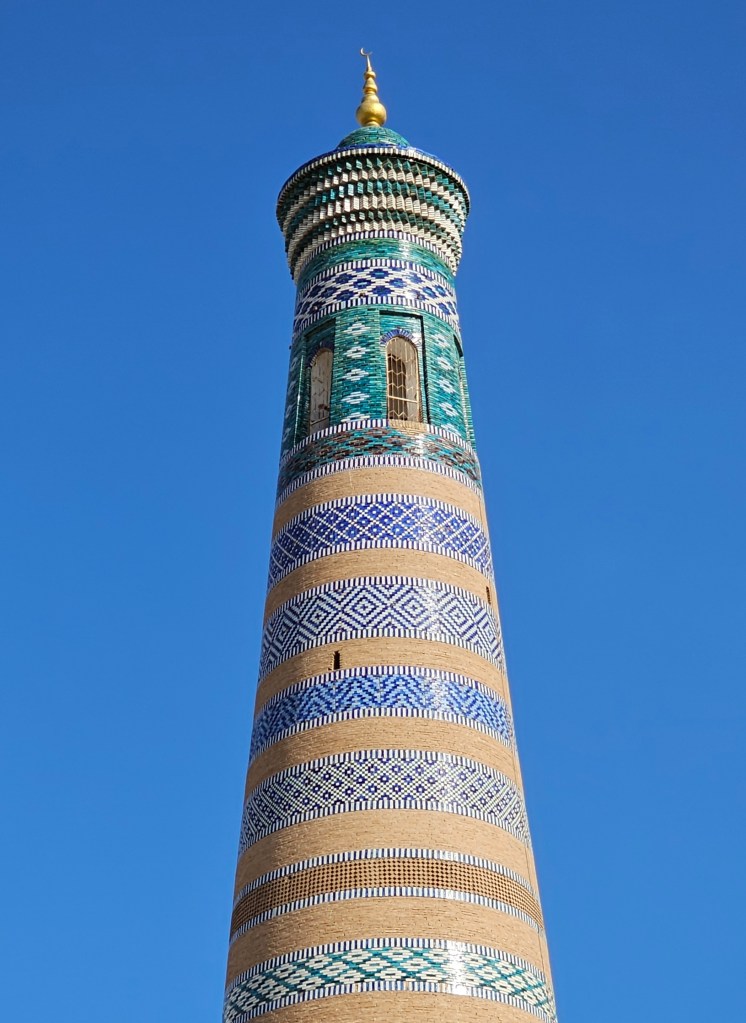
Islam Khoja Minaret
While the Kalta Minor never reached its full potential, Khiva did eventually get its record-breaking tower which we visited during an afternoon of free time.
A short walk through the old town brings you to the spectacular Islam Khodja Complex, dominated by the tallest minaret in the city. Completed much later, in 1910, this slender tower climbs 57 metres (187 feet) into the sky, making it visible from almost anywhere in the city.
This minaret was commissioned by Islam Khodja, who introduced modern schools, telegraph lines, and hospitals to the city before he was tragically assassinated.
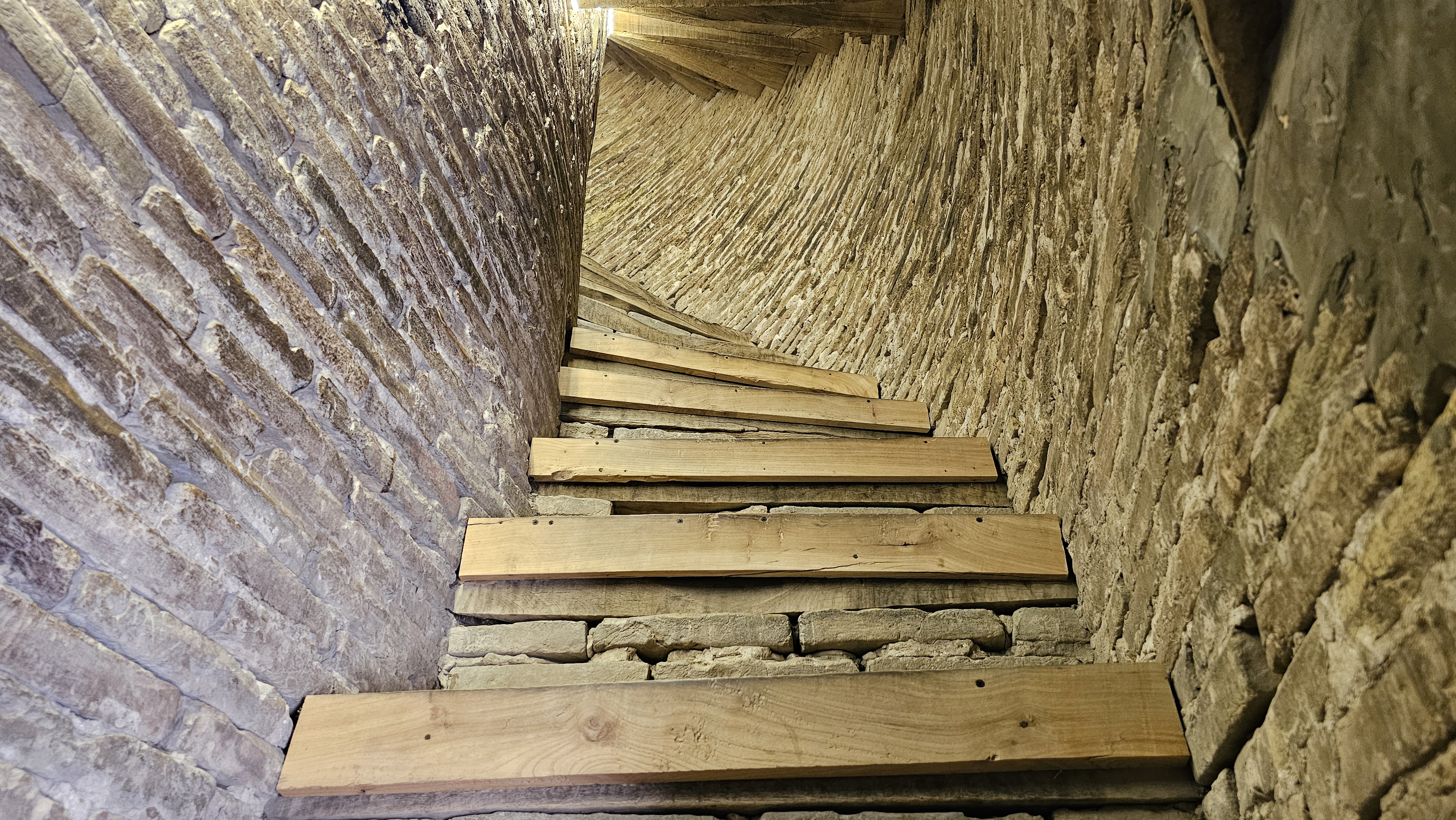
In anticipation of panoramic views, Bridget, our new friend Dave and myself purchased our tickets and climbed the dark, narrow, and incredibly steep internal steps to the top observation deck.
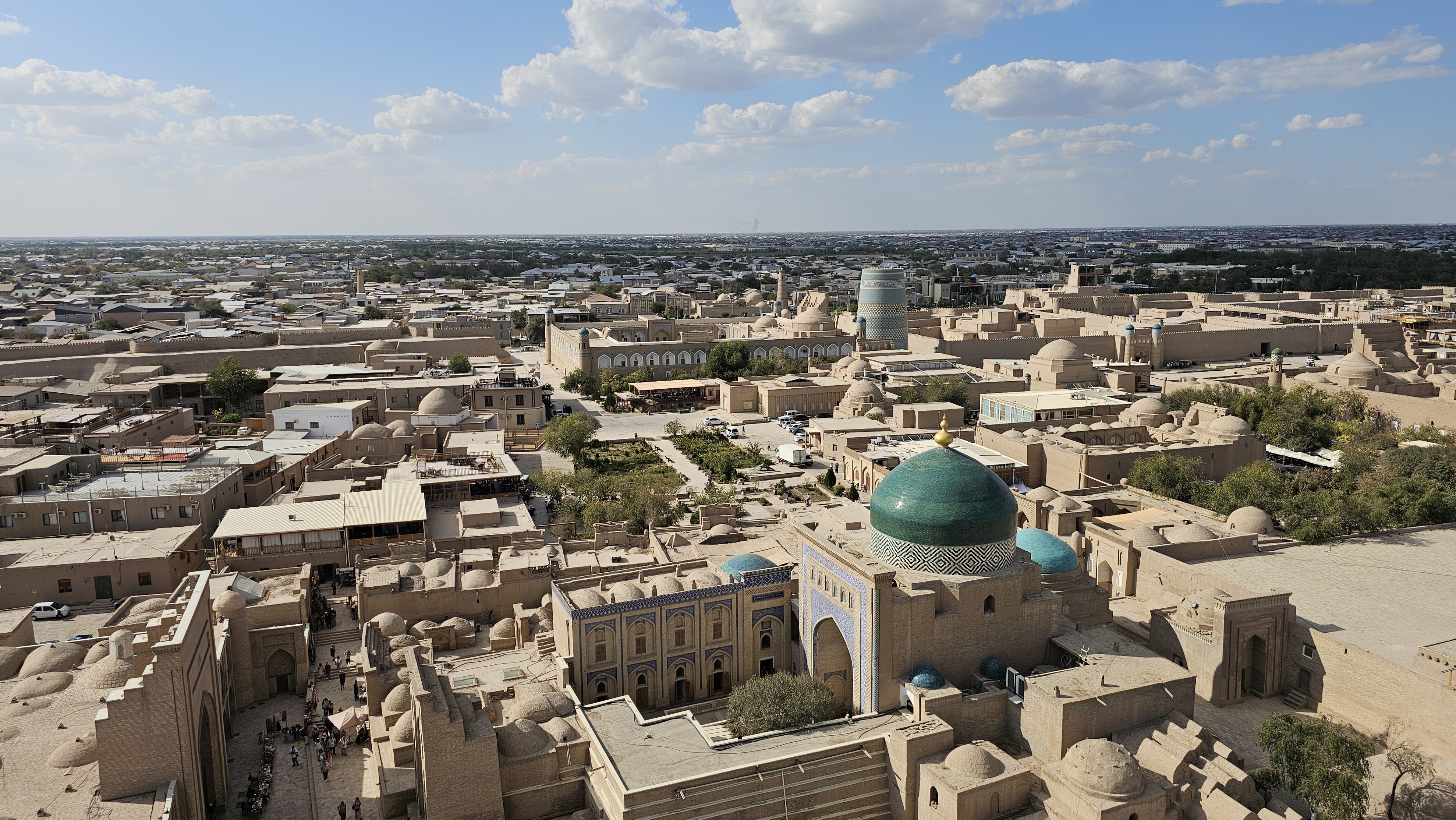
The steep climb was worth it for the far reaching 360 degree views of Itchan Kala and beyond from the top.
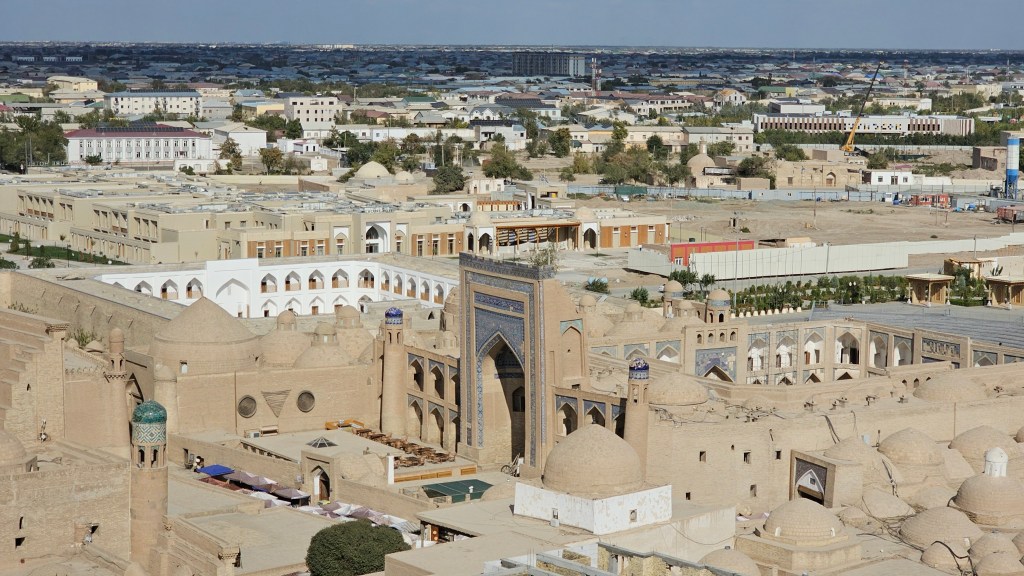
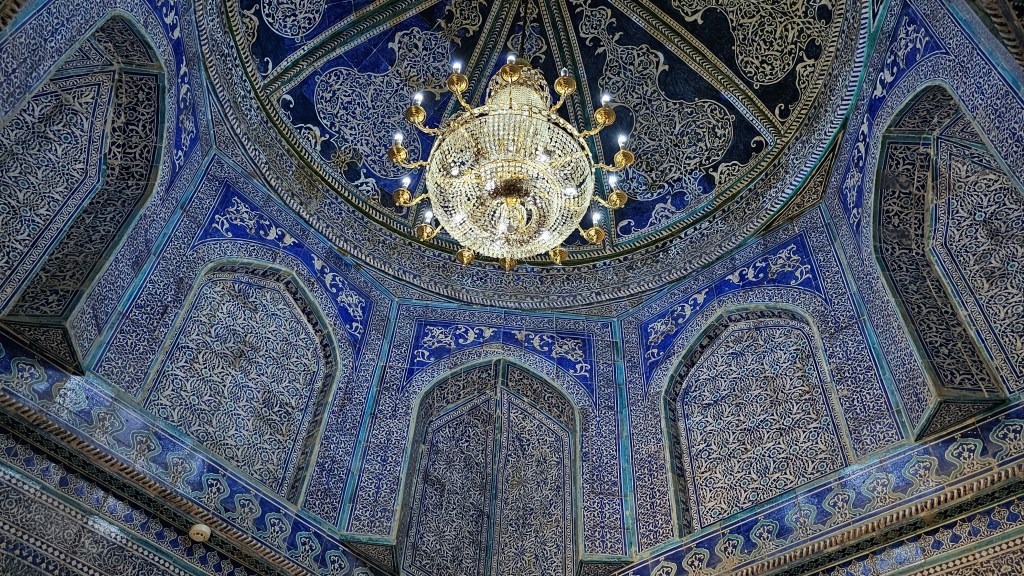
Pahlavon Makhmud complex
From the tower the 3 of us came across the Pahlavon Makhmud complex, a mausoleum. A majestic building was built over the top of the grave of Pahlavon Makhmud (1247-1326) who was a renowned poet, philosopher and healer. He became the patron saint of Khiva.
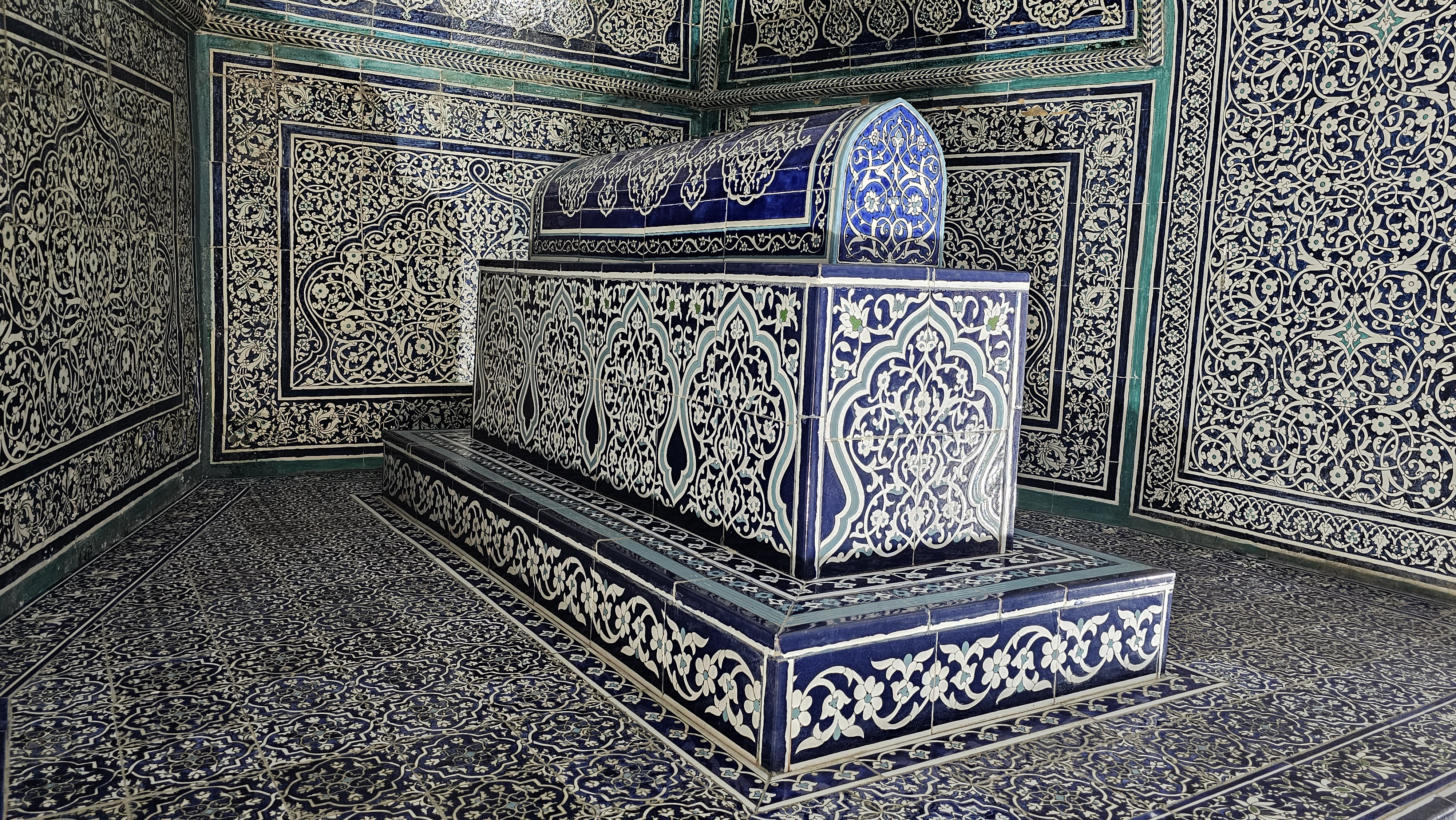
With its intricate blue and white tile patterns, this sacred place is spectacular and well worth the small entrance fee.
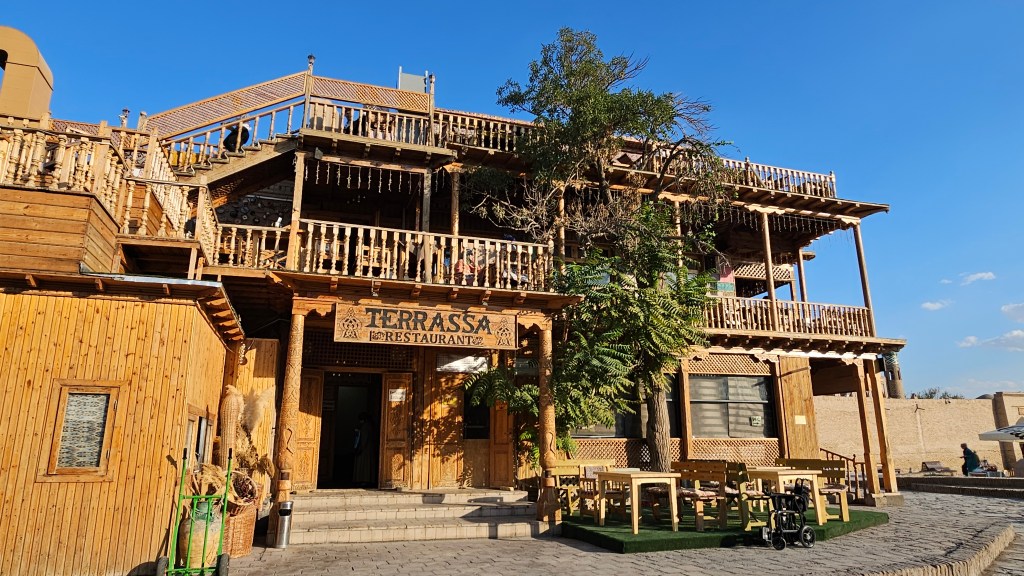
Khiva has a number of roof top terrace bars and restaurants and one of the most popular was the Terrassa restaurant which overlooked the Kunya-Ark citadel.
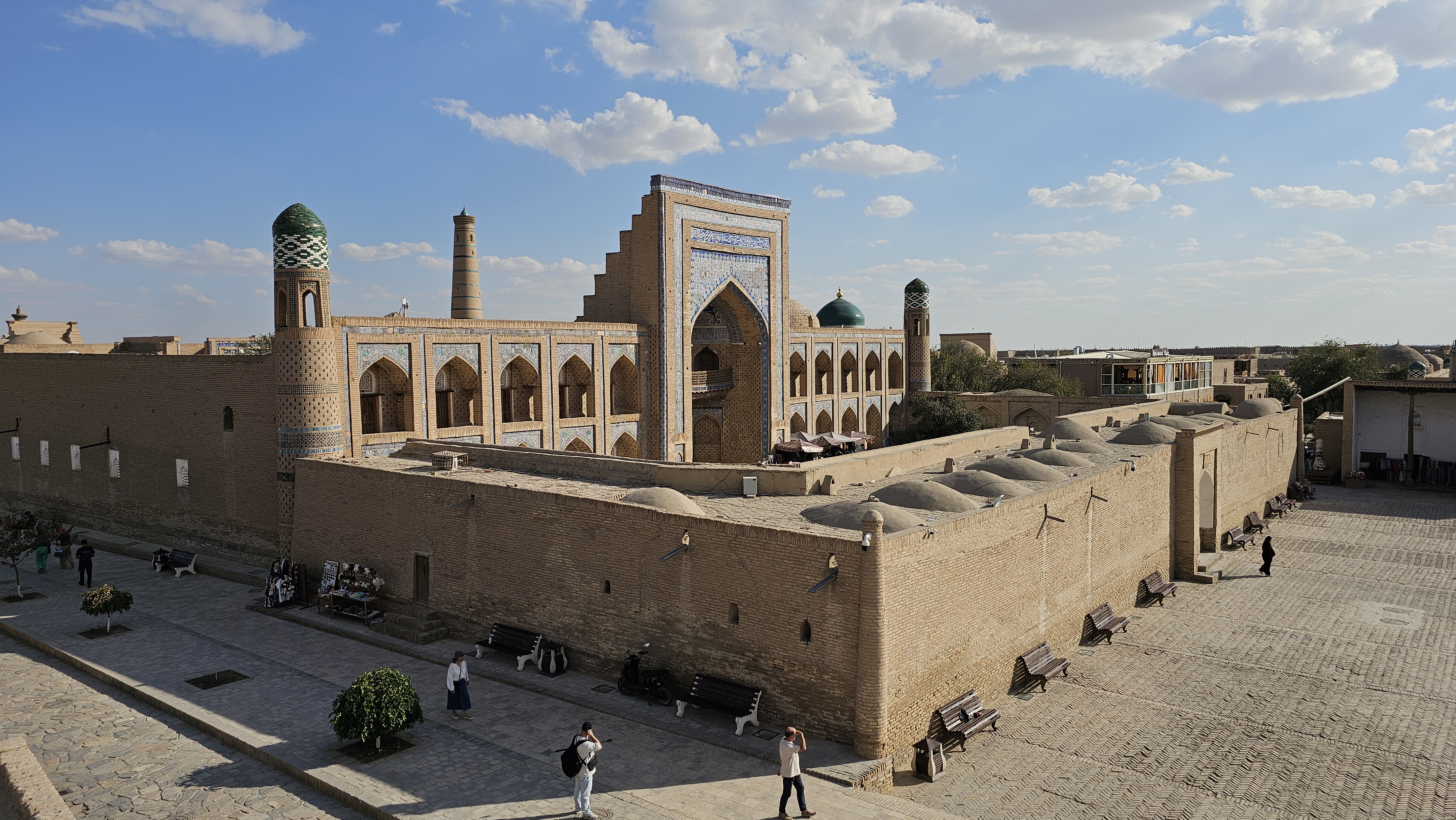
As one of the top rated restaurants the rooftop terrace was busy however Bridget, Dave and myself were allocated a table.
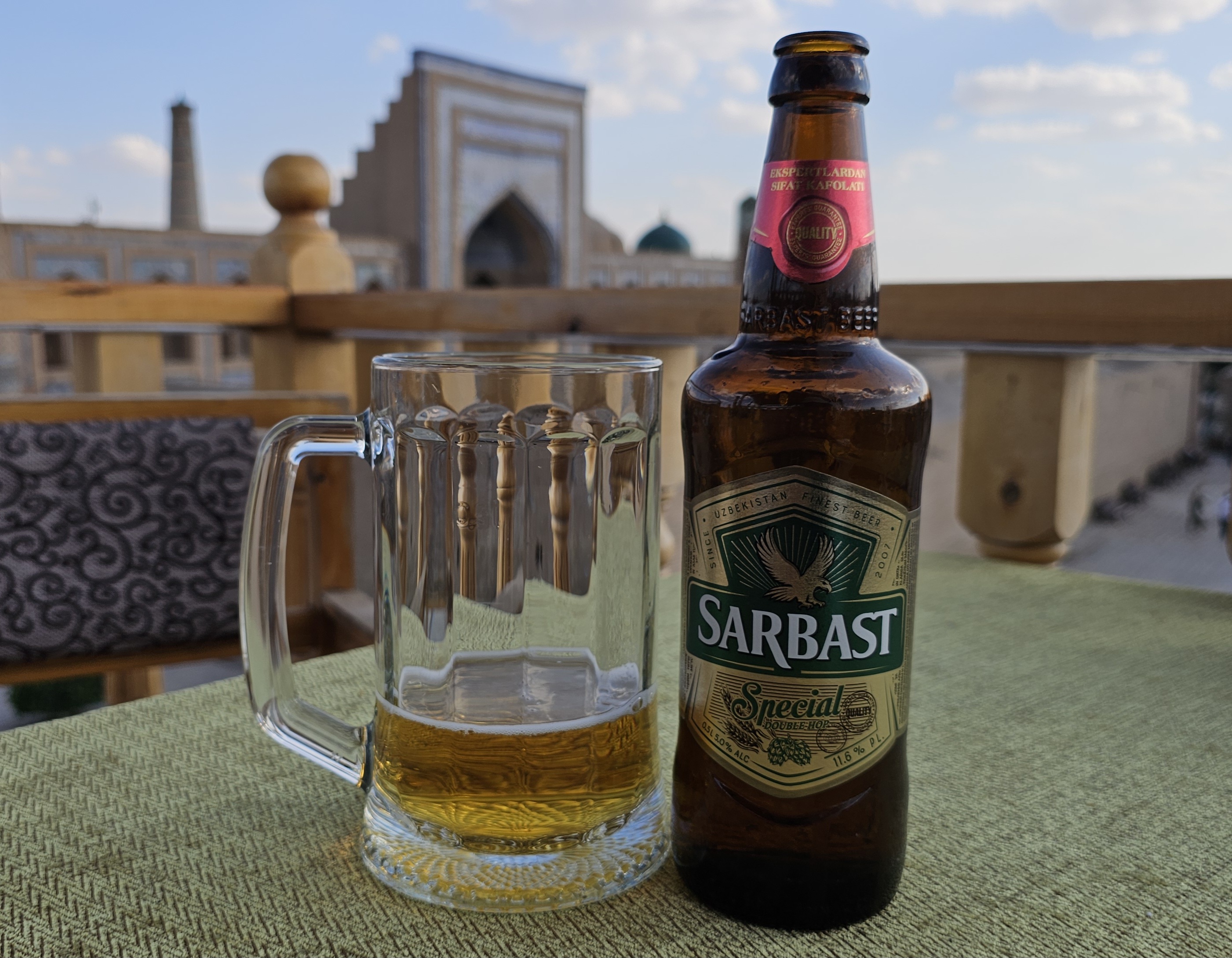
Sarbast Special is slightly stronger than the Sarbast Original I had tried previously and in the warm sunshine the chilled bottle was especially welcome.
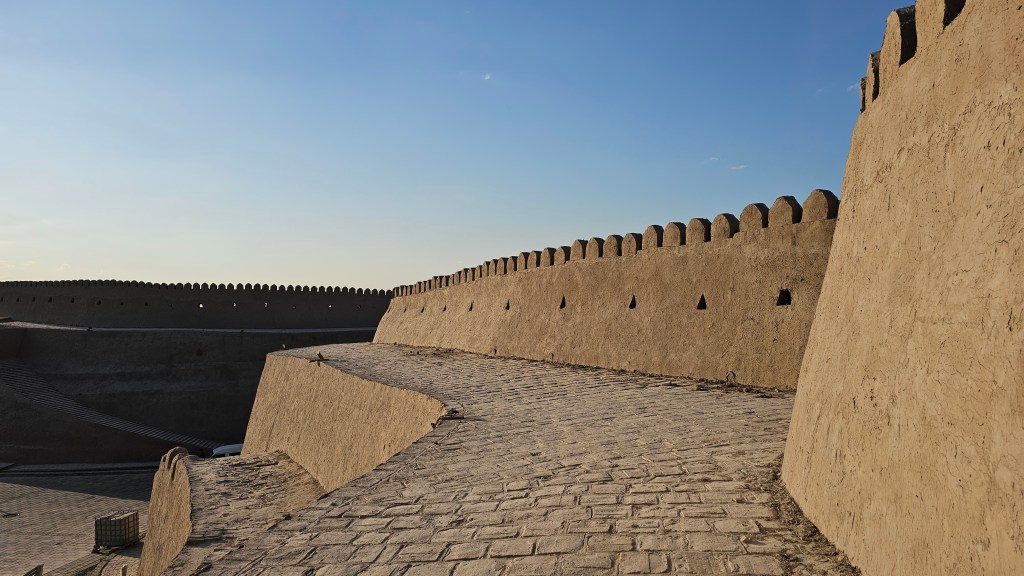
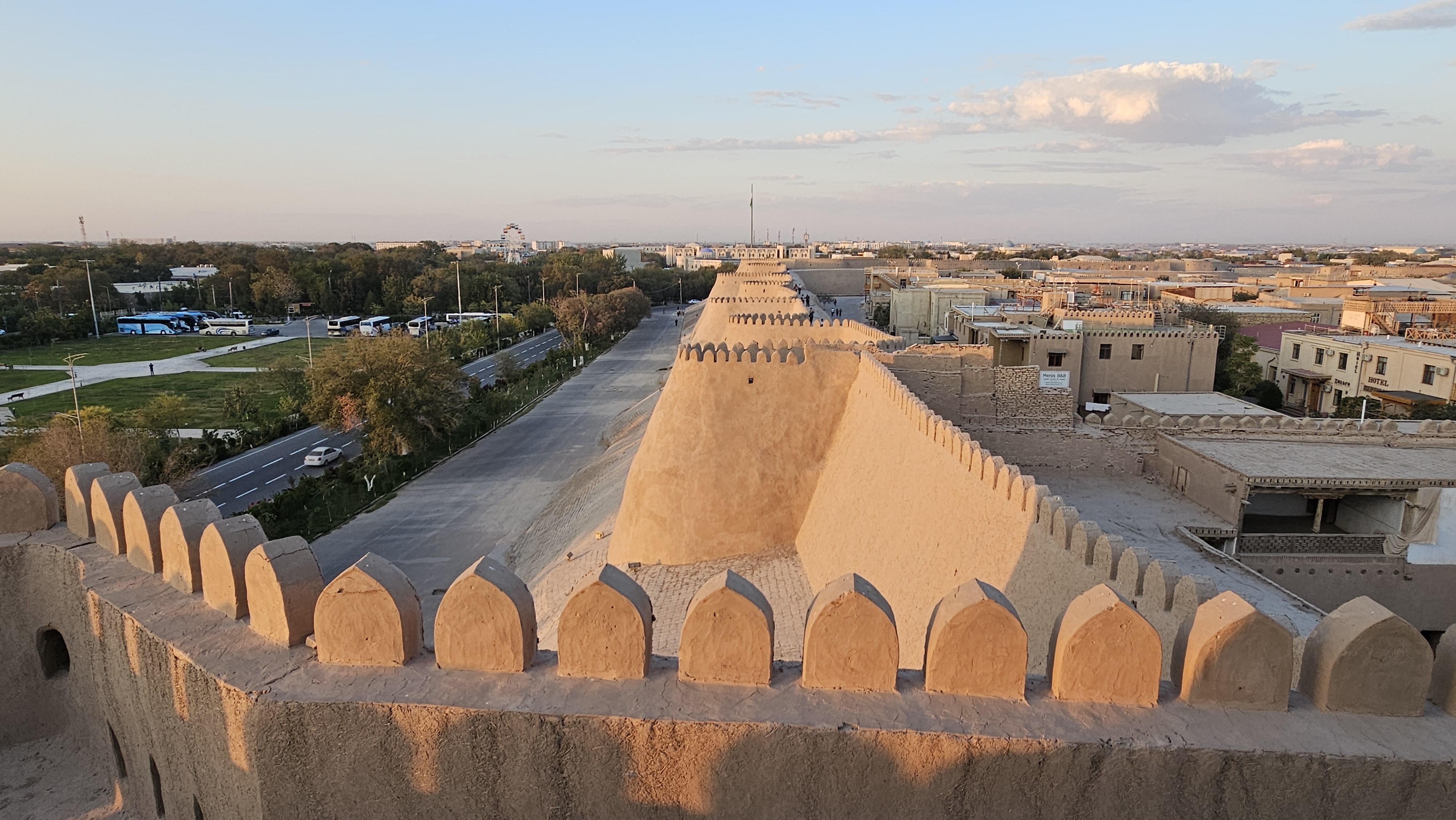
Following our refreshments the three of us headed to the 17th century clay wall which wraps around Itchan Kala, the inner city of Khiva. At the wall we bumped into fellow Explorer Marvilynne (Marv) who joined us.
At the north gate for a small sum we purchased tickets and were able to walk along sections. There wasn’t anything of particular interest to see along this part so the now 4 of us walked to the watchtower.
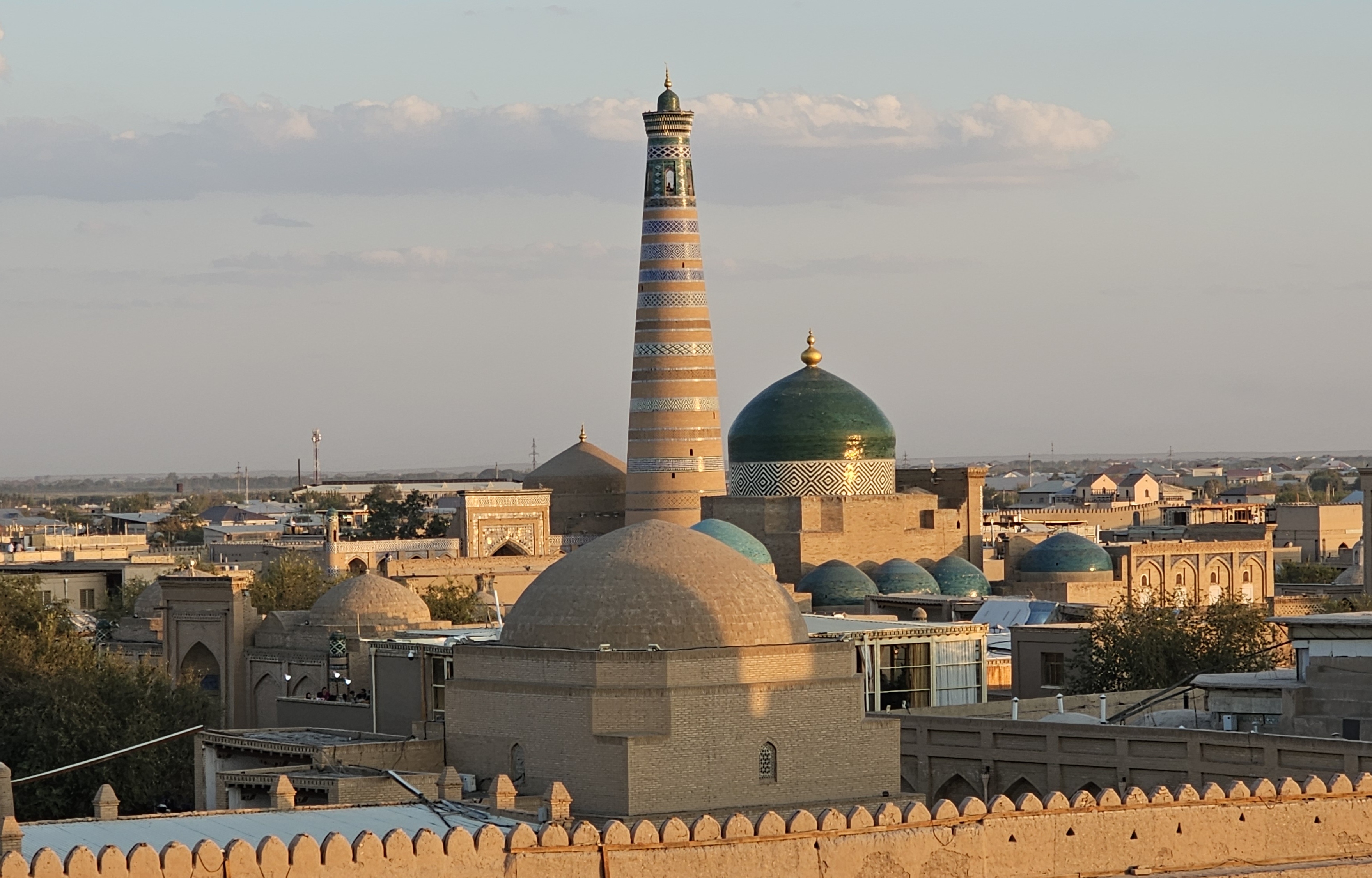
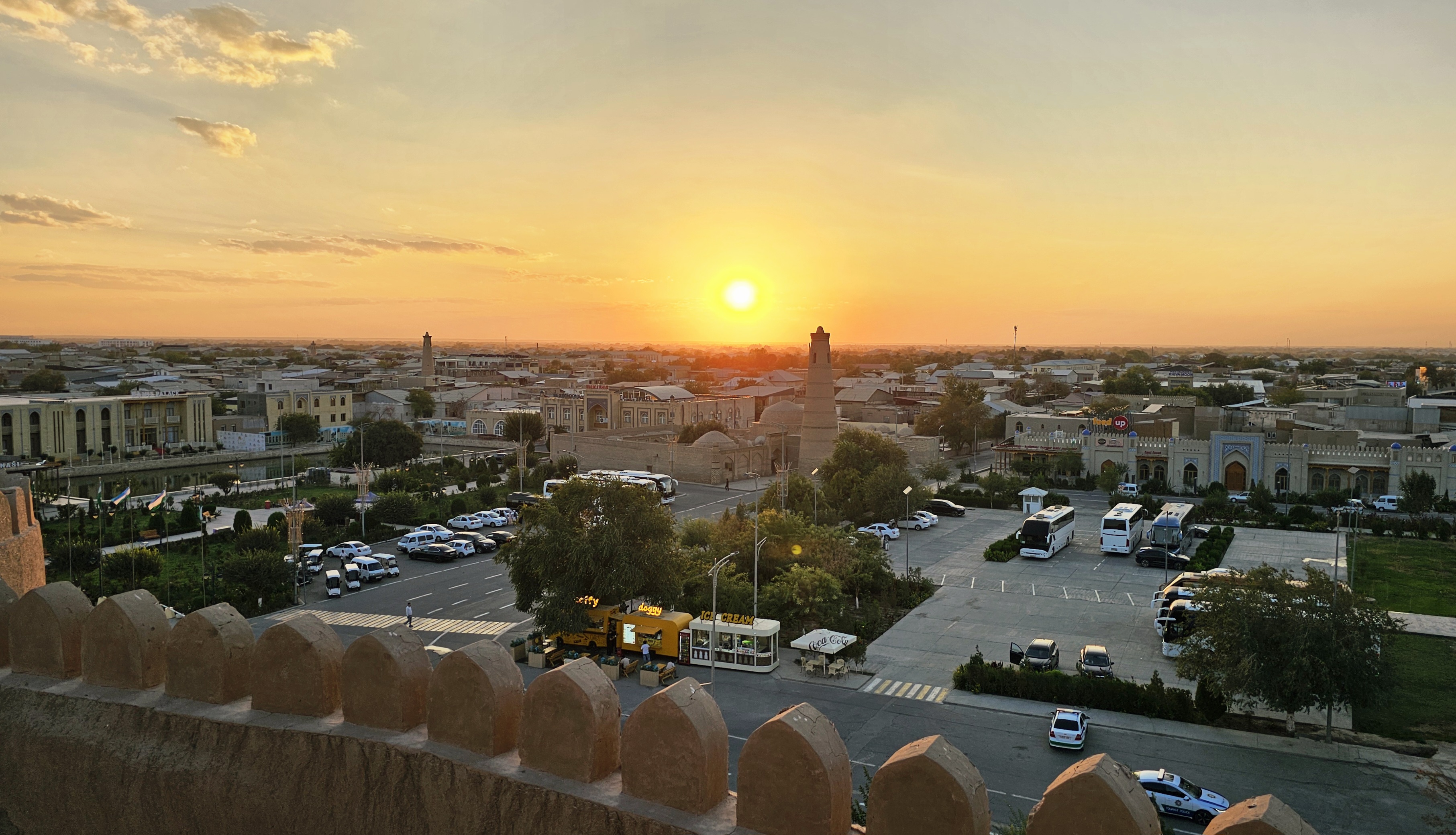
The watchtower (Ak Sheikh Bobo Bastion) at the edge of the fortress offers panoramic sunset views over the mud-brick skyline of old Khiva.
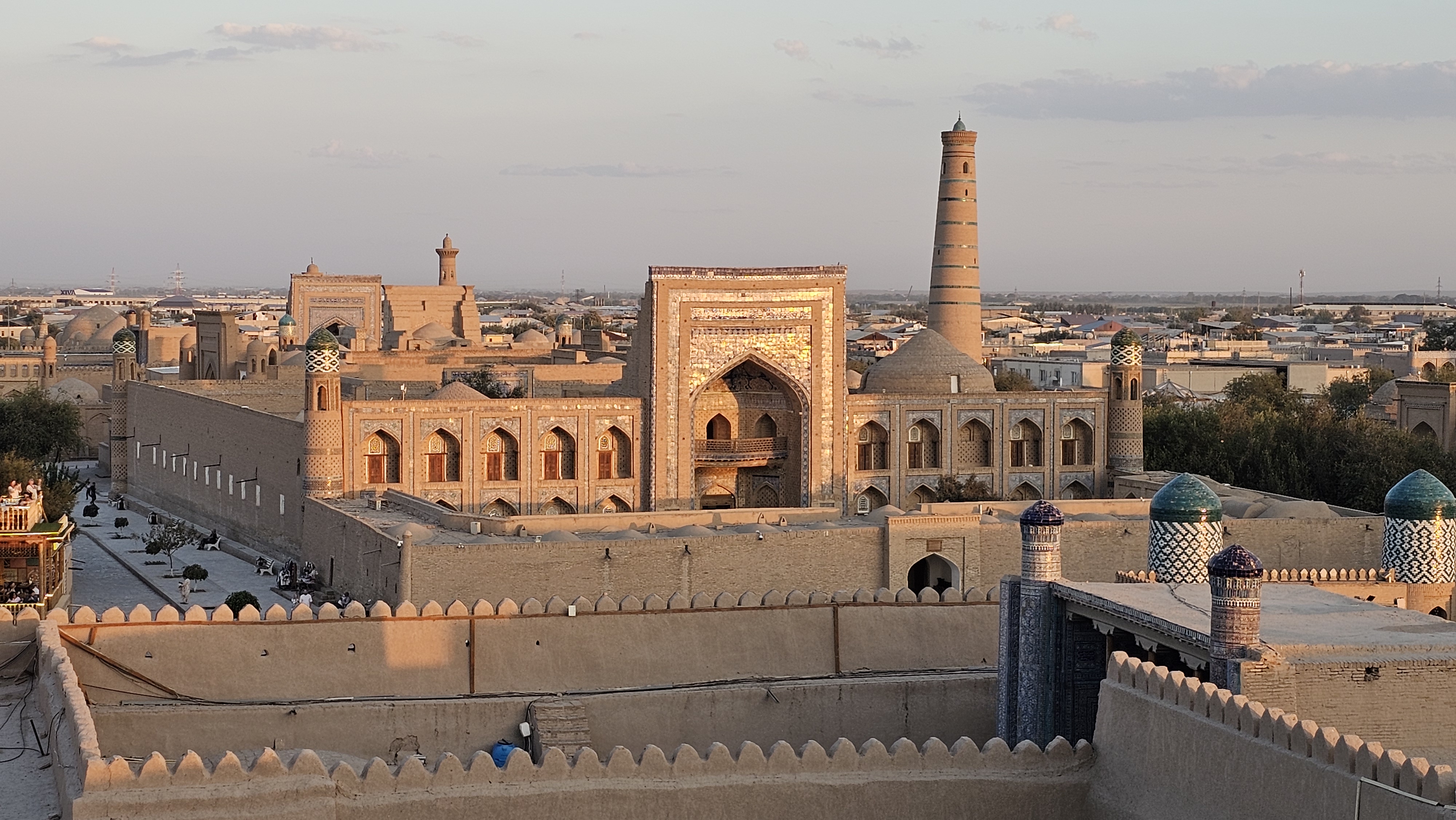
This was busy but well worth a late afternoon visit.
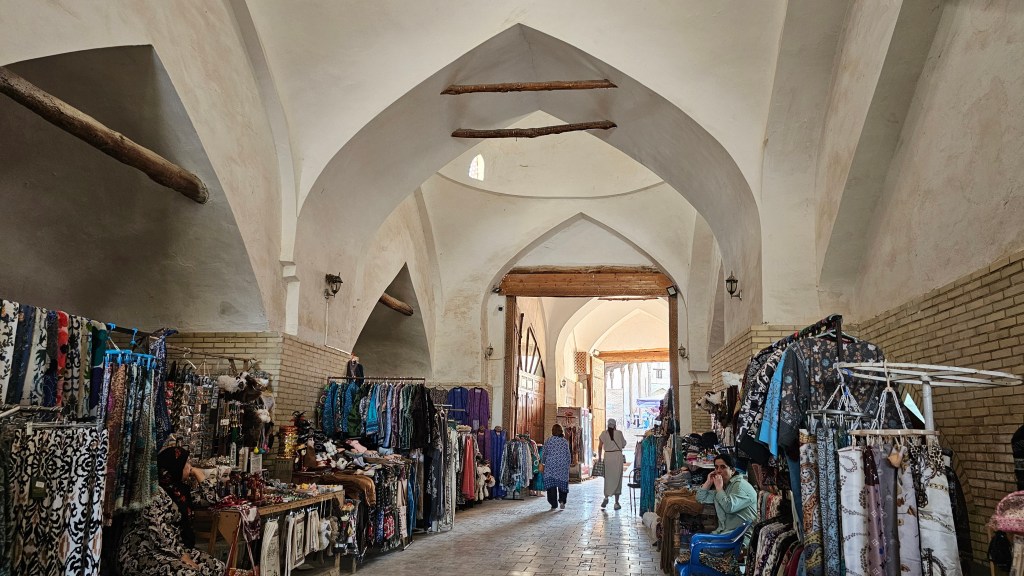
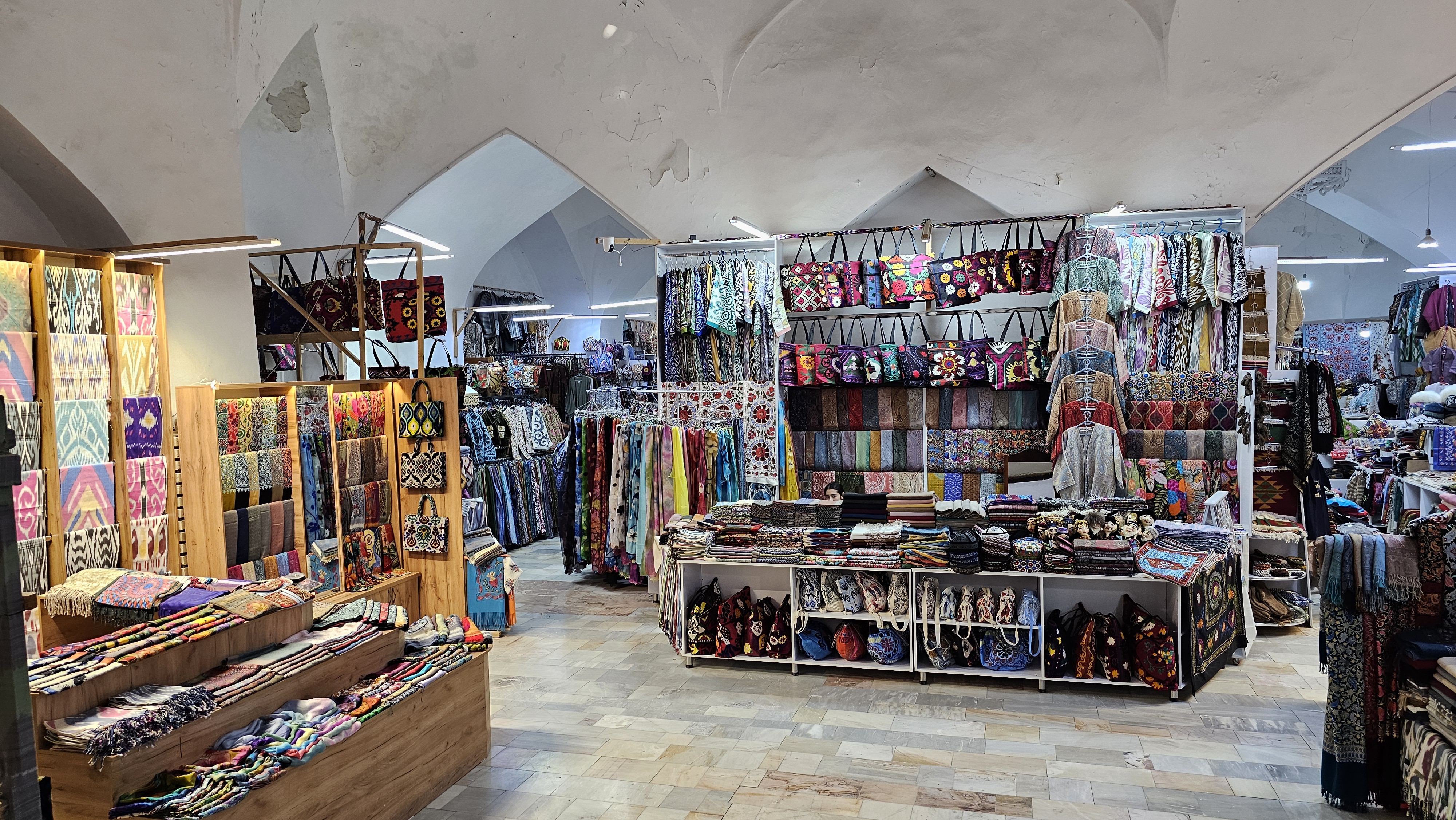
Khiva was a significant part of the Central Asia slave trade from the 17th century until it was abolished in 1873 during the Russian conquest. The slaves were mostly Persians and Russians and were sold in the slave markets. Today the above building houses traditional crafts and souvenirs for tourists.
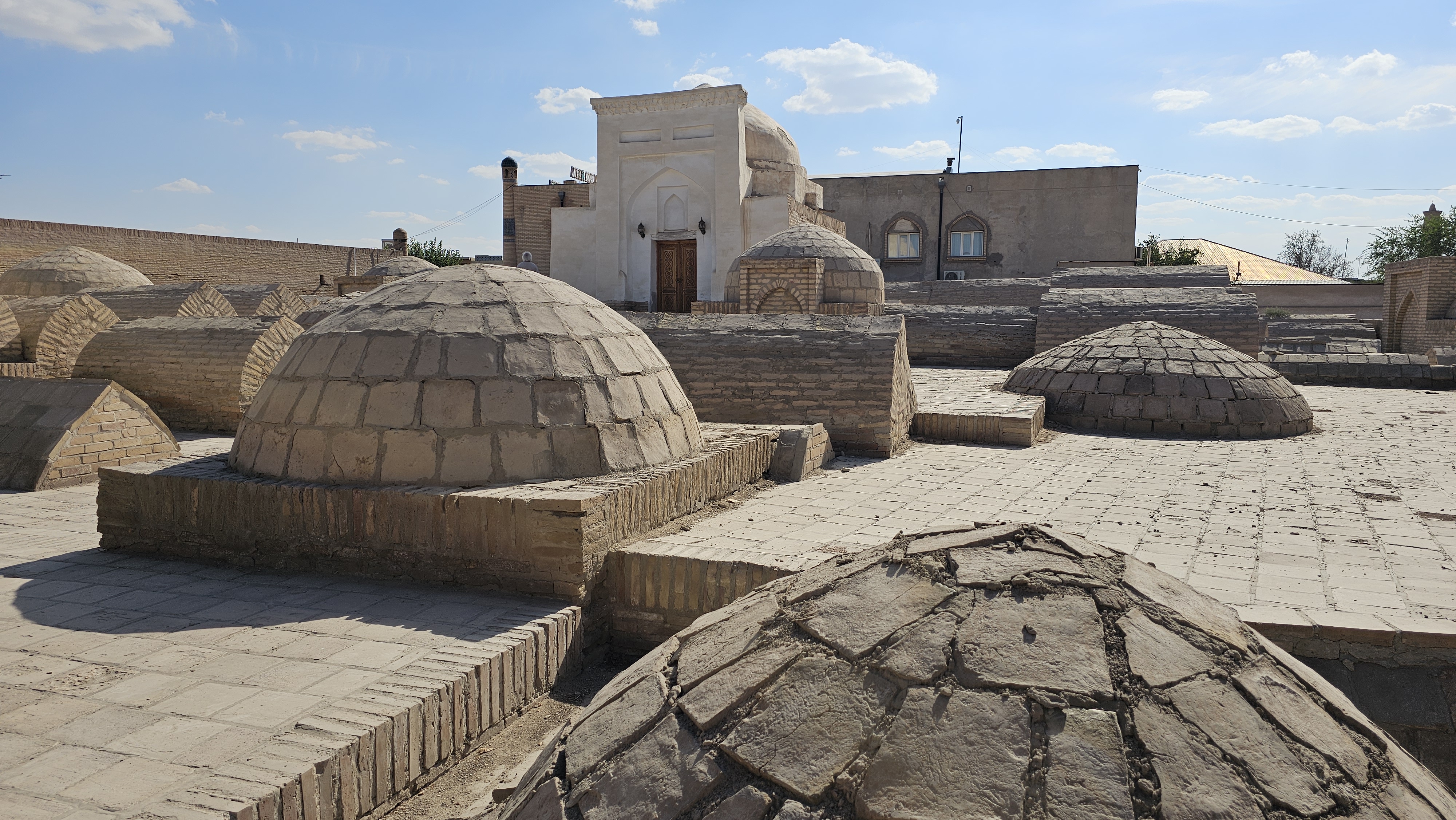
Just outside the city walls of Khiva is the Complex of Shokalandar Bobo’ an architectural monument of the XVI century.
Food and drinks in Khiva
During our first day in Khiva, Sanjar had organised a group lunch in the restaurant Khiva Moon. In here I tried my first glass of local Uzbek white wine. Unlike many countries around the world, Uzbekistan is not known for its wine production and this tasted pretty average. Not terrible but maybe wine will not feature too much on this trip!
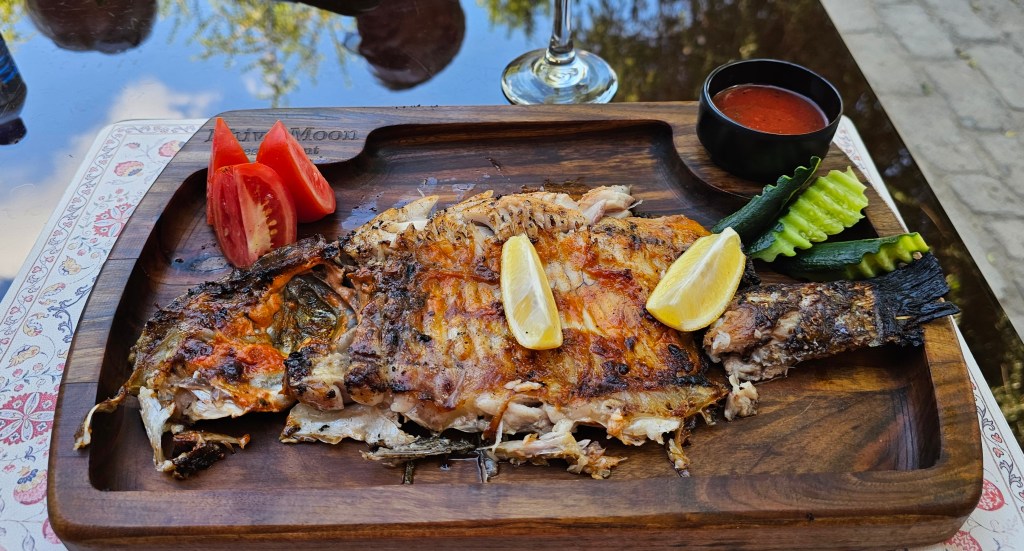
For dinner I had my only fish of the trip, baked local carp with a beetroot and apple side salad. Despite the large bones in the fish, this was all very tasty.
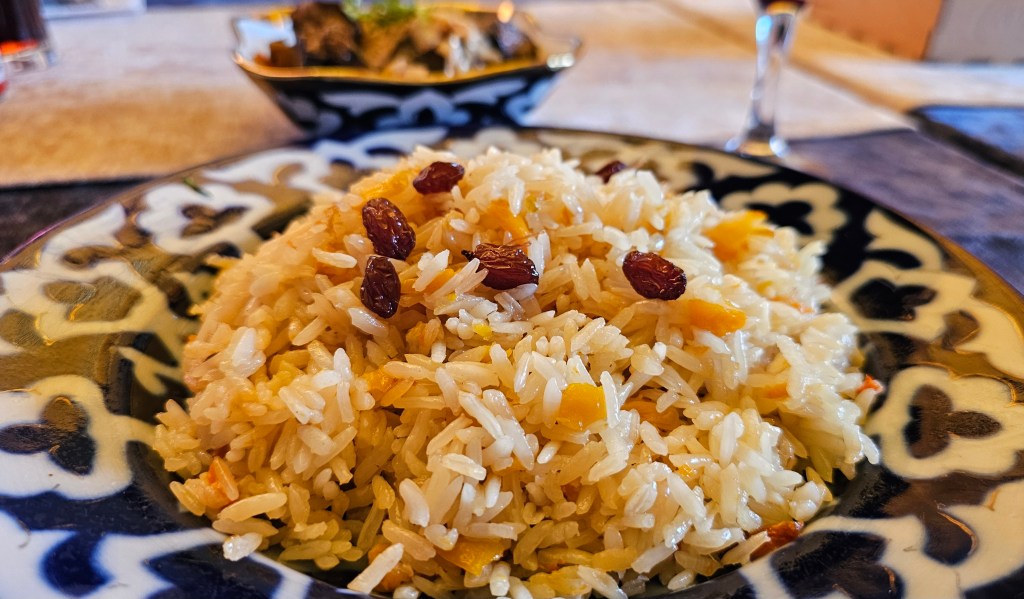
Plov is the staple main dish of Uzbekistan and for lunch on the second day in Khiva I was able to order a vegetarian version which was rice and vegetables. Standard plov is topped with beef or lamb.
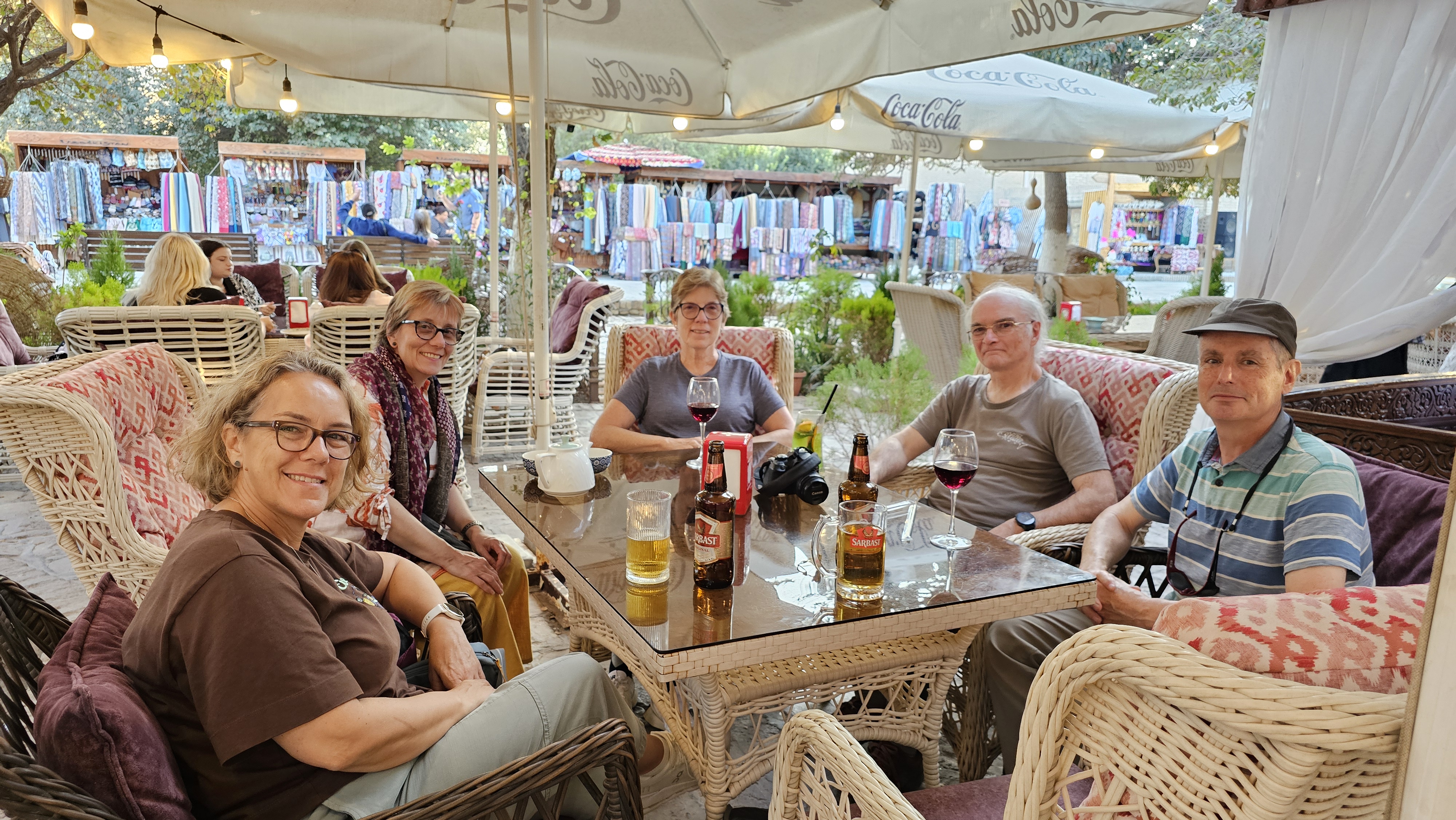
At around 5.45 pm on day 1, as our Sanjar-led tour ended, a small sub group called into a bar next to our hotel for impromptu drinks. We were all so comfortable chatting and drinking that we later ordered food too and, as darkness fell, we stayed there for the rest of the evening!
Our final meal was during the evening of day 2 where 6 of us had dinner up in the large terrace of the ‘Restaurant Tapas’ which came with some traditional Uzbek entertainment.
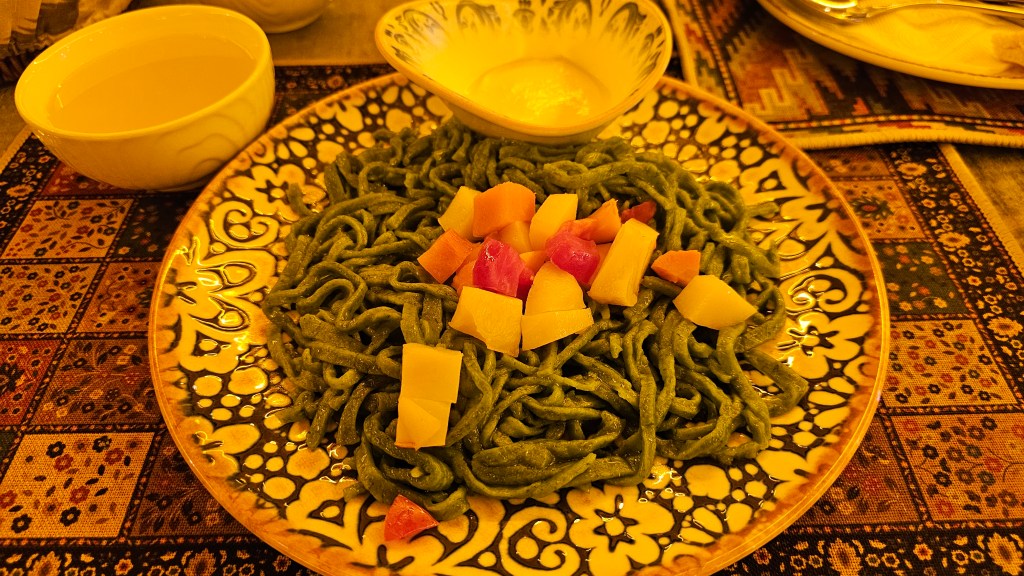
In here I tried Shuvit Oshi which is a traditional Khiva dish made with green dill noodles and topped with vegetables and meat (mine was minus the meat).
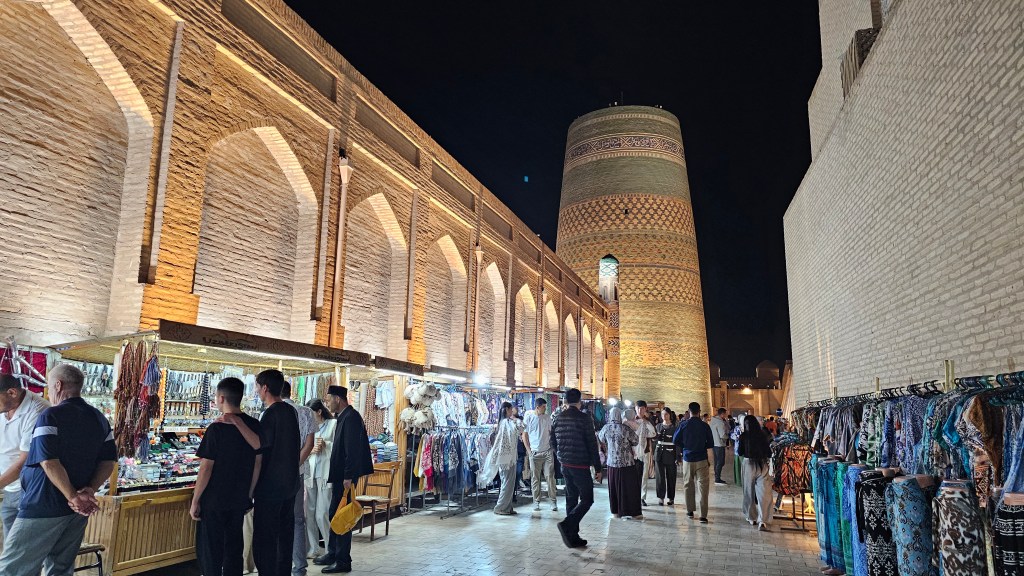
Khiva by night
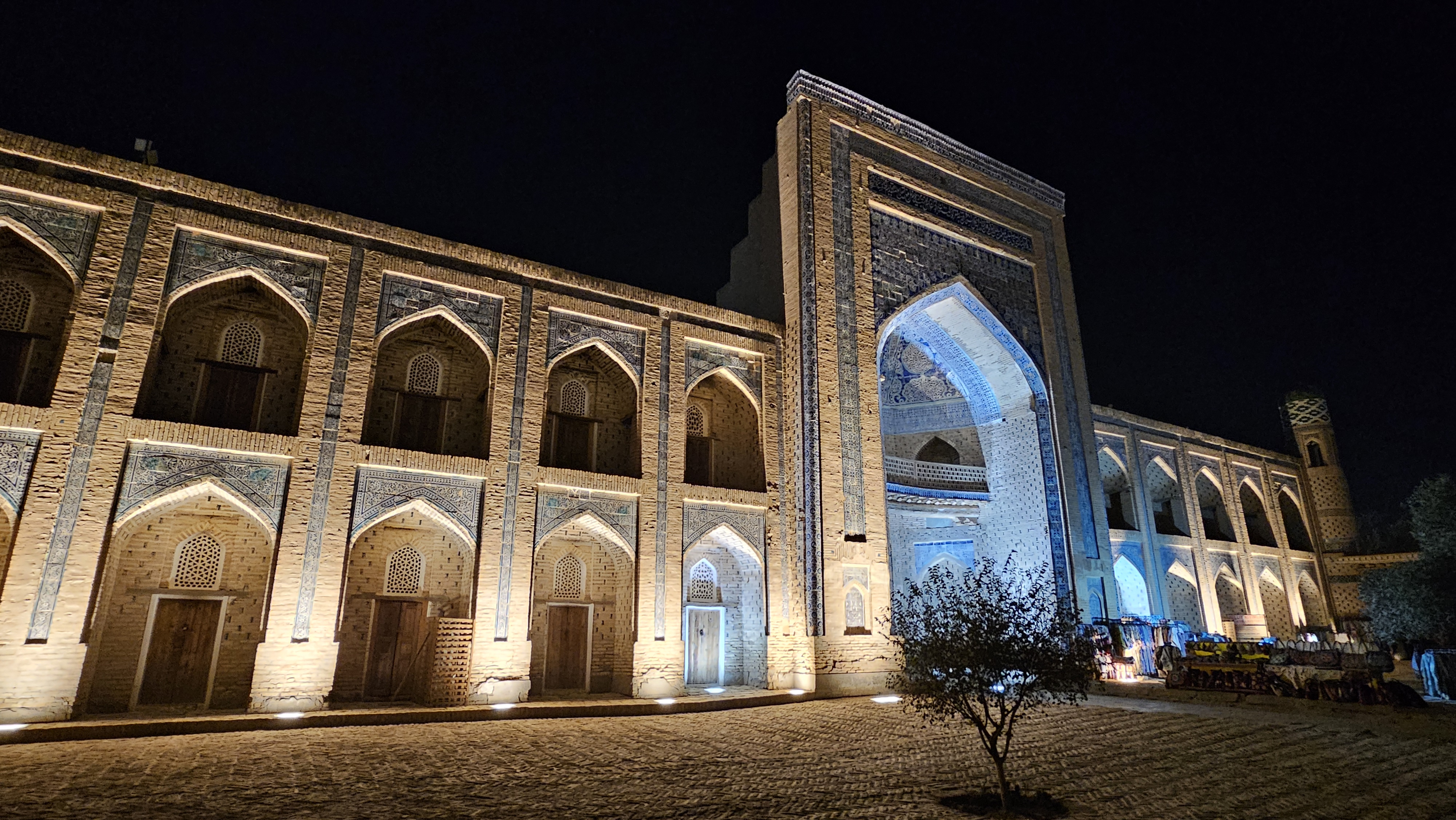
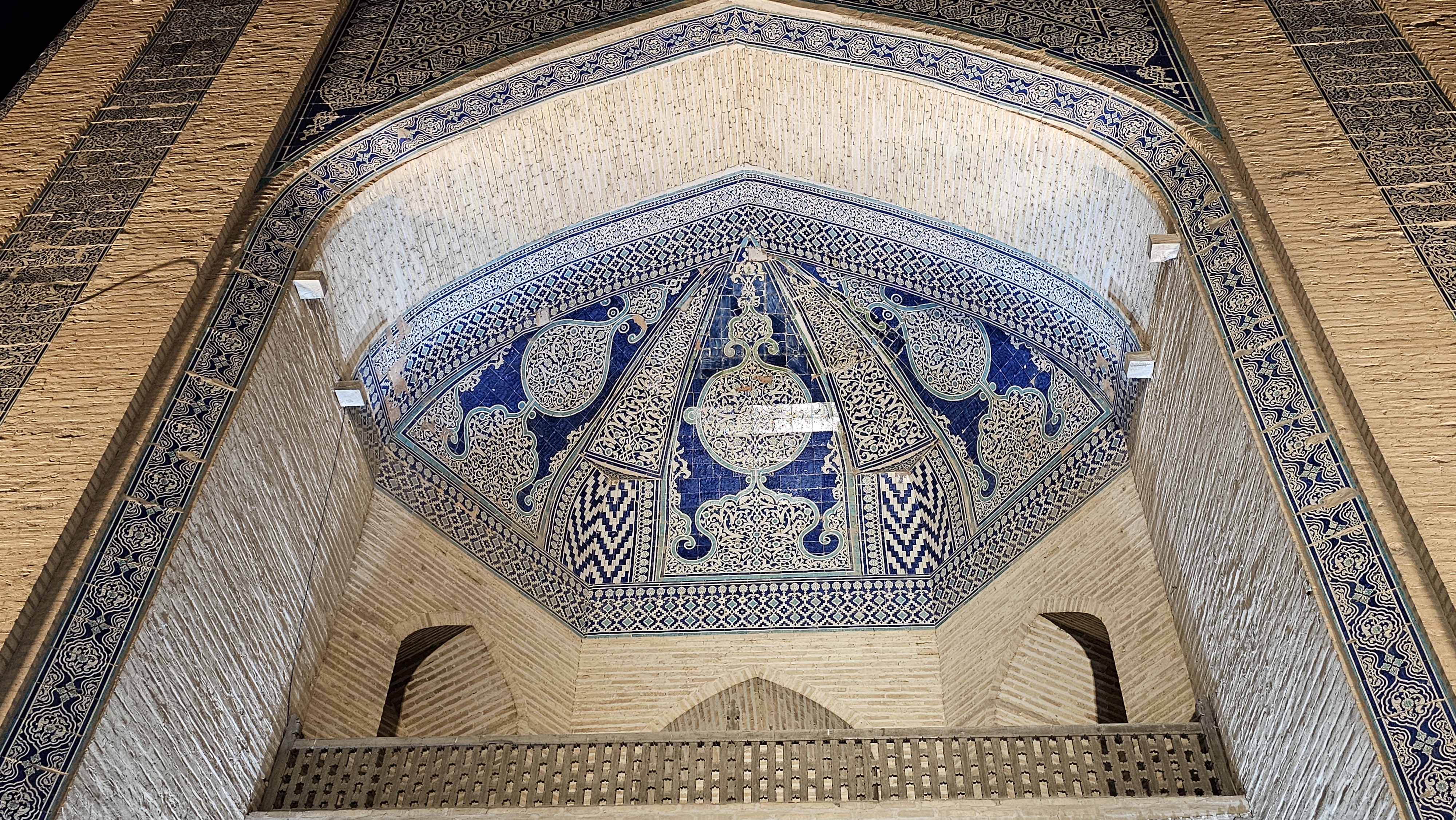
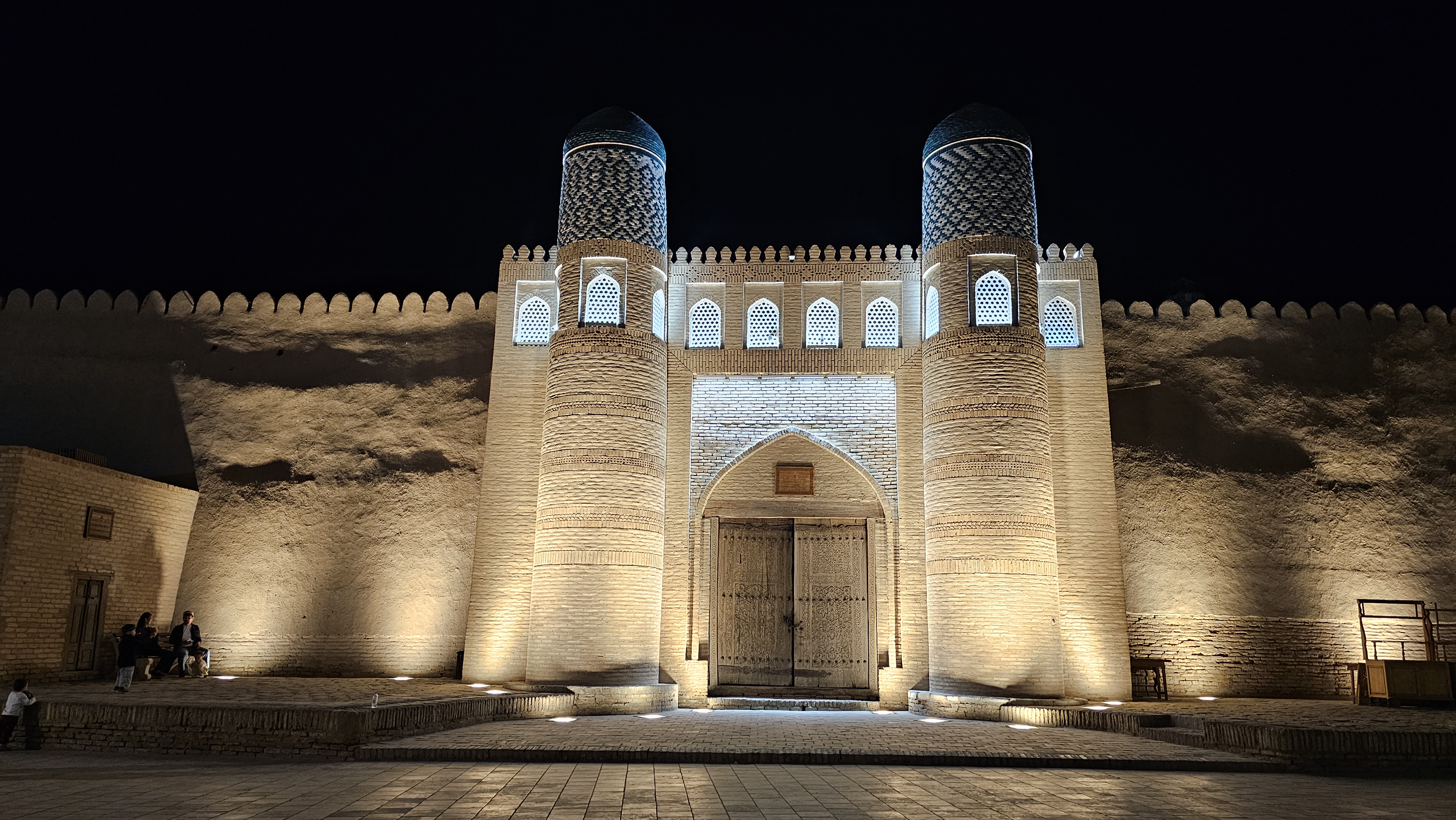
Khiva takes on an attractive and atmospheric feel at night and is a pleasant place to have a stroll around the lit up buildings.
Accommodation
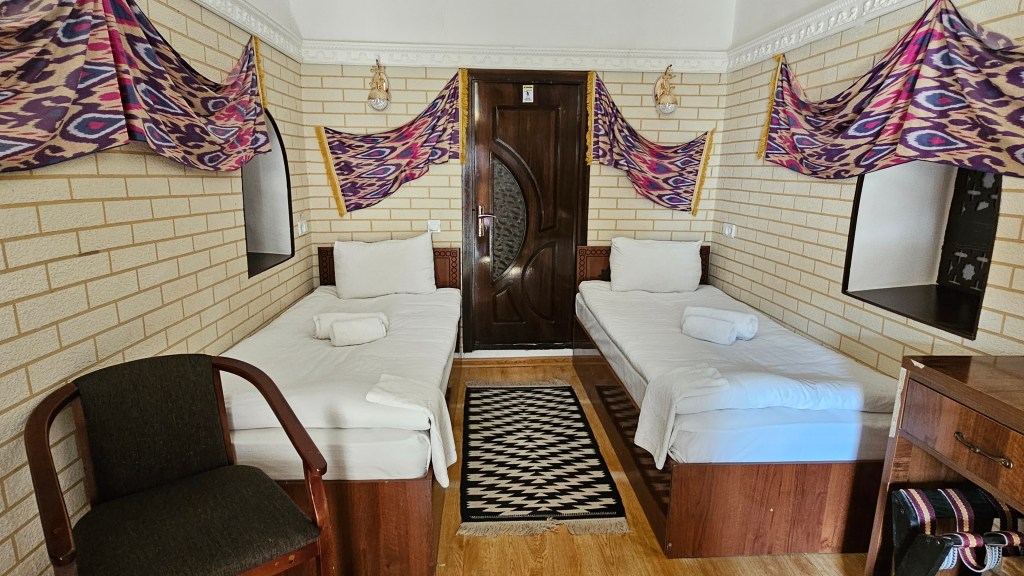
As mentioned our hotel, the Hotel Feruzkhan, was a former madrasa, or a school. Our small and quirky rooms were previously one of the original student rooms. Although small, each room had an en-suite bathroom and it was a wonderful experience to stay somewhere so quaint and historic.
Summary
After a fabulous time in delightful, fairytale Khiva, tomorrow we continue our journey east towards Bukhara, our next Silk Road destination.

