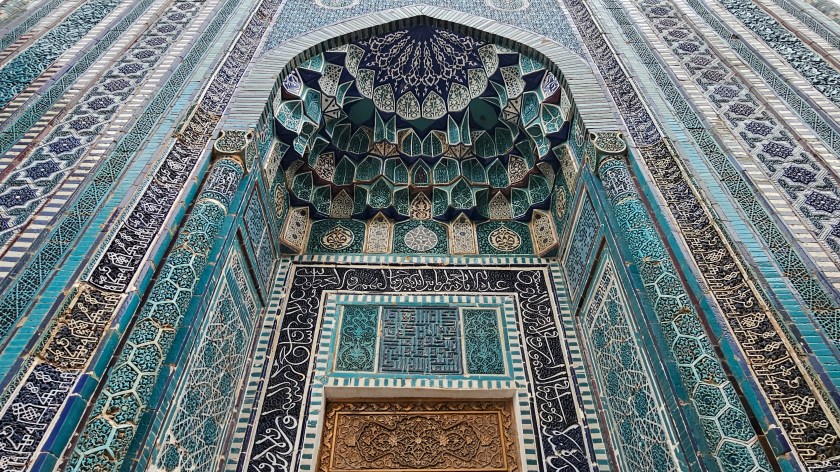
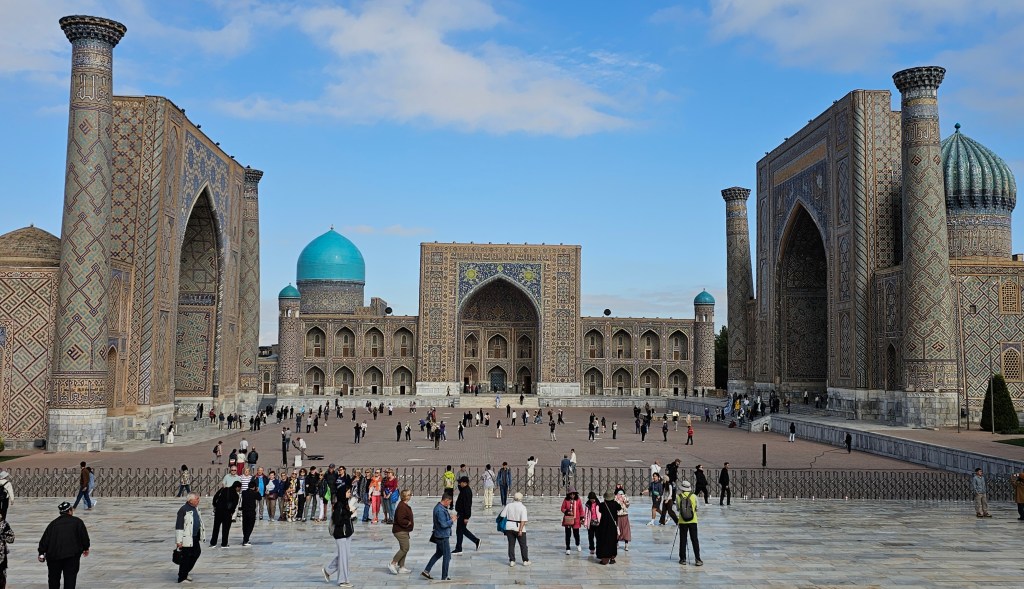
The first written mention of Samarkand dates back to the 4th century BC when it was then known as ‘Maracanda’. At the time, the city was conquered and then destroyed by Alexander the Great and has since been rebuilt and destroyed many times.
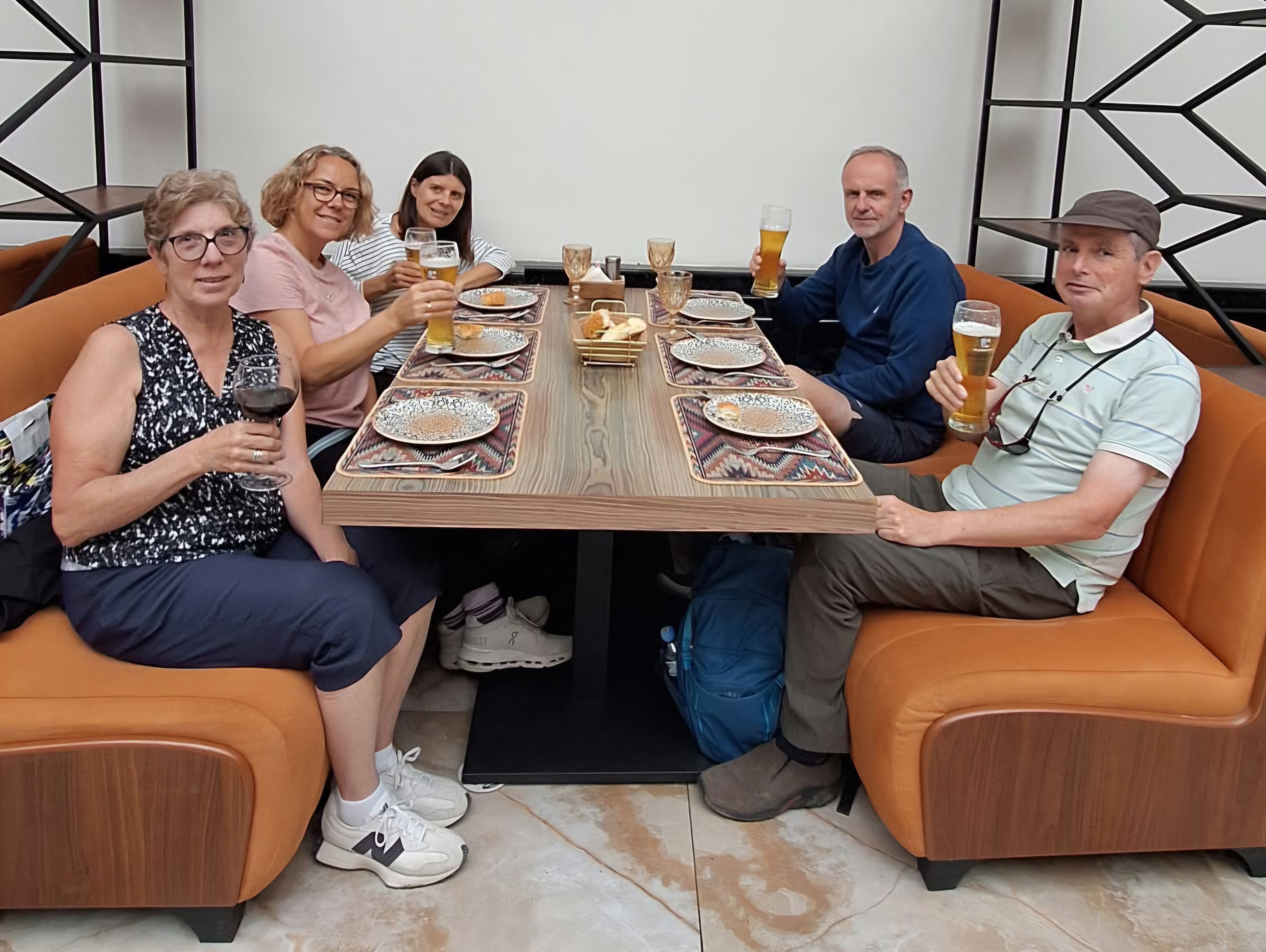
Our Explore group arrived from the mountains at around 6 pm for our 2 night stay in the city. Once we had settled into our rooms Bridget and I joined some of the group for an evening meal, arranged by our guide Sanjar.
During our stay in Samarkand we had one full day of excursions led by Sanjar and most of the second day was free time.
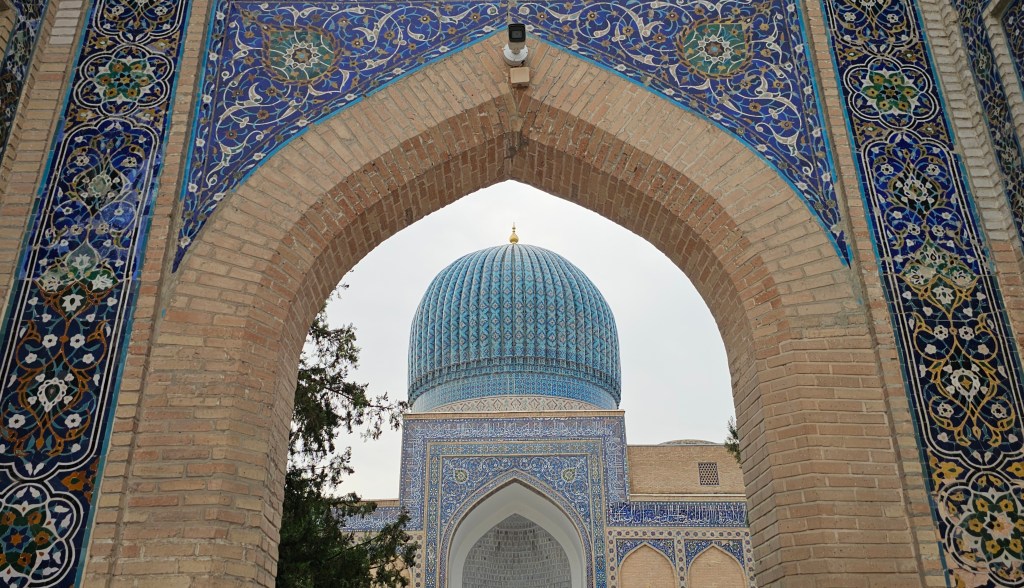
Amir Timur Mausoleum
Our first official day of sightseeing kicked off at the magnificent Amir Timur Mausoleum (historically known as the Gur-e-Amir), which was located just a convenient five-minute walk from our hotel. It was the perfect introduction to Samarkand’s epic history. Born in 1336, Amir Timur was one of the most formidable military leaders of the Middle Ages. During his extraordinary 35-year reign, he forged a colossal empire that spanned across continents—and remarkably, he never lost a single battle throughout his entire military career.
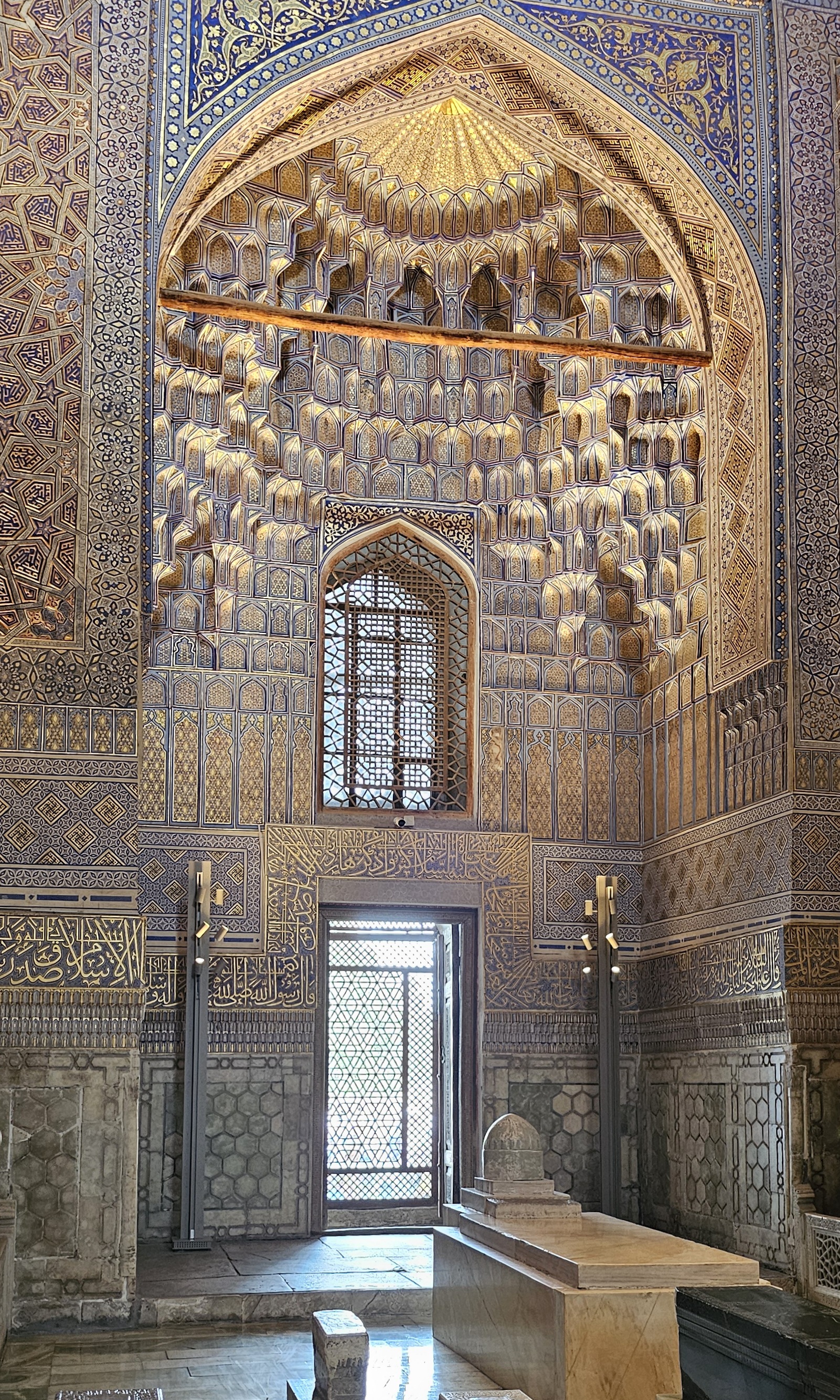
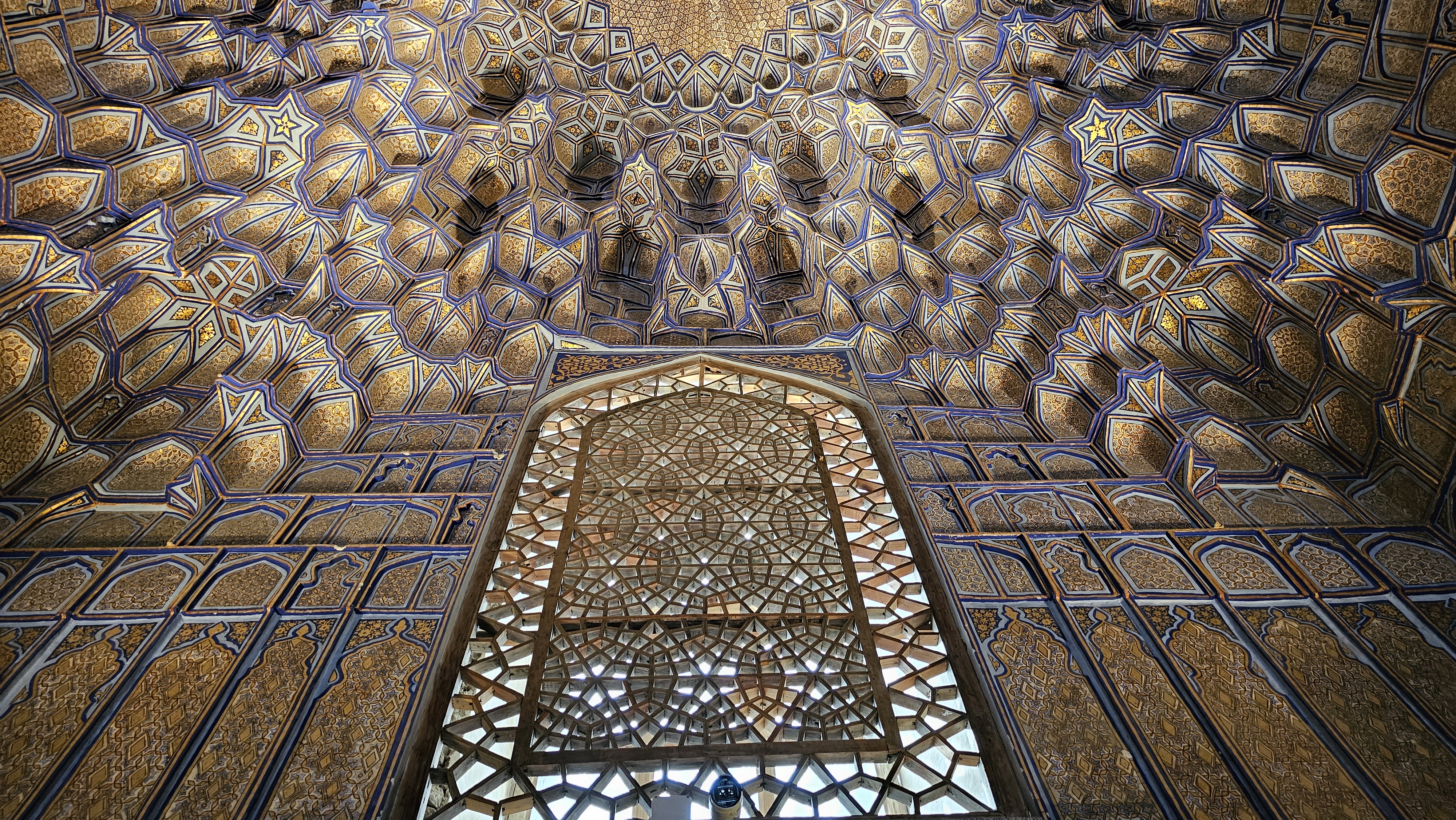
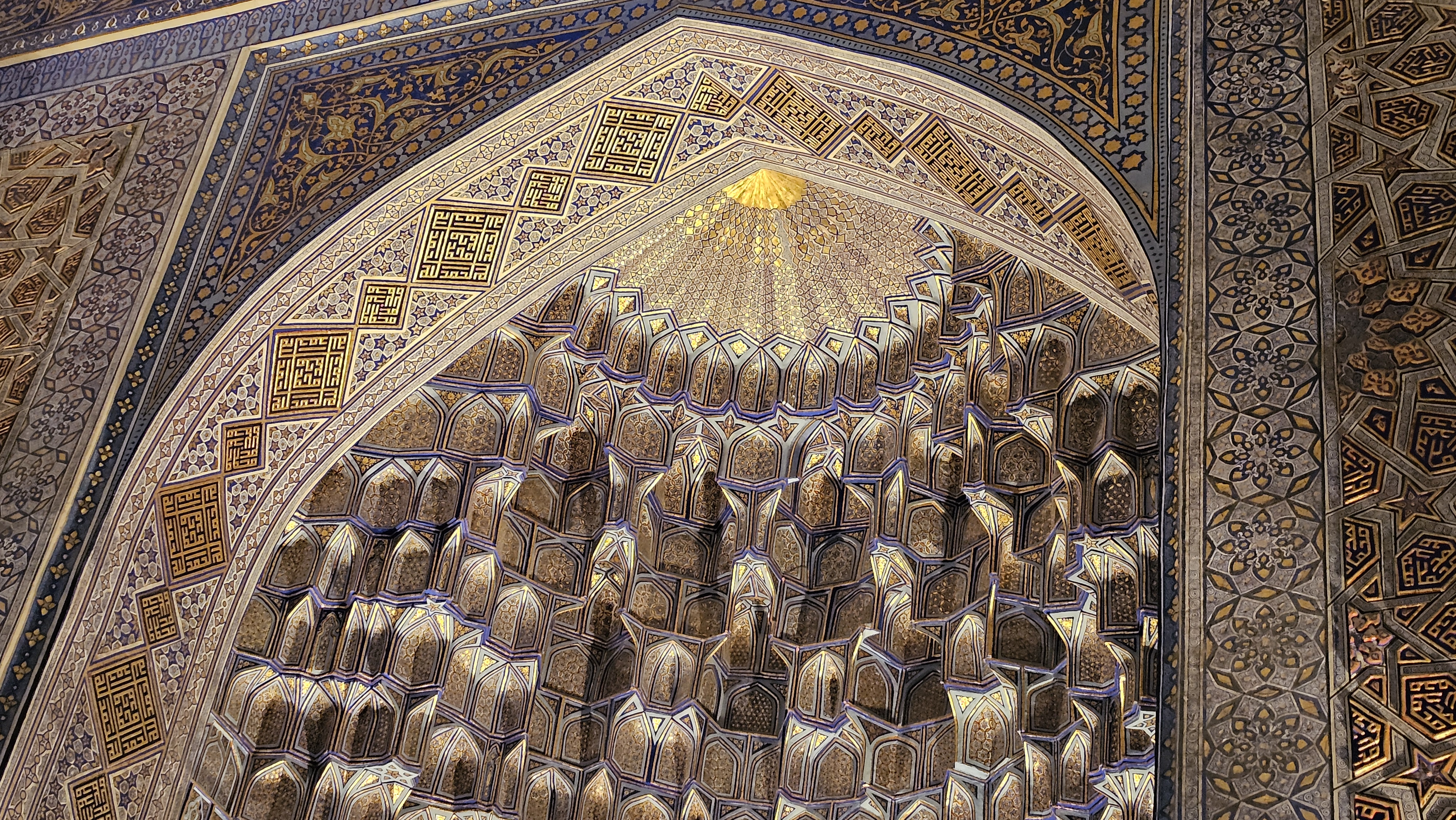
Stepping through the wooden doors and into the main crypt is breathtaking – a genuine wow moment! The entire interior hall is completely covered from floor to ceiling in intricately carved shimmering gold leaf, catching the light from a massive central chandelier.
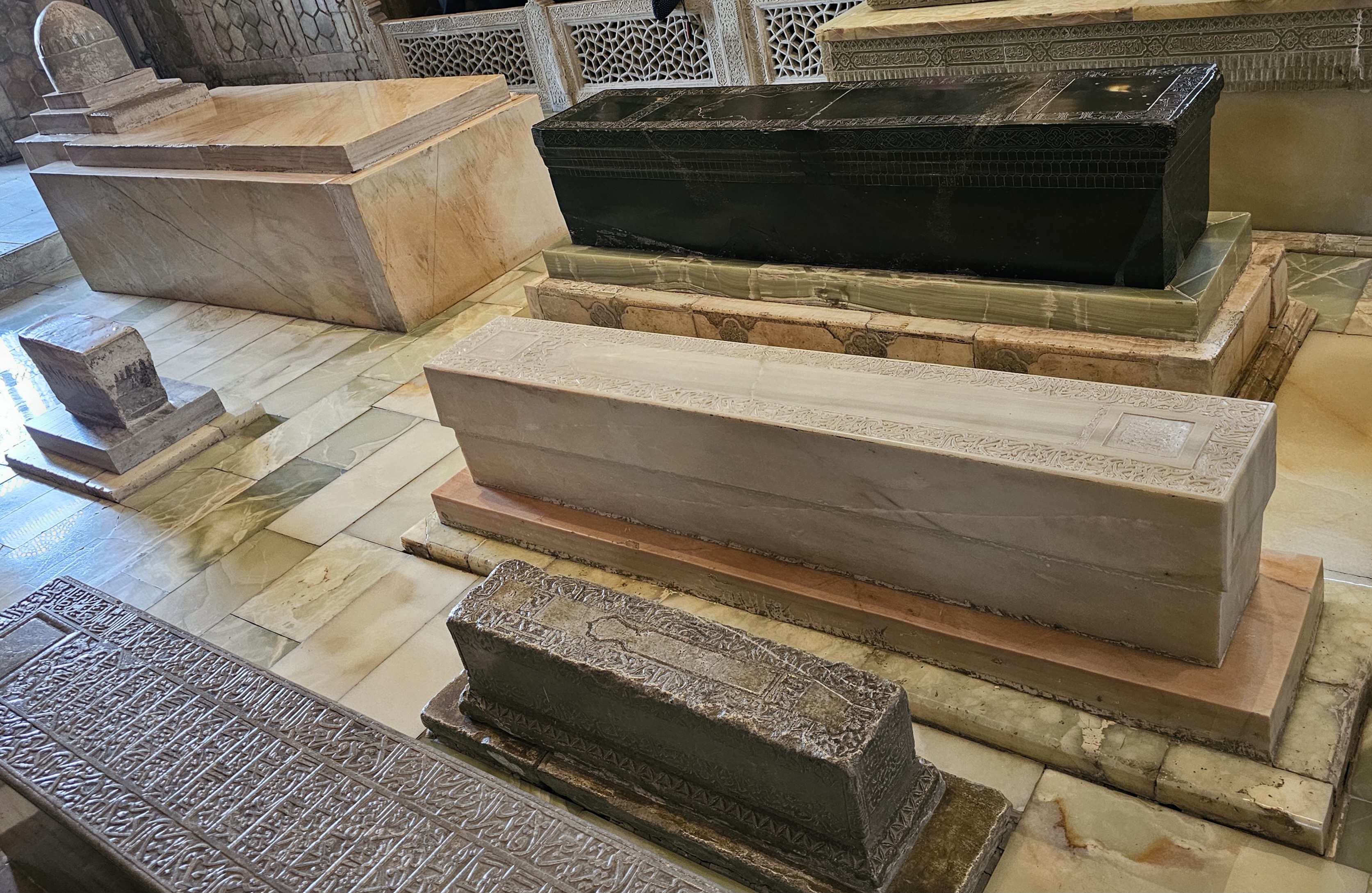
Directly in the center of the room, surrounded by an elegant marble railing, sit the decorative tombstones of Timur, his sons, and his grandsons. Right at the heart of the collection is the final resting place of the conqueror himself, marked by an absolute historical treasure: a massive, single block of rare dark green jade that serves as Timur’s headstone.
Registan Square and the Three Grand Madrasas
Next we headed to Registan Square… Framing the iconic Registan Square are three monumental madrasas, creating a spectacular vista by day and mesmerizing sight at night when the entire complex is beautifully lit up. Interestingly, the name ‘Registan’ translates to ‘sandy place,’ a reference to its humble origins as a desert crossroads before it became the grand heart of the Timurid Empire. There is a modest entrance fee of the equivalent of around £6 to £7 to step inside the inner square and explore the three historic Islamic schools. Once our guide, Sanjar, secured our group ticket, he led us past the gates to share the epic history behind these incredible buildings.
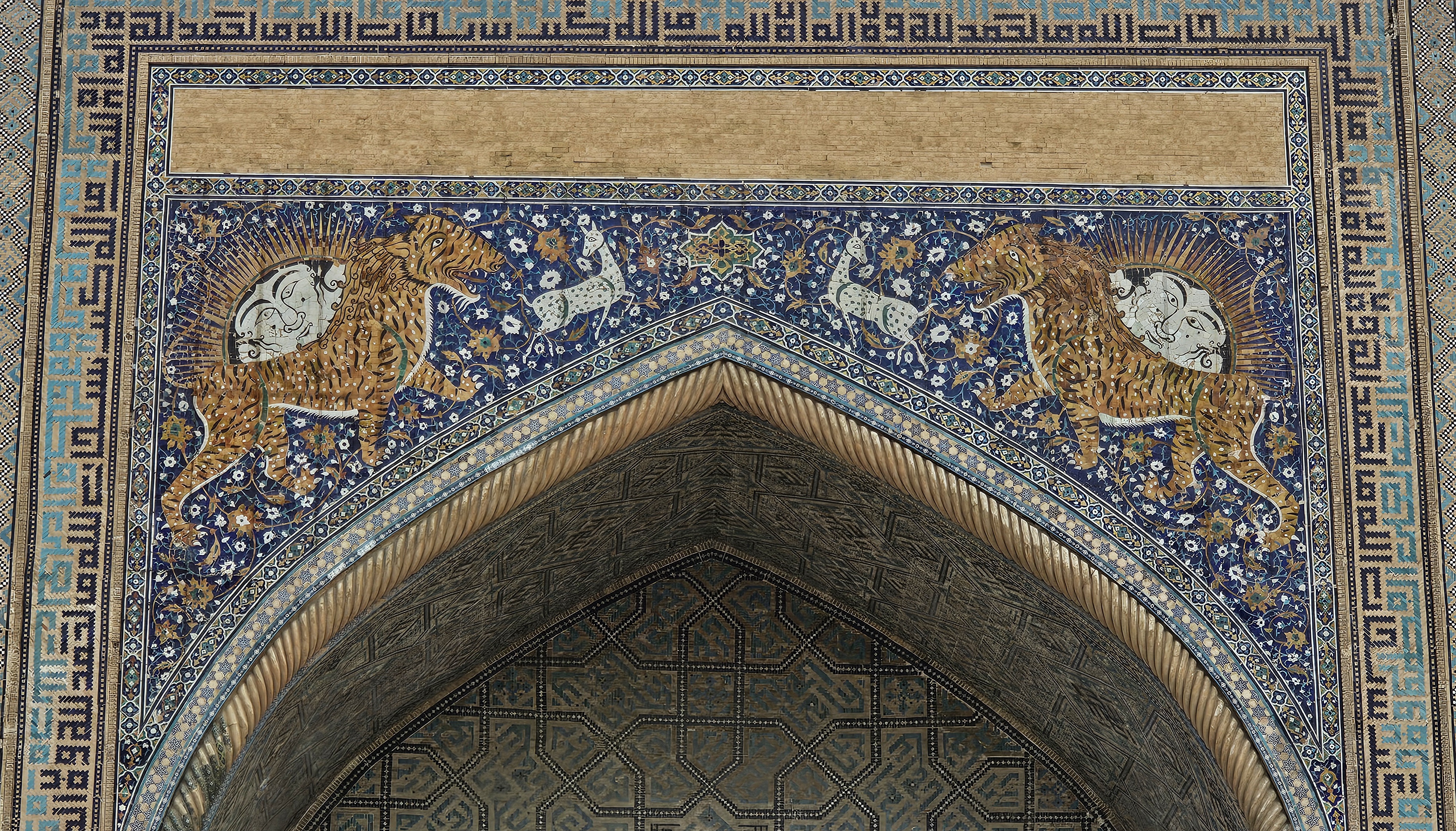
Sher-Dor Madrasa (Built 1619–1636)
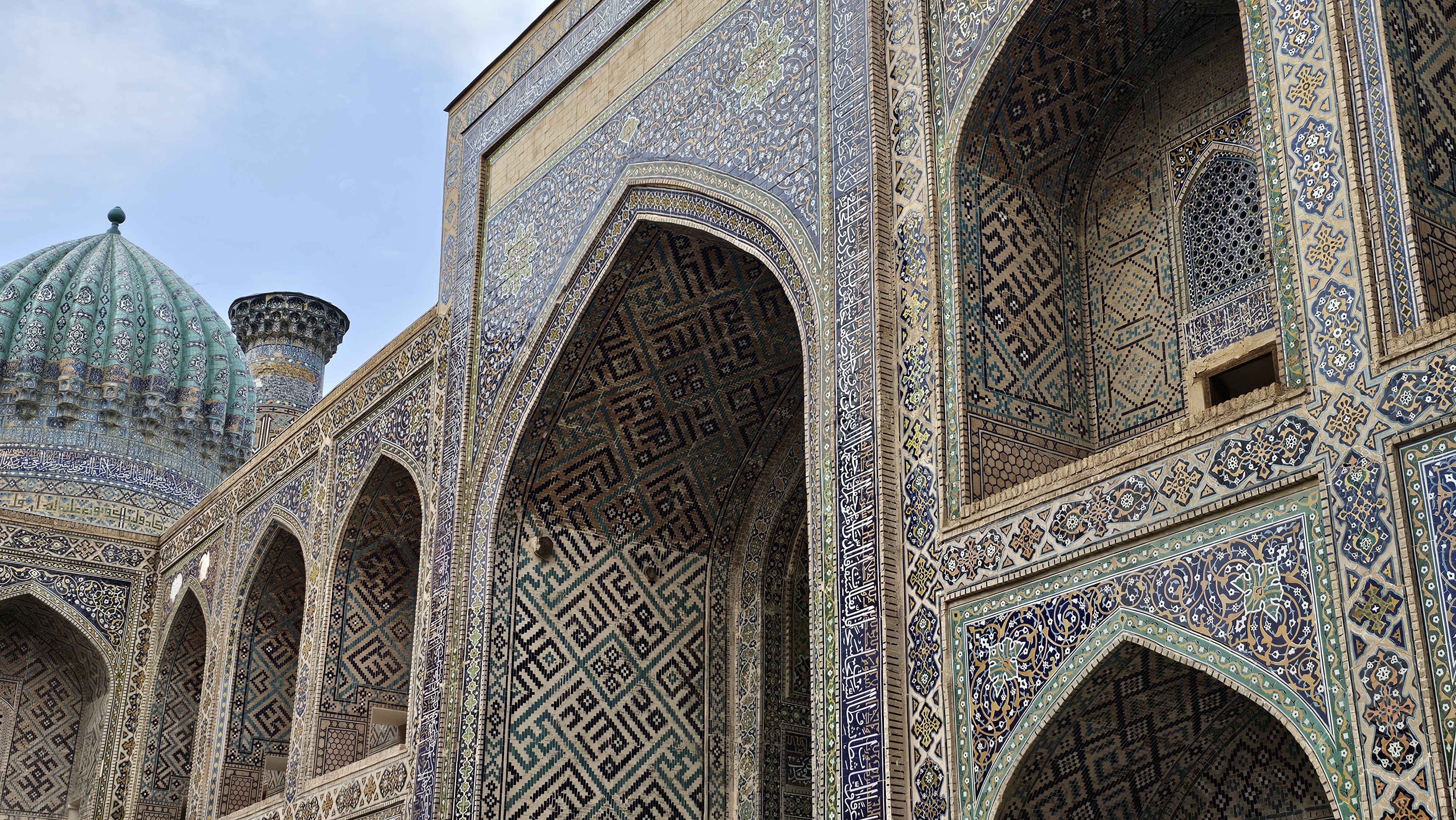
The name Sher-Dor translates as ‘Madrasa with Tigers’ and was built by the then ruler of Samarkand, Yalangtush Bakhodur. It’s facade features one of the most famous and controversial artworks in the Islamic world. Breaking strict religious traditions that forbid the depiction of living creatures, the grand arch displays a vivid mosaic of two fierce tigers hunting stags under a glowing human-faced sun. It is a bold, theatrical piece of political messaging meant to project absolute power.
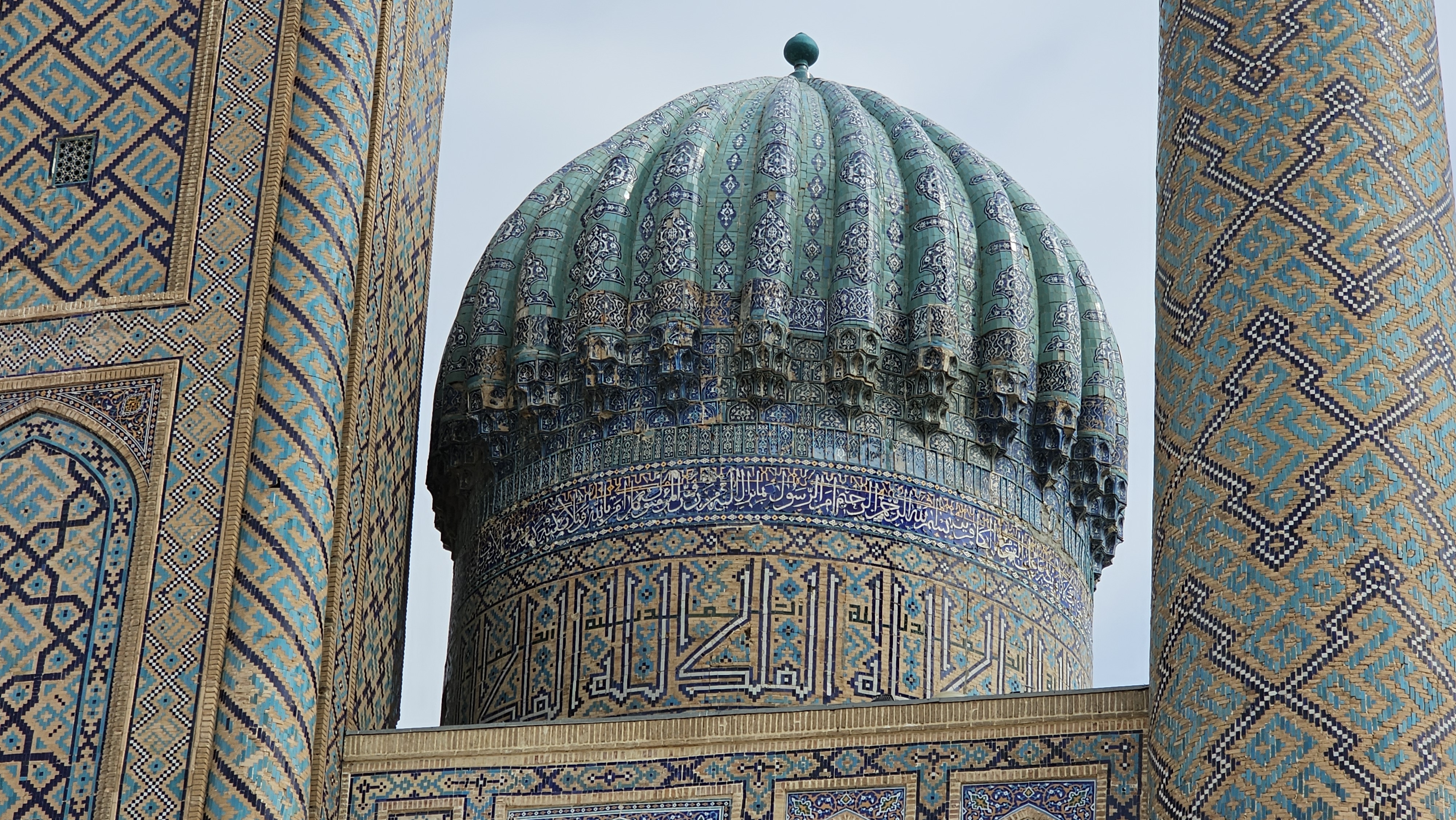
This madrasa has two huge turquoise ribbed domes which are situated above the original lecture halls.
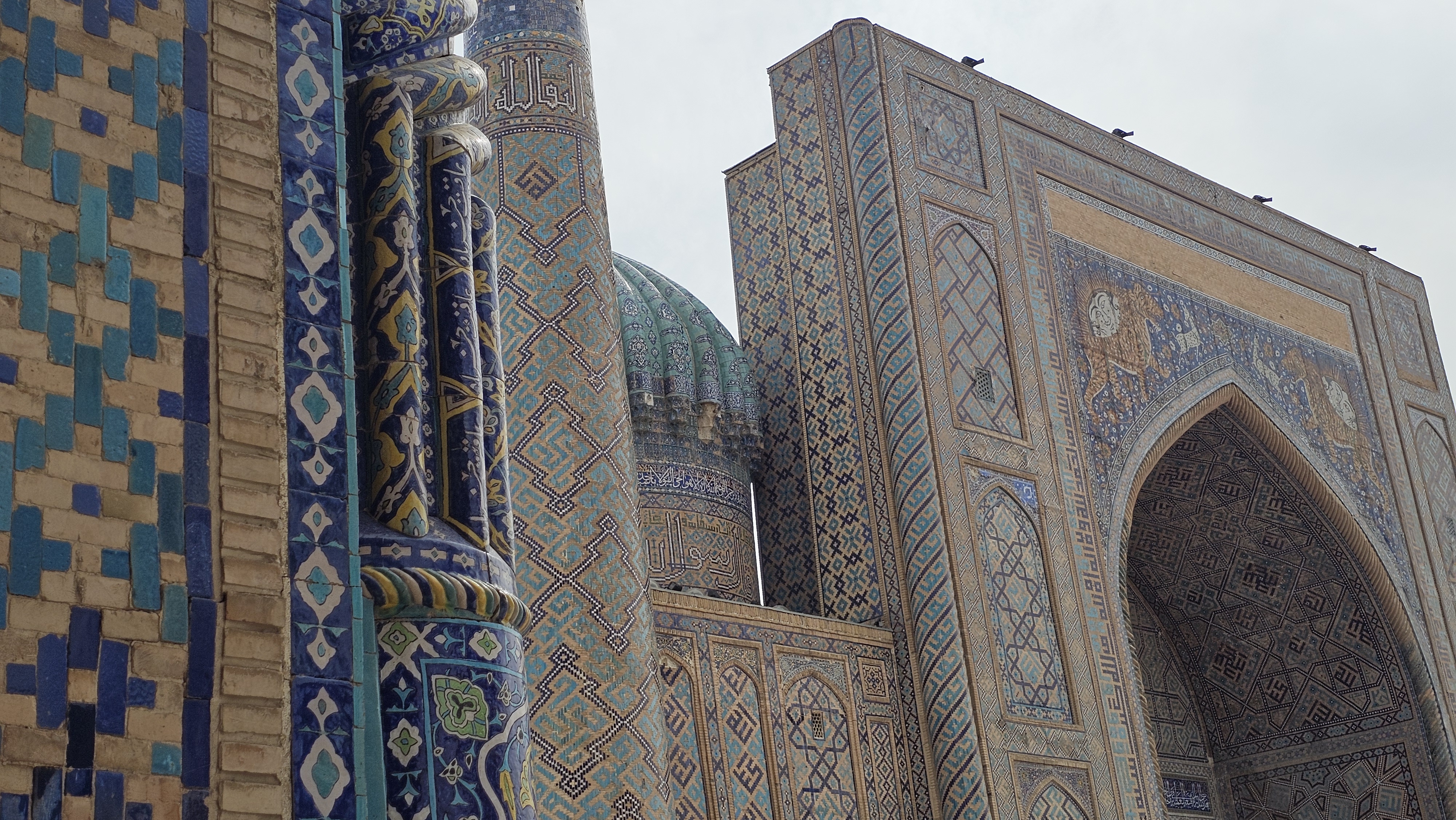
In the above picture the buildings look slightly tilted. On this occasion this may be my lopsided photography but actually many of these ancient buildings are tilted!
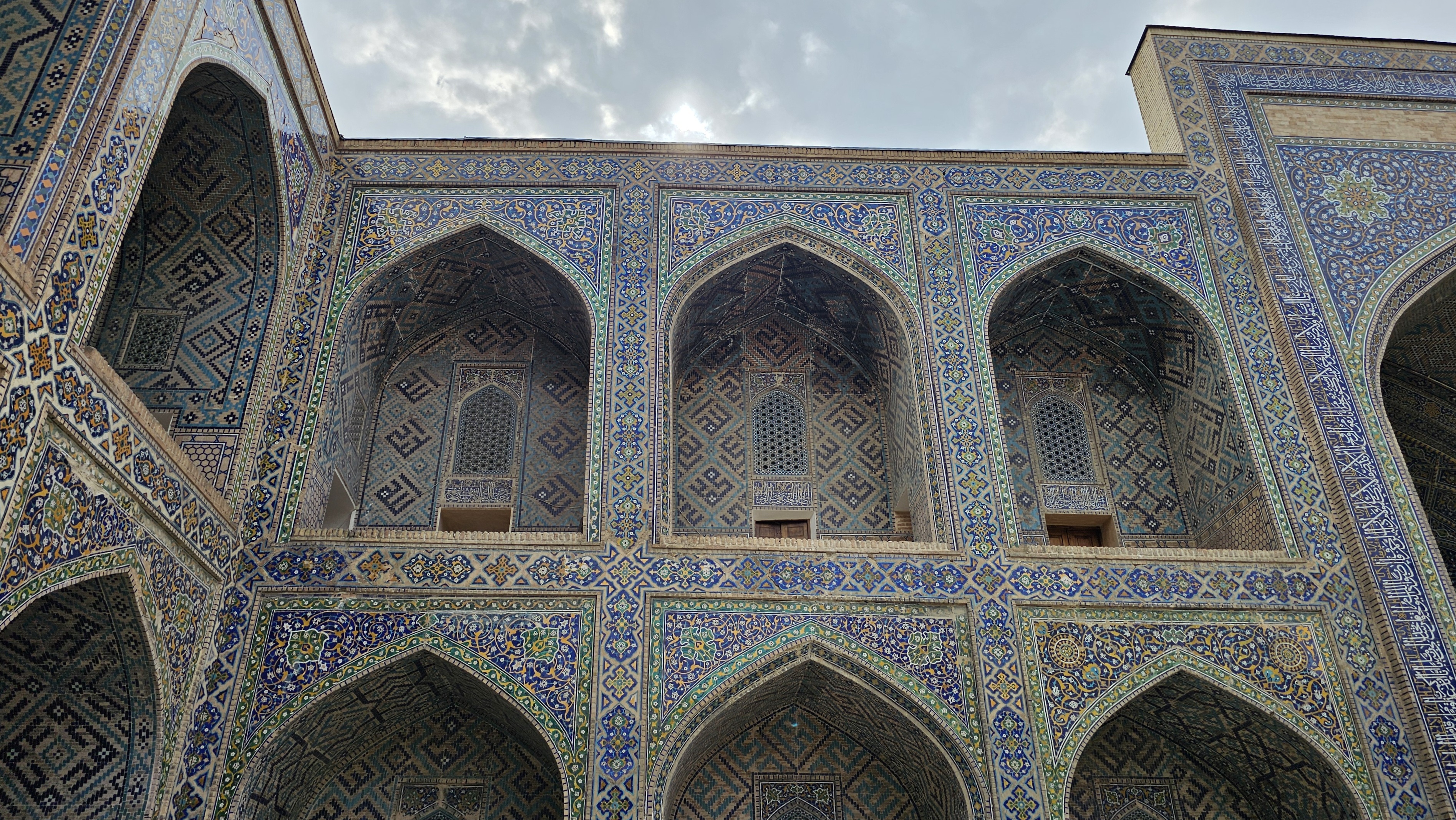
Stepping through into the serene and peaceful we found this madrasa had taken on a vibrant new life. The historic student rooms have been converted into charming, tiny workshops where local artisans sell beautiful hand-painted ceramics, traditional musical instruments, and silk scarves.
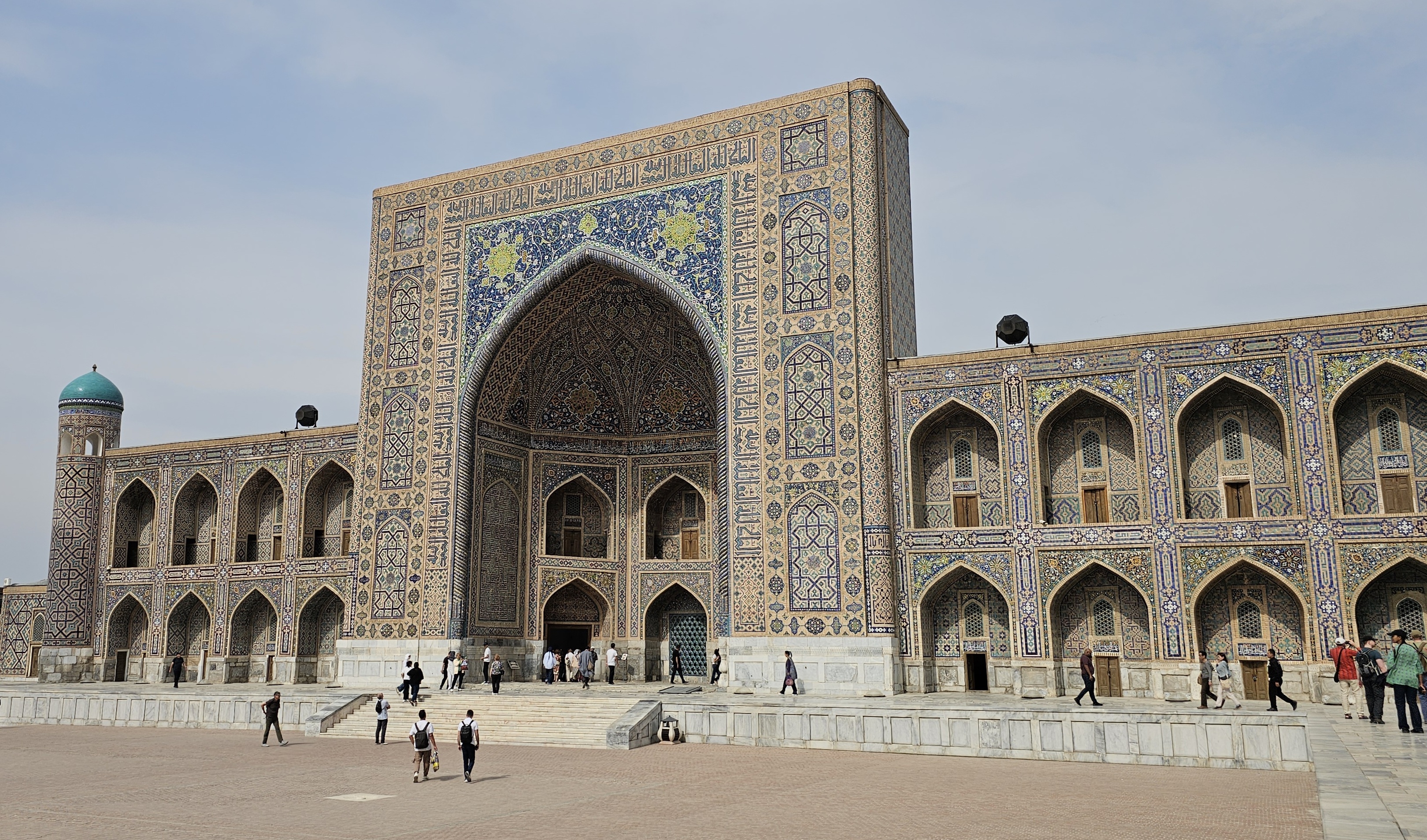
Tilla-Kari Madrasa (Built 1646–1660)
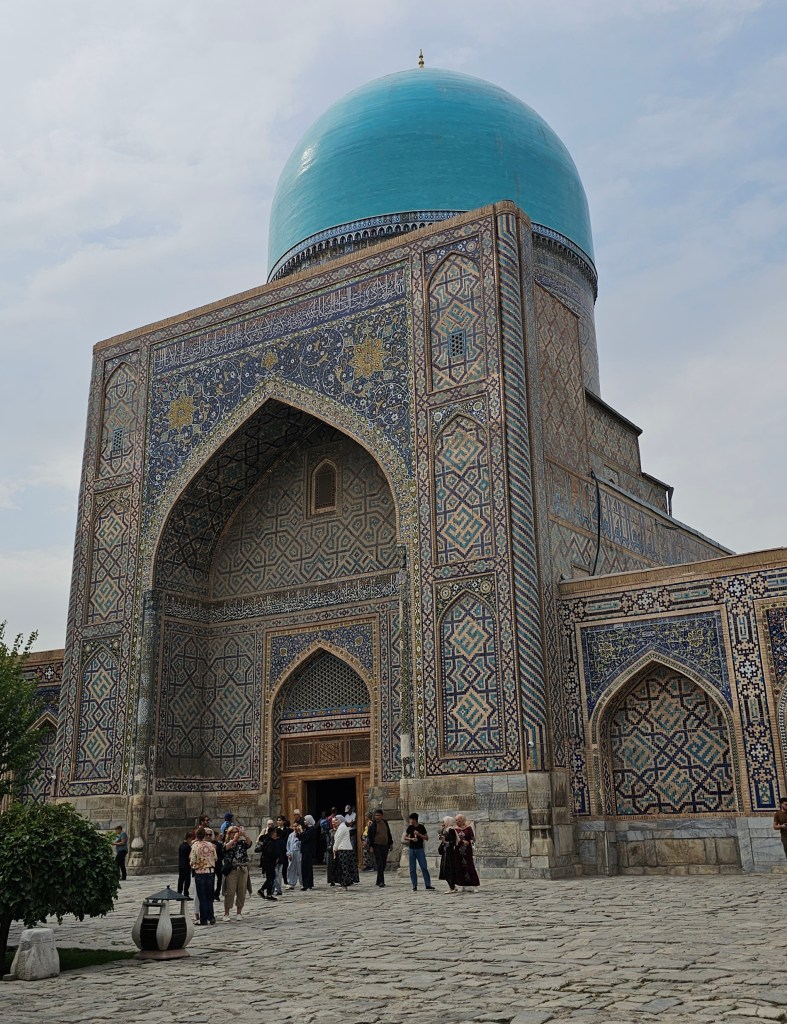
This structure was constructed 10 years after Sher-Dor by the same ruler, Bahadur Yalangtusj-biy. However this was built not just as a madrasa but also to serve as Samarkand’s grand Friday mosque. The name ‘Tilla-Kari’ translates as ‘guilded’ or “Decorated in Gold,” which becomes instantly obvious the moment you step into its magnificent residential courtyard.
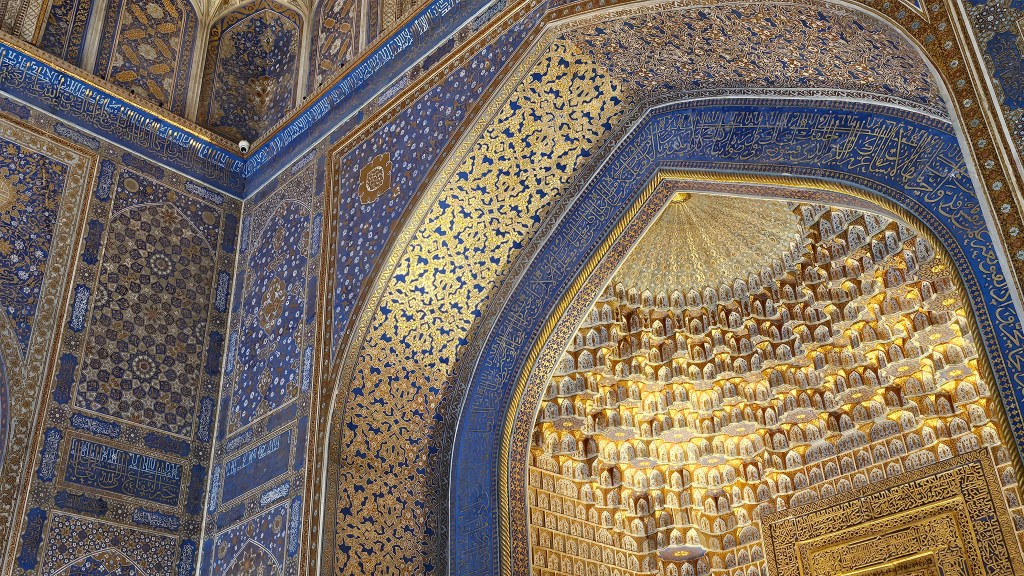
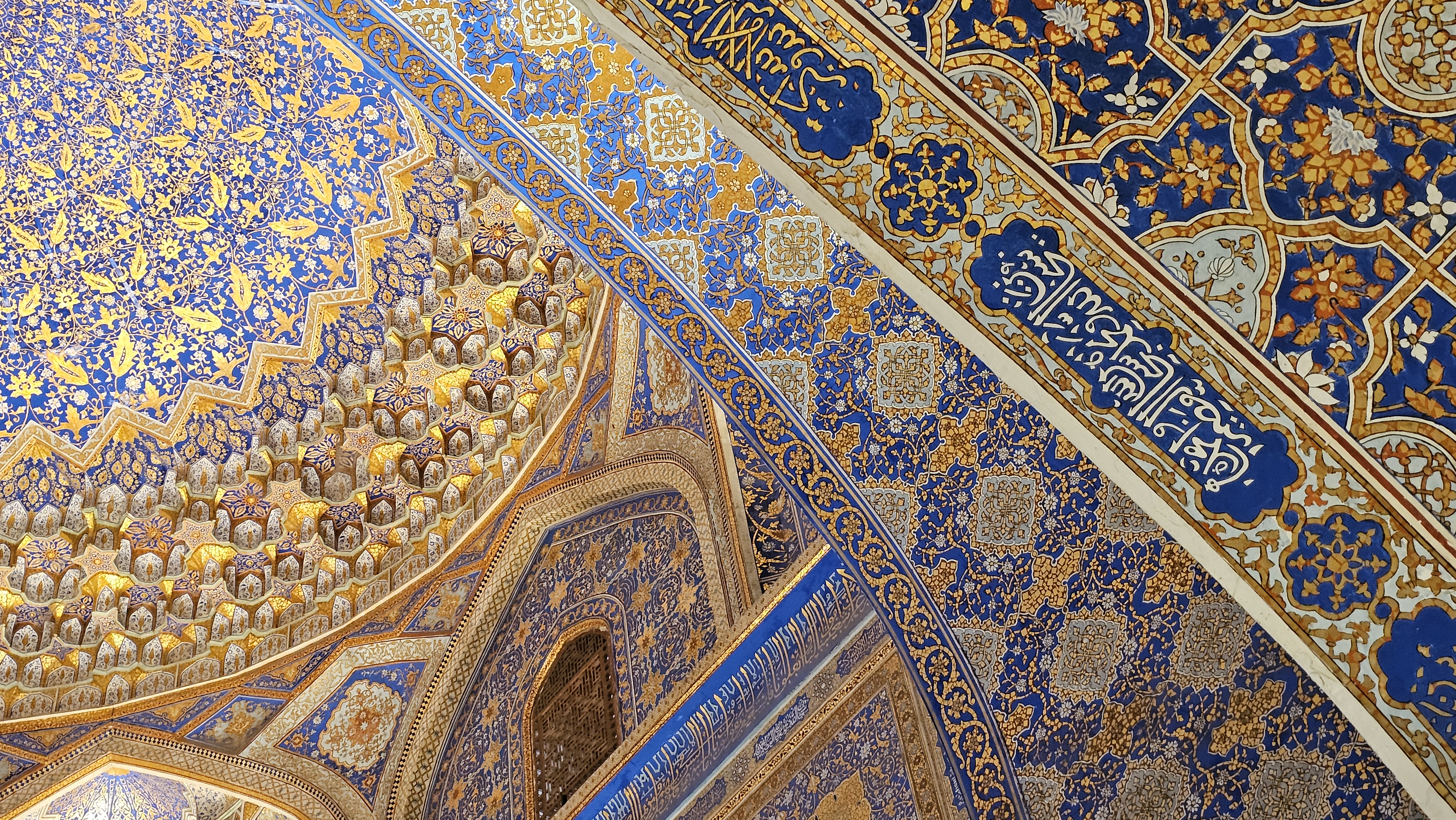
This building contains a magnificent guilded prayer hall lavishly decorated in gold-leaf. The flat ceiling features a complex geometric pattern which results in a spectacular optical illusion, making the flat surface look like a huge dome.
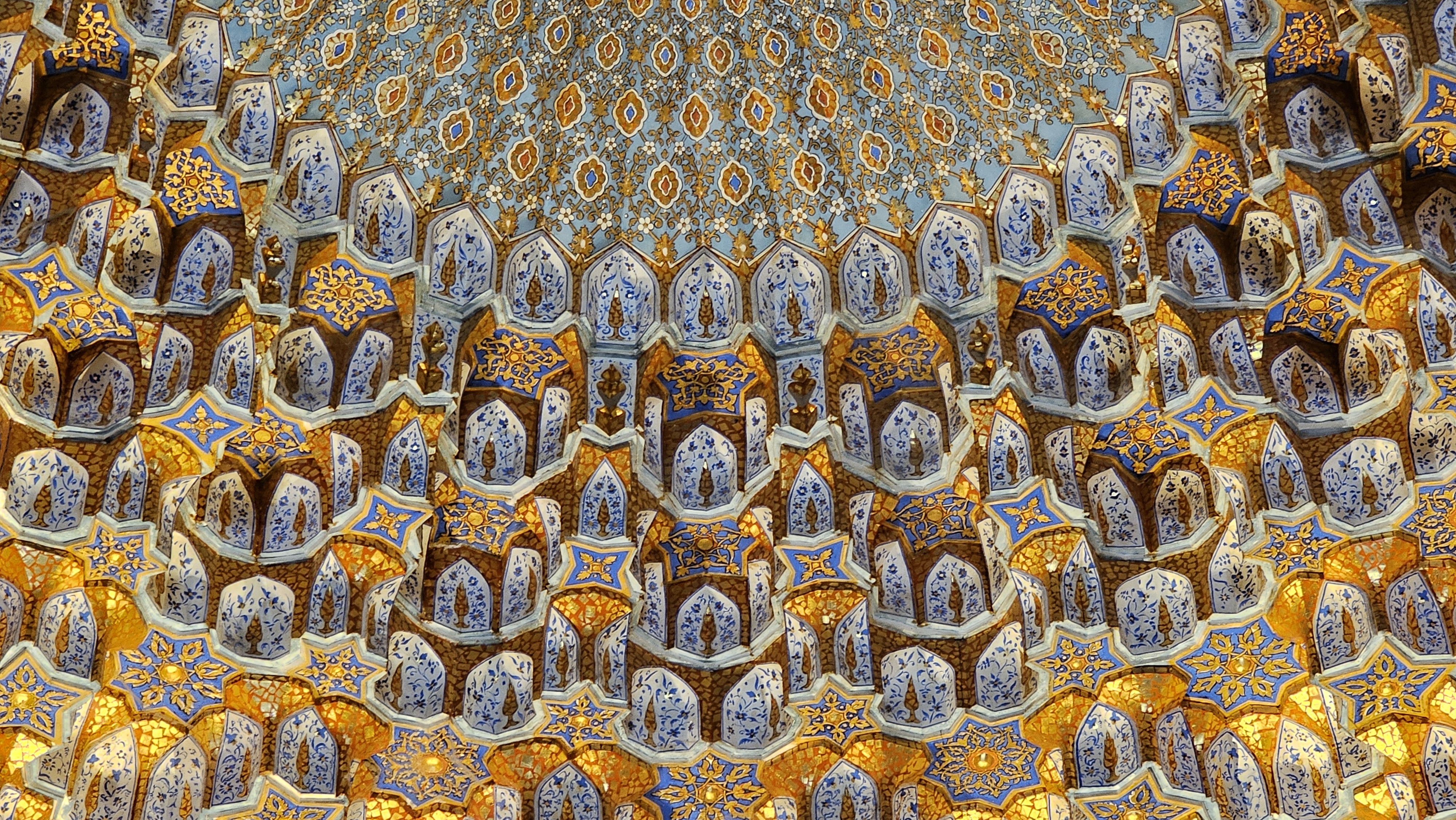
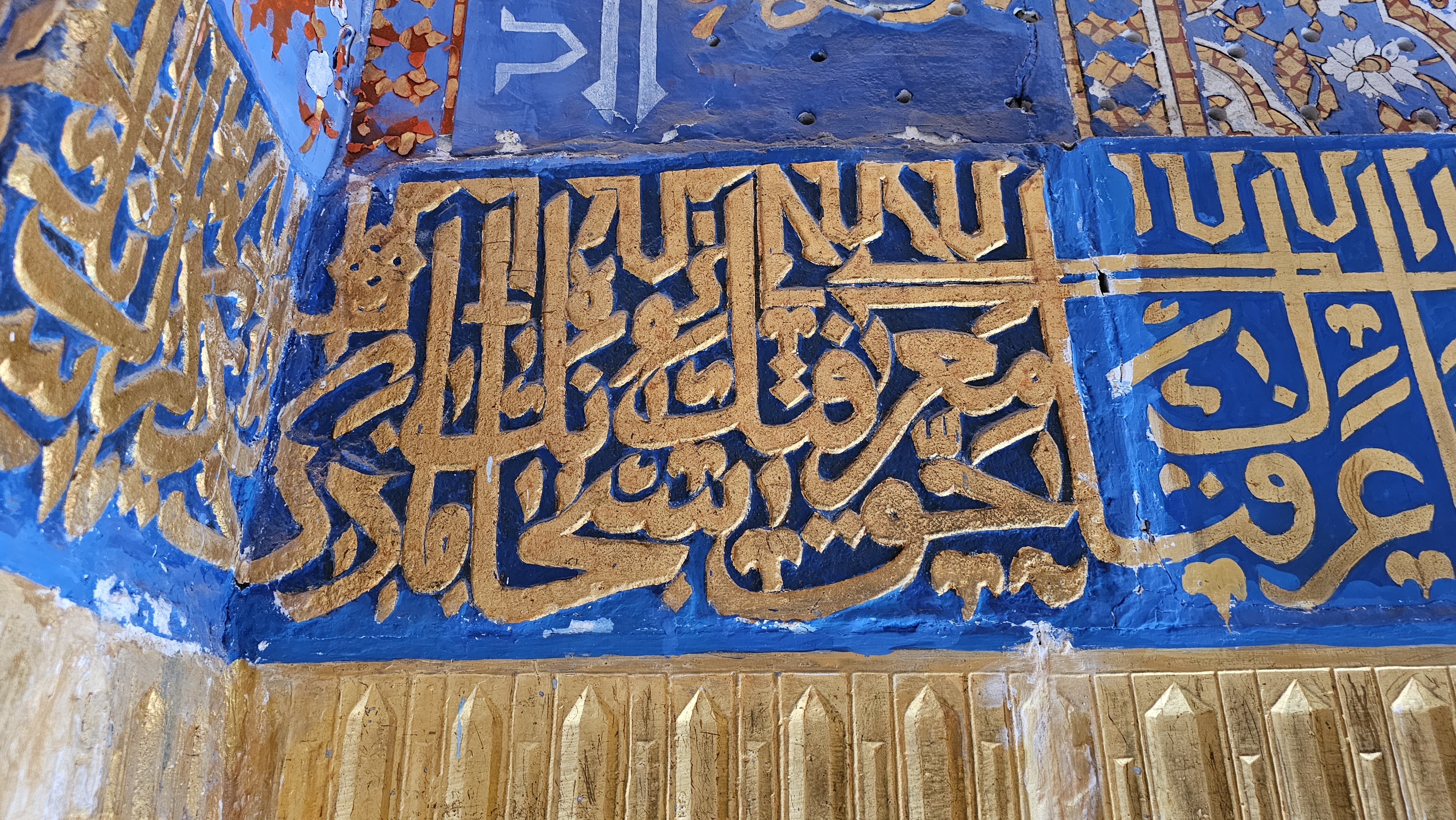
All of these buildings have been restored and the above photo shows to the left, original 3D side and to the right, the flat painted side.
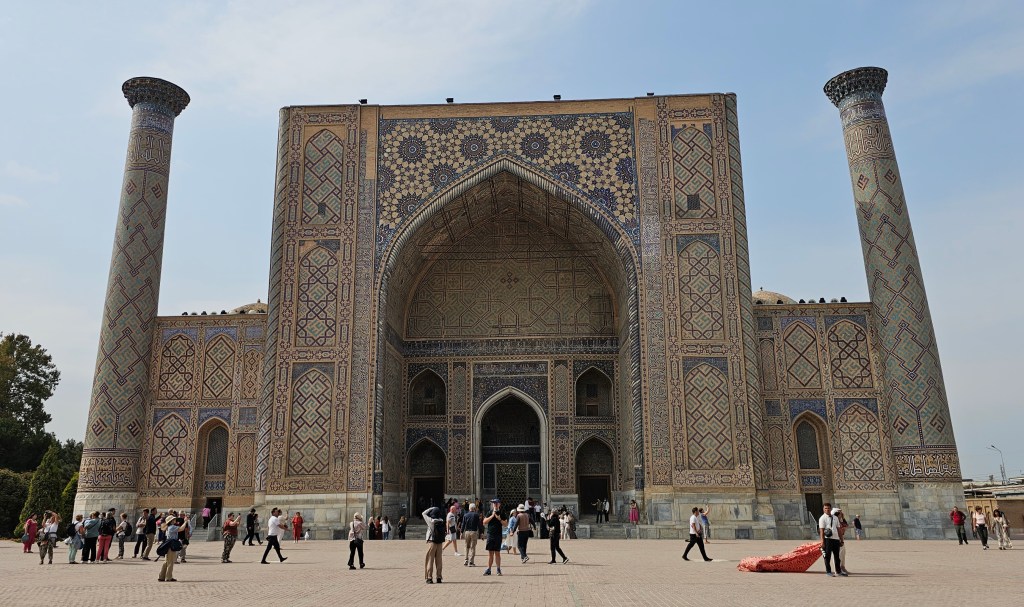
Ulugh Beg Madrasa (Built 1417–1420)
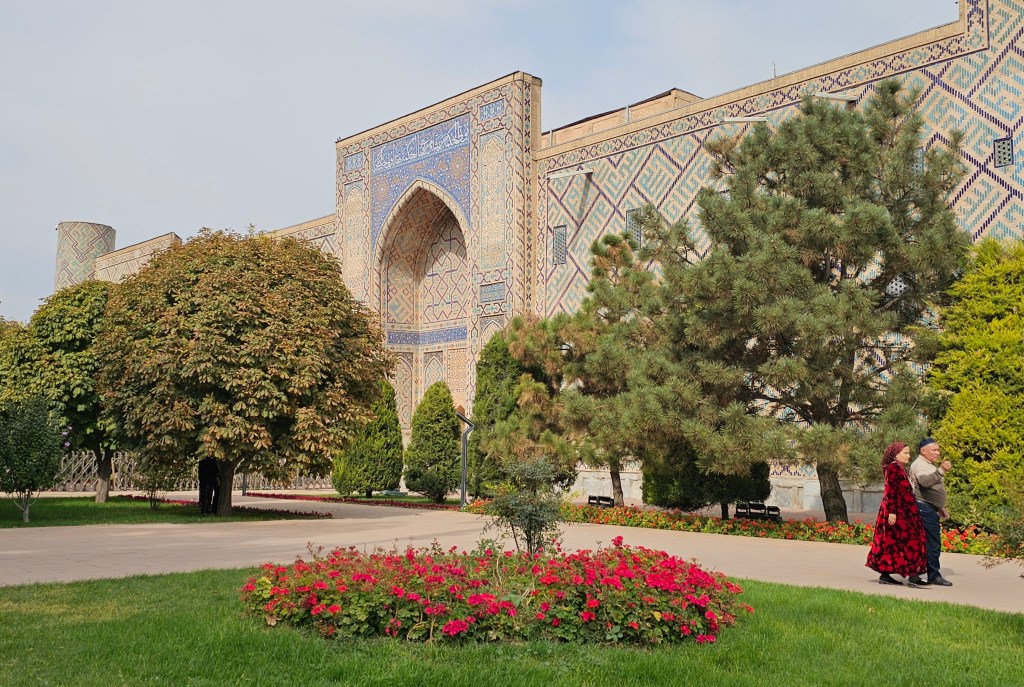
On the western side of the square stands the oldest of the trio, the Ulugh Beg Madrasah, completed in 1420. Unlike many rulers who focused solely on warfare, Ulugh Beg was a passionate scientist and astronomer. He built this university to be a world-class hub for mathematics, philosophy, and science. In fact, he taught astronomy courses here himself! The grand front portal features a beautiful design of five-pointed stars, reflecting Ulugh Beg’s lifelong obsession with the universe. (More on Ulugh-Beg later)
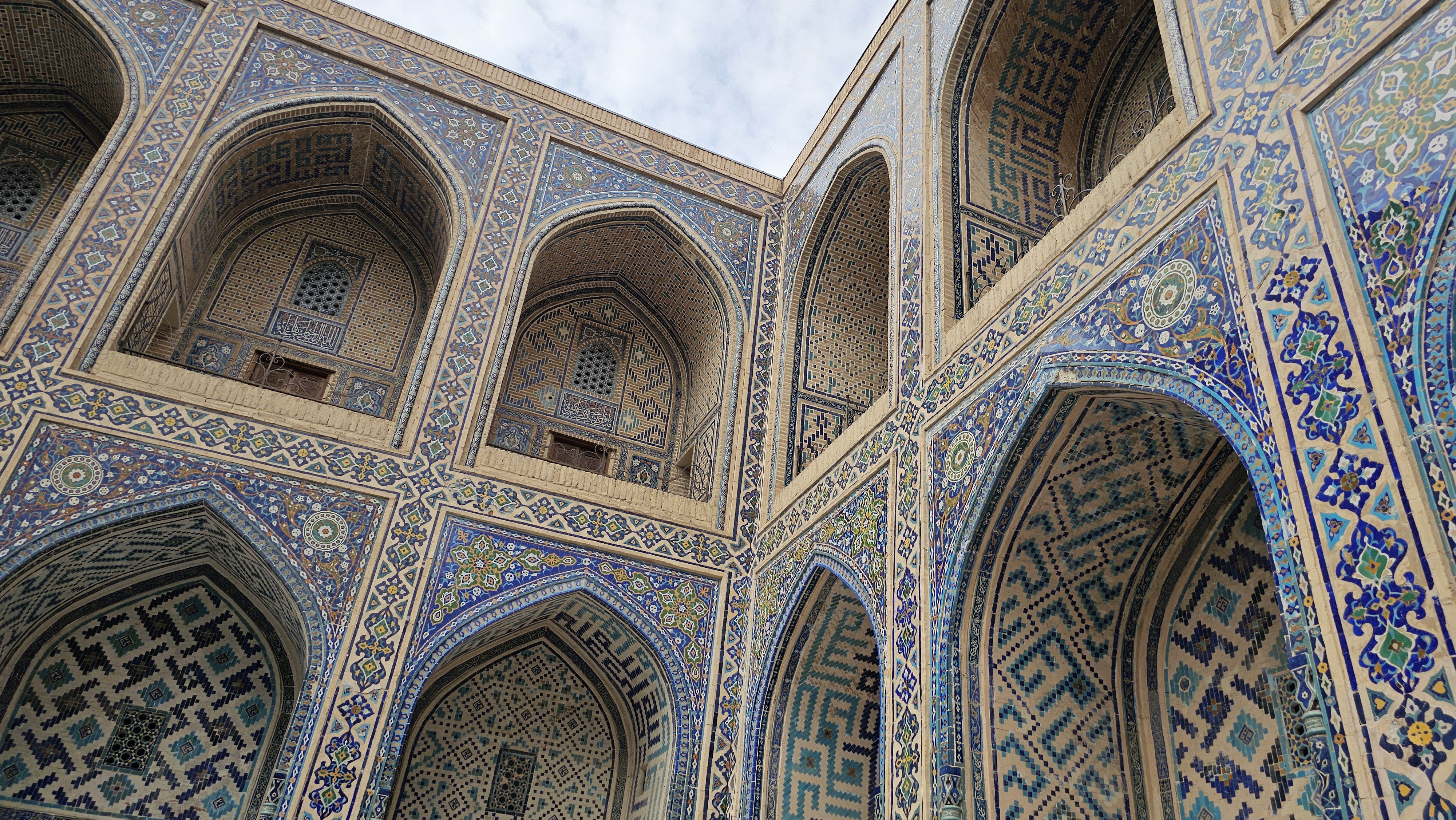
There is an inner courtyard which contains two stories of rooms where the students lived.
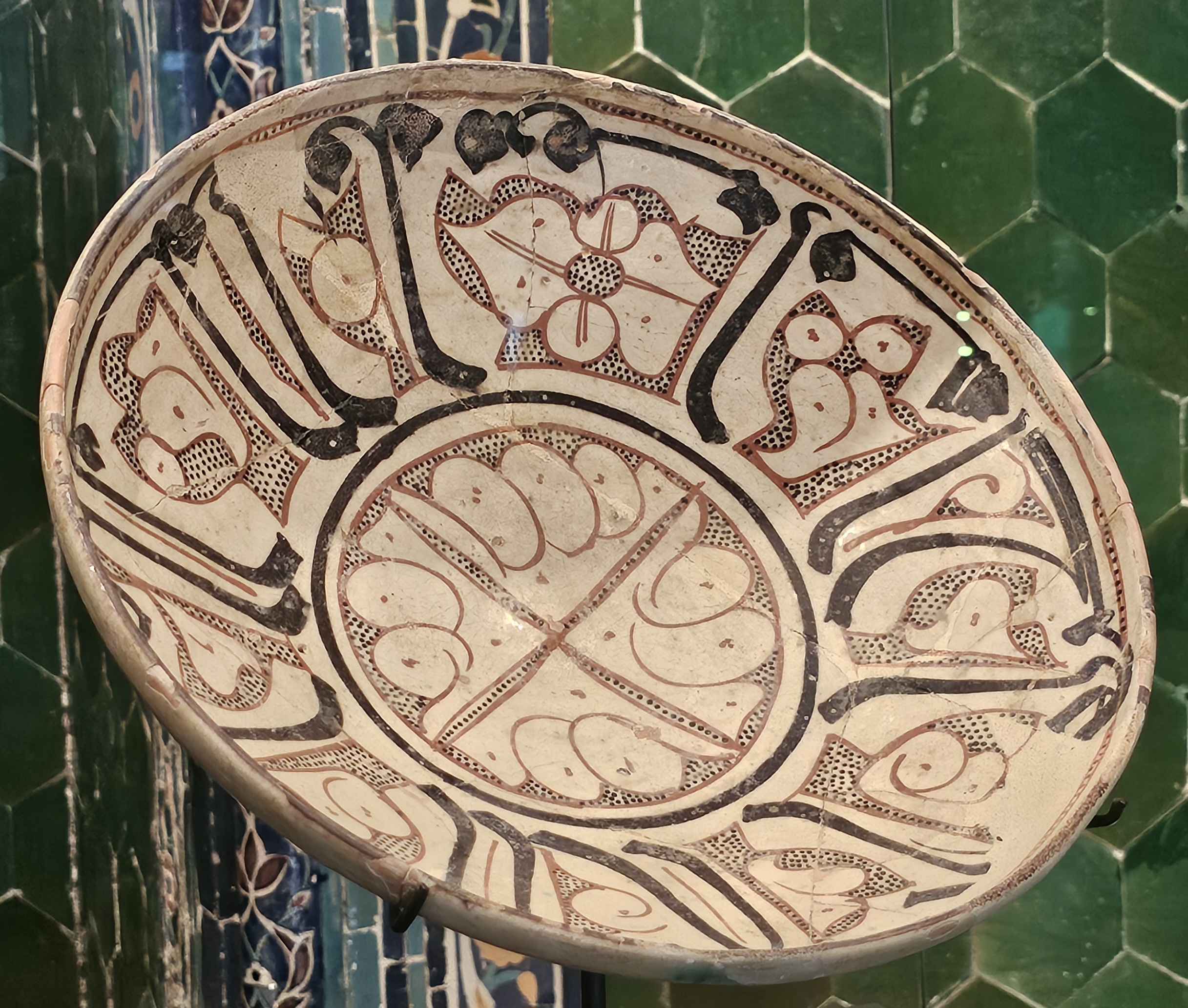
There is also interior museum dedicated to Samarkand’s golden age of science. The exhibition is housed inside the former classrooms and lecture halls where the astronomer-king himself once taught. The museum beautifully captures Ulugh Beg’s life work, displaying ancient astronomical instruments, complex mathematical charts, and early celestial maps that his team used to track the stars without telescopes. And a display of bowls!
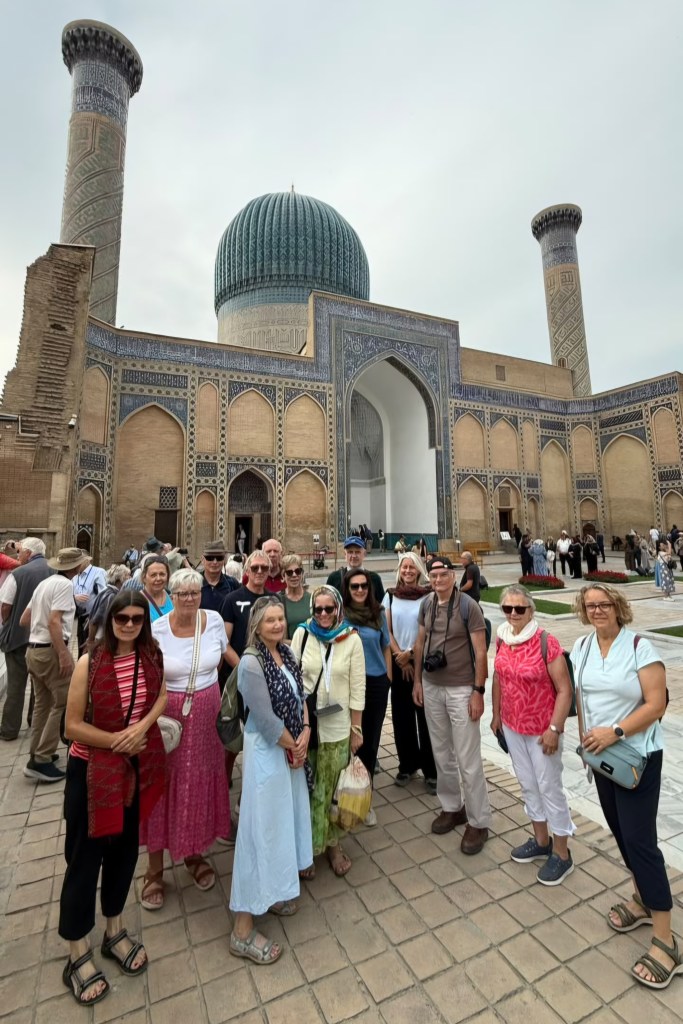
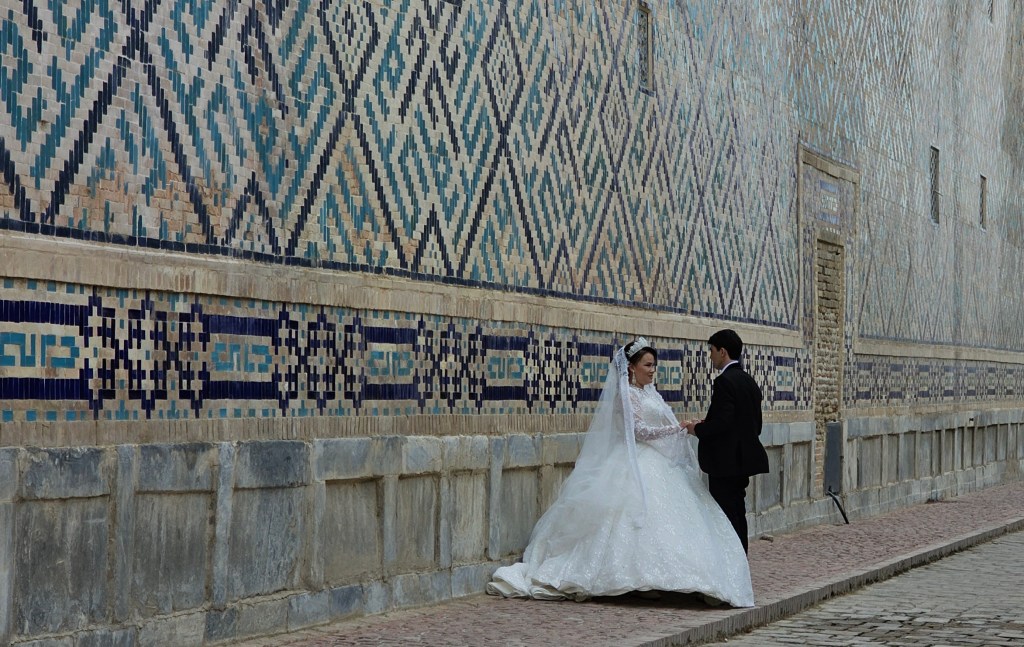
As we left the complex we saw a young couple having wedding photos being taken.
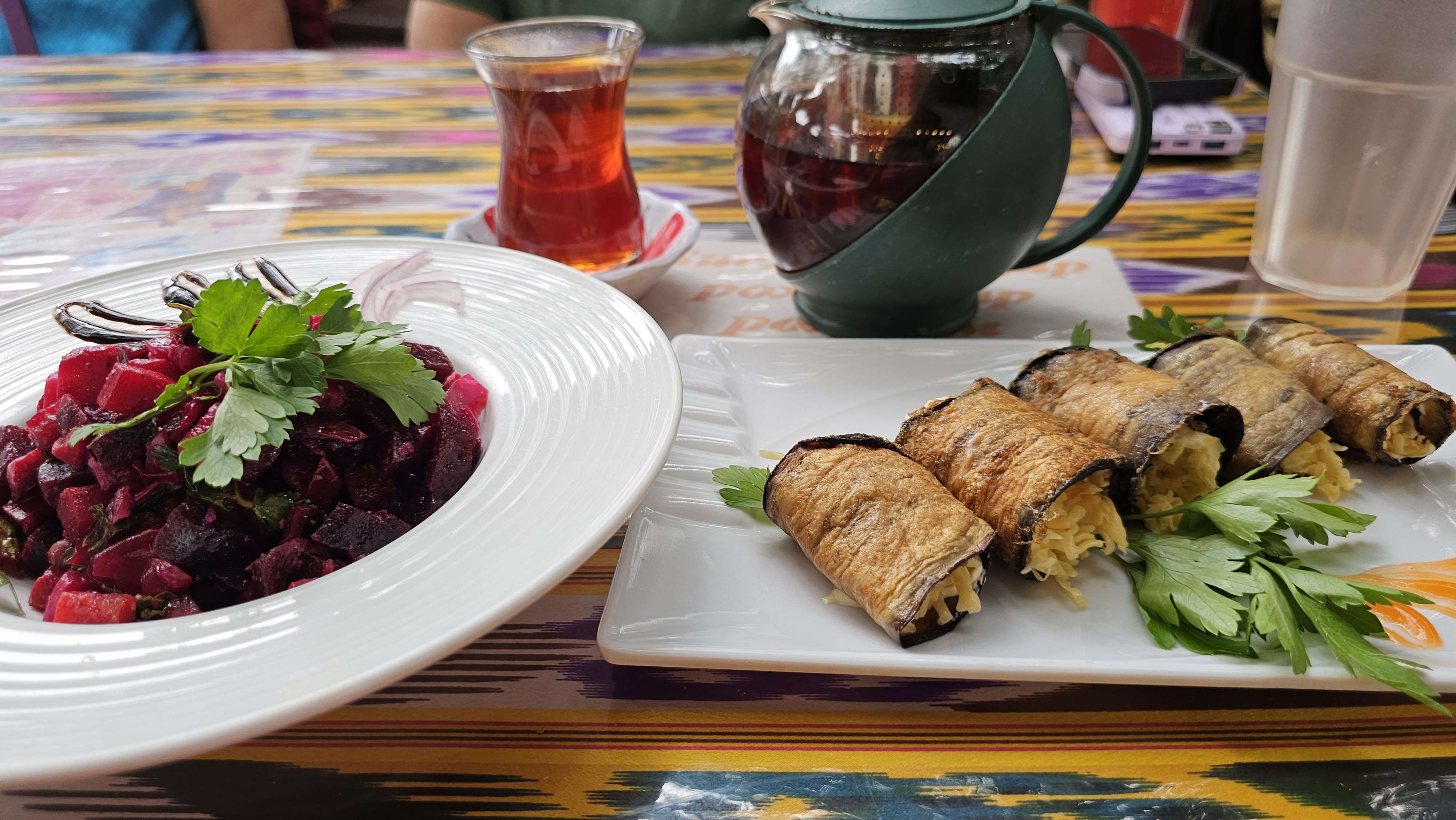
By now it was just after midday and before the restaurants got too busy we had a group lunch in the Bibikhanum Tea House. Today I had a pot of Turkish tea, a beetroot salad and a plate of aubergines which were wrapped around some grated cheese.
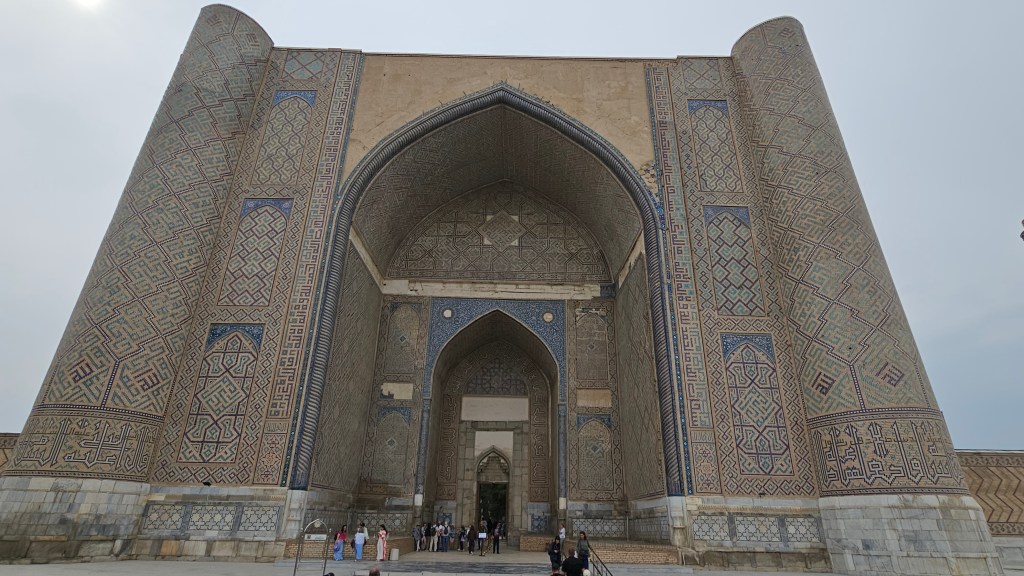
Bibi Khanim Mosque
After lunch we visited the towering ruins of the Bibi Khanim Mosque. Construction of this mosque began in 1399 and at the time it was the largest mosque in Central Asia with the capacity for more than 10,000 pilgrims. Sanjar explained that during its construction more than 90 elephants were brought in from India to transport large stone blocks.
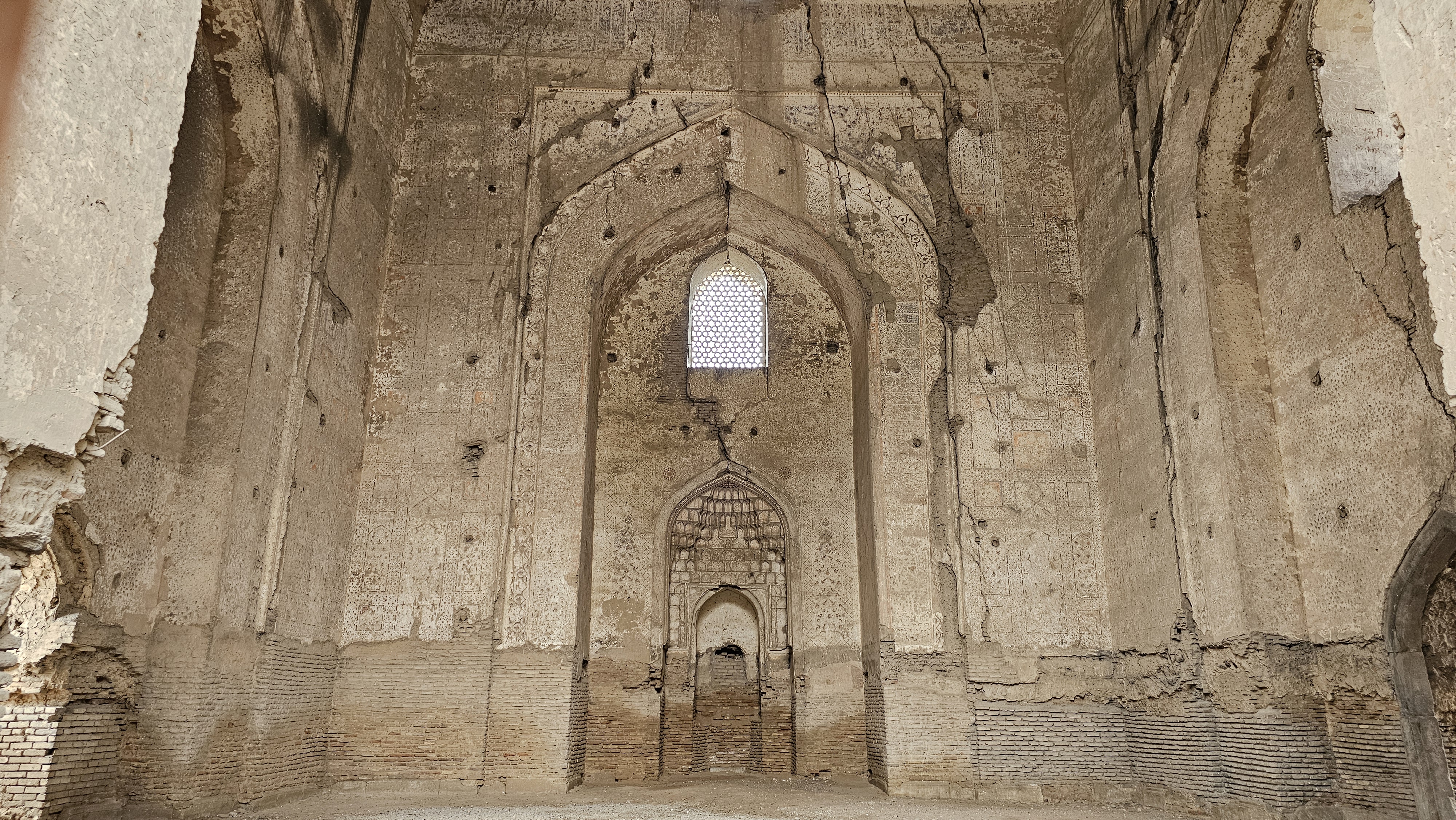
The mosque was commissioned by Amir Timur himself using the immense wealth and treasures he plundered during his successful military campaigns in India. Timur wanted to build a mosque that would push the absolute limits of 15th-century engineering.
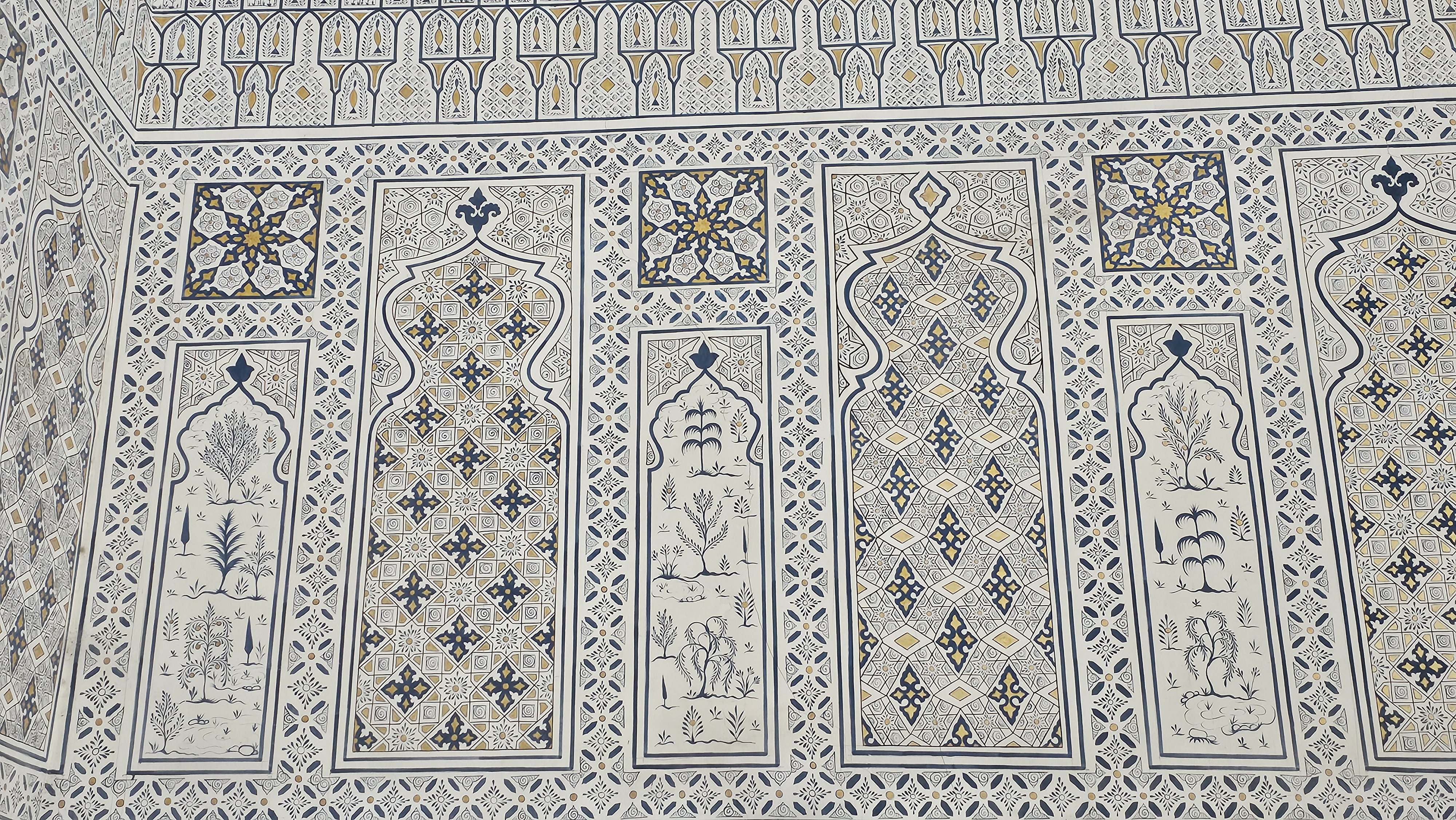
However, the mosque’s immense size was also its downfall. Because the architects built the towering walls too fast and used materials that couldn’t support the weight, structural stones began to crumble and rain down on worshippers during Friday prayers just years after it opened. Though heavily ruined by earthquakes over the centuries, recent restorations have brought its grand blue domes back to their imperial glory.
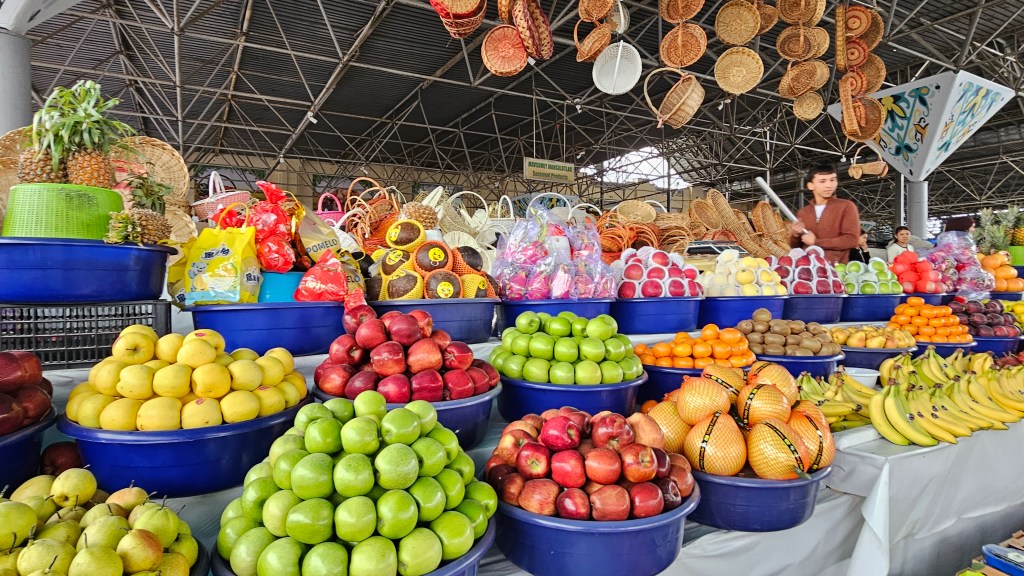
Siyob Bazaar
Next Sanjar took us to the nearby Siyob Bazaar, a large covered food market selling a range of fruit, vegetables, spices, nuts, sweets, souvenirs and suchlike.
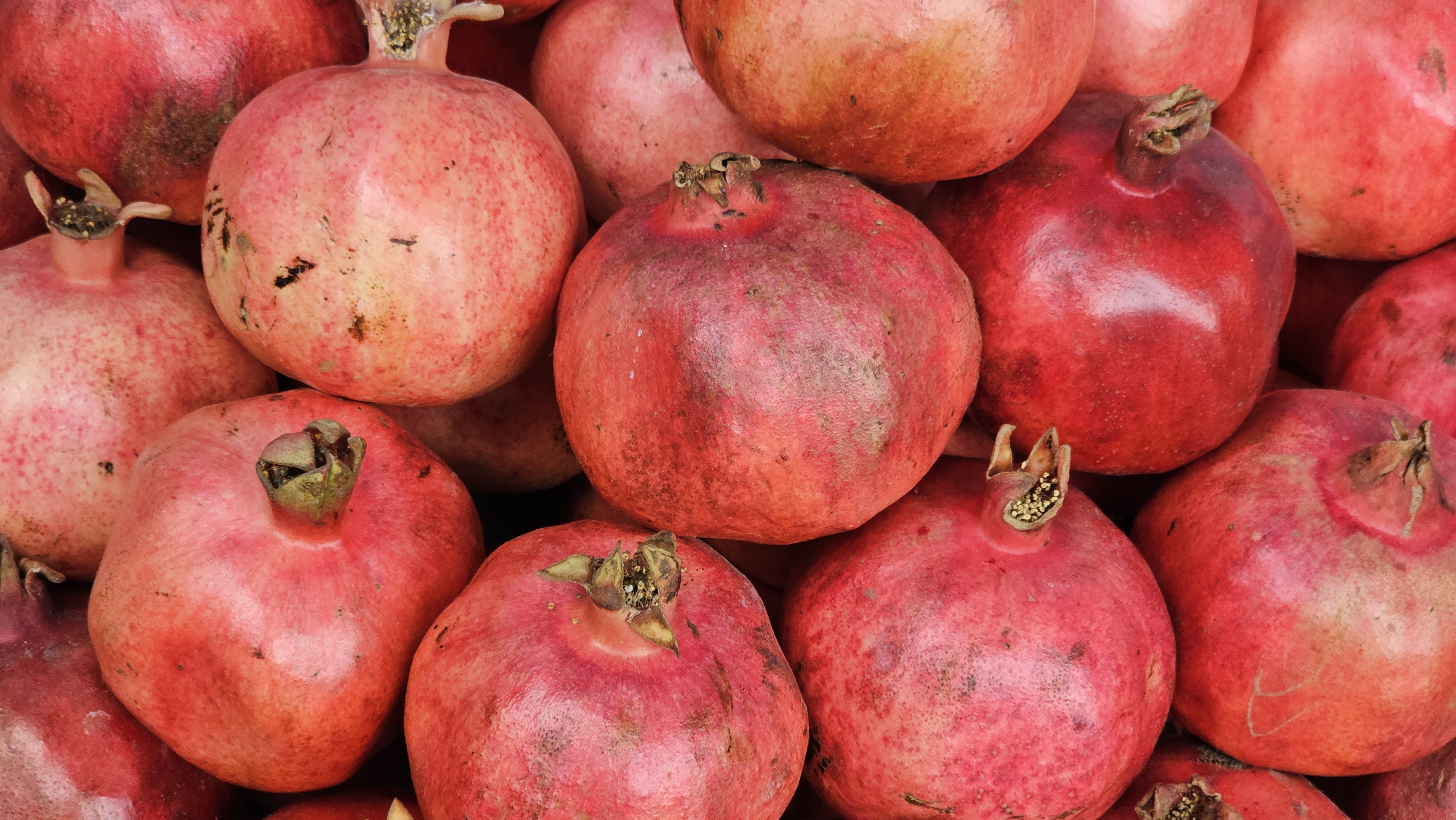
Known locally as ‘anor’ Uzbekistan produces some of the highest quality pomegranates in the world. At the market several stalls were selling freshly squeezed pomegranate juice.
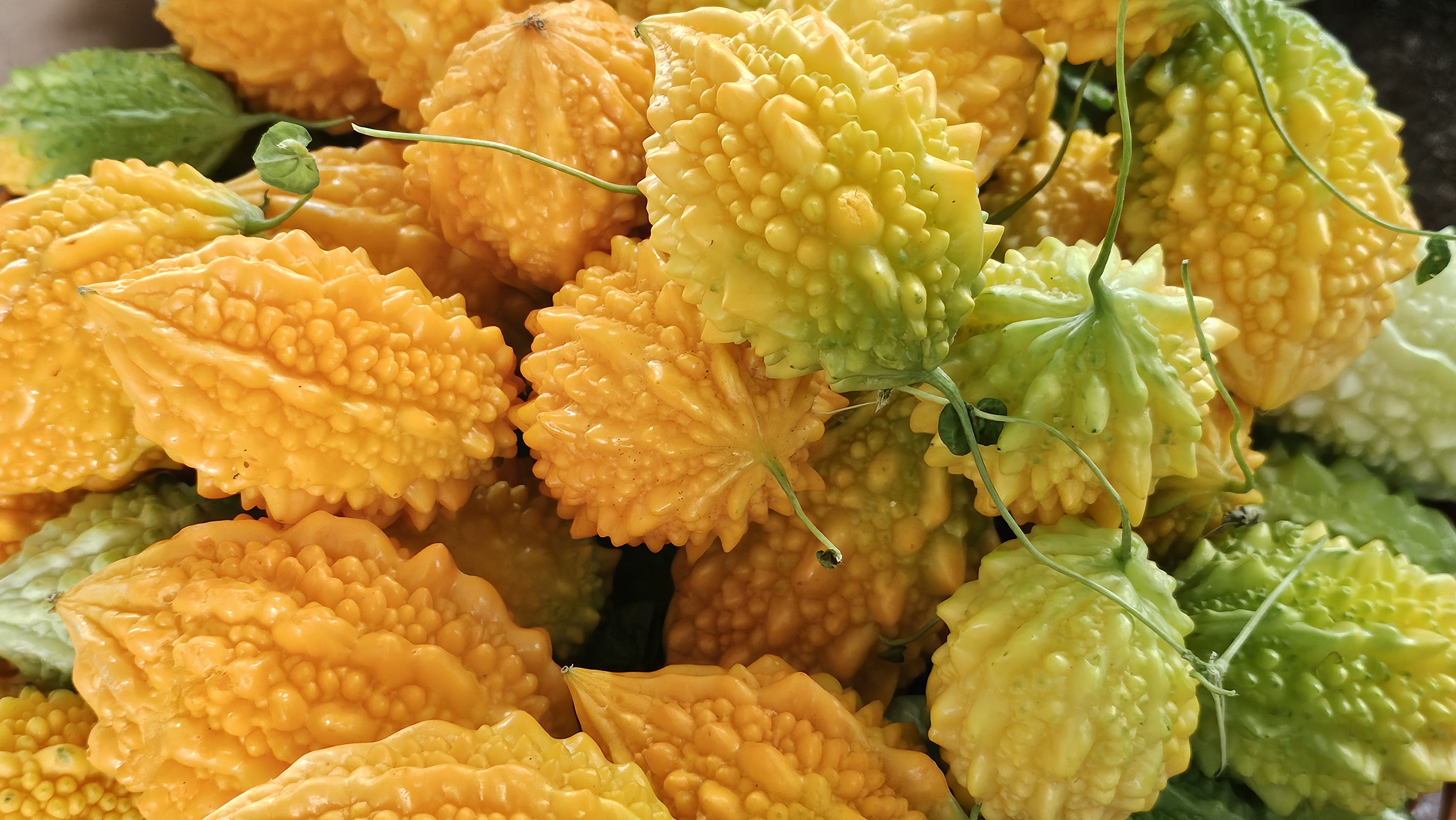
Over 160 varieties of melon have been cultivated in Uzbekistan for 2000 years. I had been enjoying both honeydew and water melon every morning for breakfast and it was the best. In the market we found some small knobbly orange, yellow and green melons which, Sanjar explained, are bitter melons that taste a bit like a meloney cucumber.
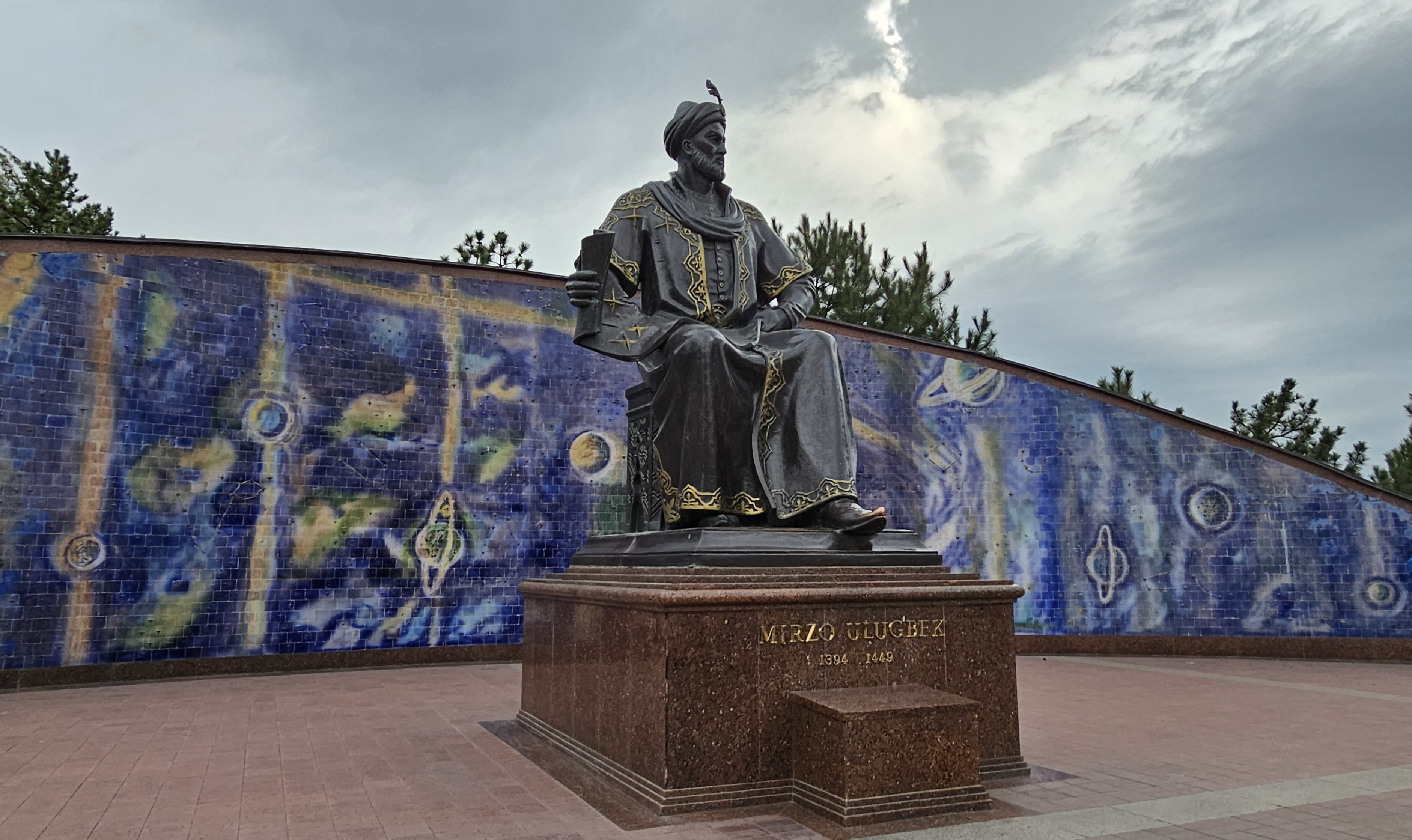
Ulug-Beg Observatory
From the market we boarded our bus and were taken to the Ulug-Beg Observatory which was built on a hill in Samarkand between 1428-29 to observe the sun, the moon and the night skies.
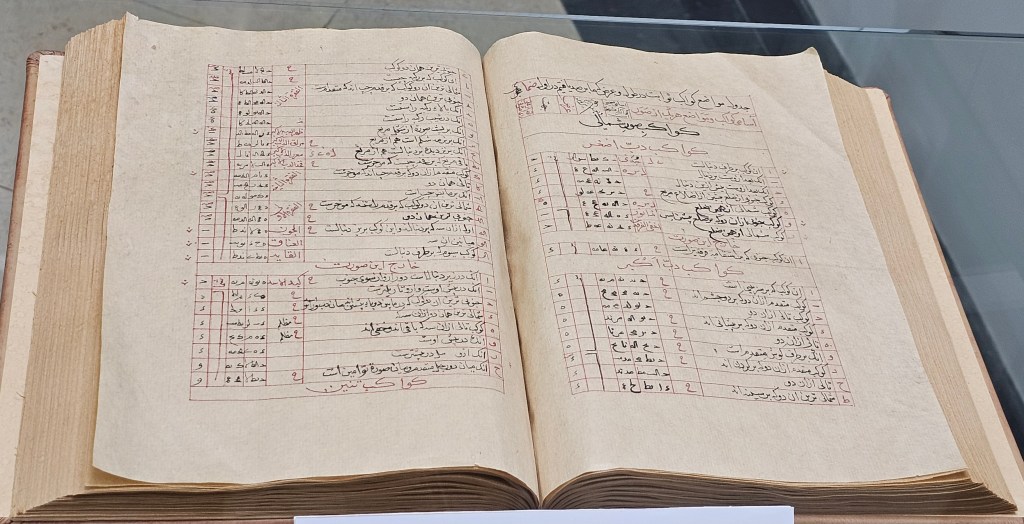
Grandson of the conqueror Amir Timur, Ulug-Beg was a medieval astronomer who built an enormous sextant, known as ‘the Starry tables of Ulug-Beg’. This catalogue enabled him to calculate the length of a year to within just 10 seconds. The telescope hadn’t yet been invented at this time.
We were fortunate to see the actual catalogue, the book, as shown in the above photo, on display. Titled: ‘the main scientific masterpiece of Ulugh Beg’ this book contains the co-ordinates of 1018 stars.
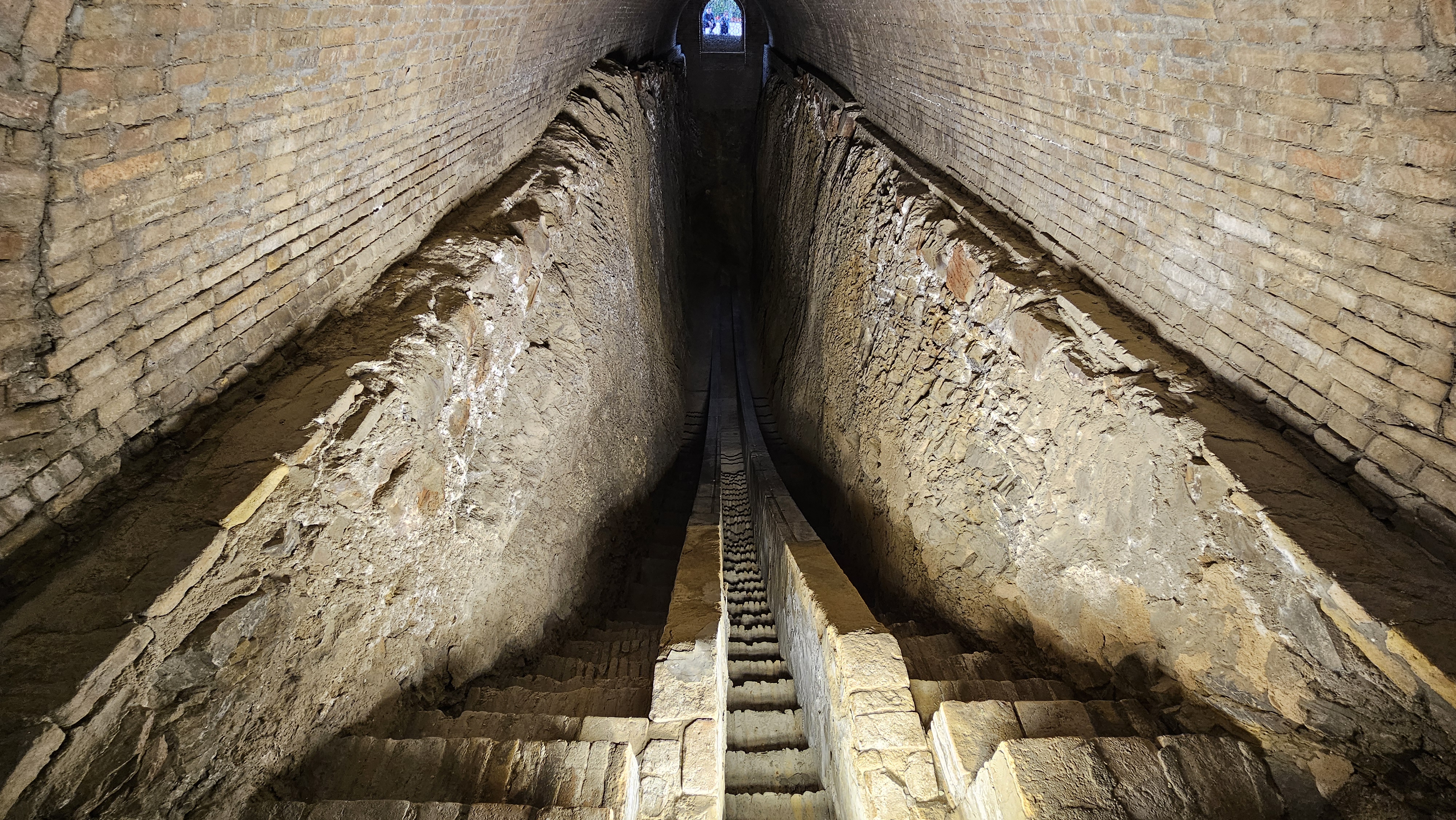
Following Ulug-Beg’s death, the observatory was destroyed and remained unknown for centuries until being discovered in 1908 by an archaeologist called Vasiliy Vyatkin. Only the underground part of the sextant had been preserved however documents revealed the original 3 story building to be a massive sphere.
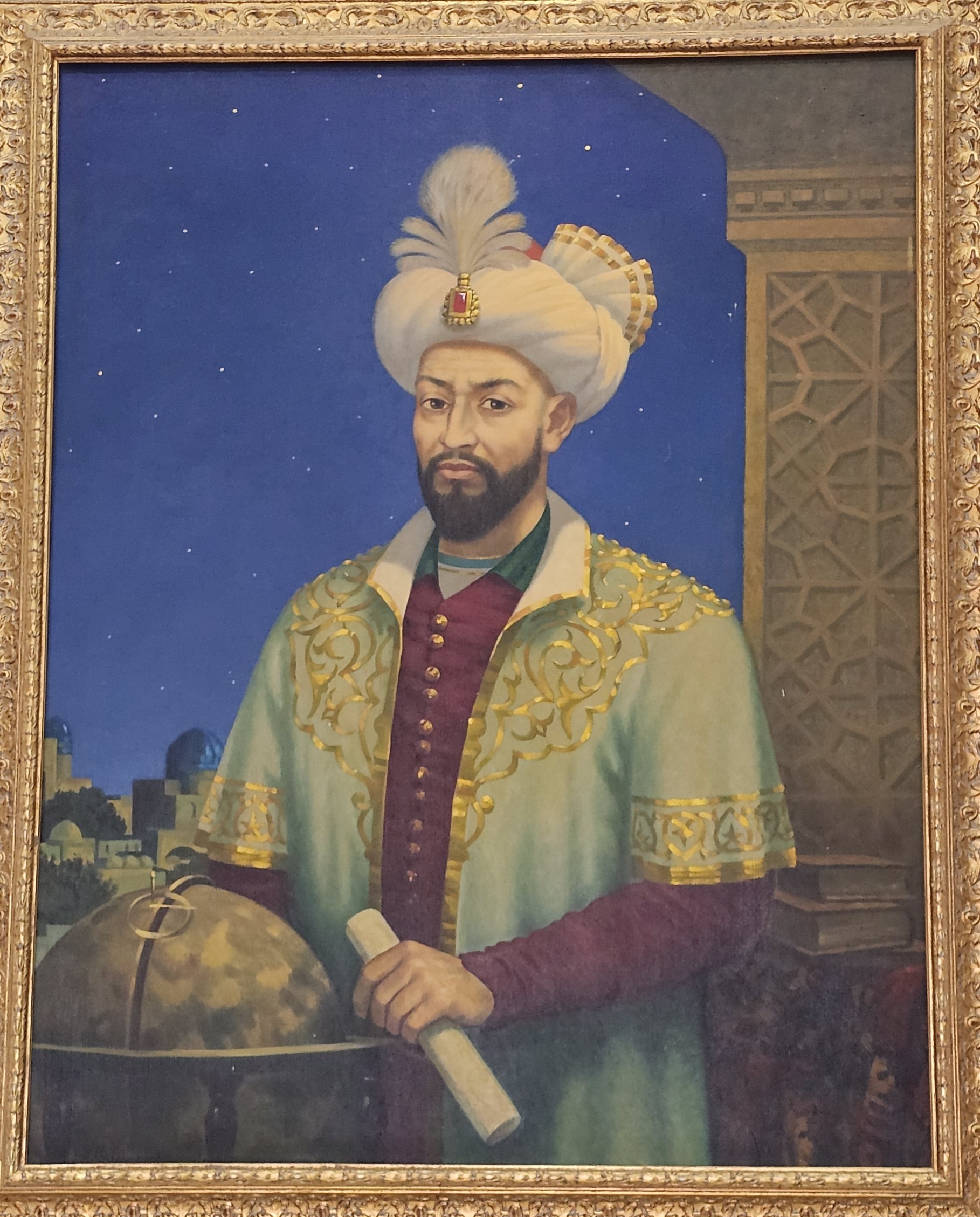
This observatory visit was such an interesting dynamic of our trip to Uzbekistan. It was fascinating to learn that this incredible structure was built so many centuries ago.
It reminded me of the visit I took with Chris to the Sacred Valley in Peru. It was interesting to compare the approaches made by completely different and completely isolated civilisations across history—like the Incas with their intricate astronomical calculations of the sun, and Ulugh Beg right here in Samarkand doing the exact same thing for the stars.
Shakhi-Zinda Complex
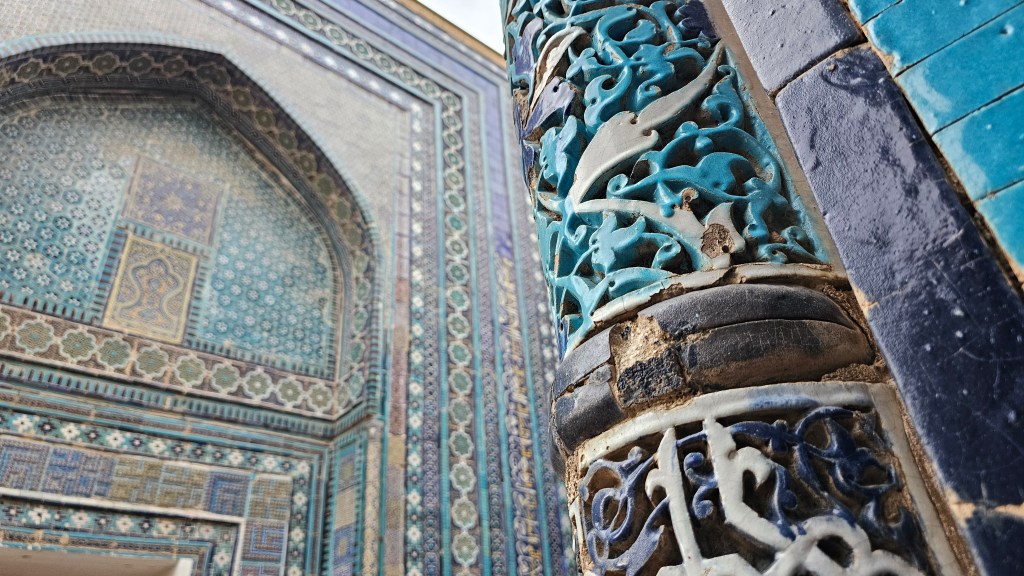
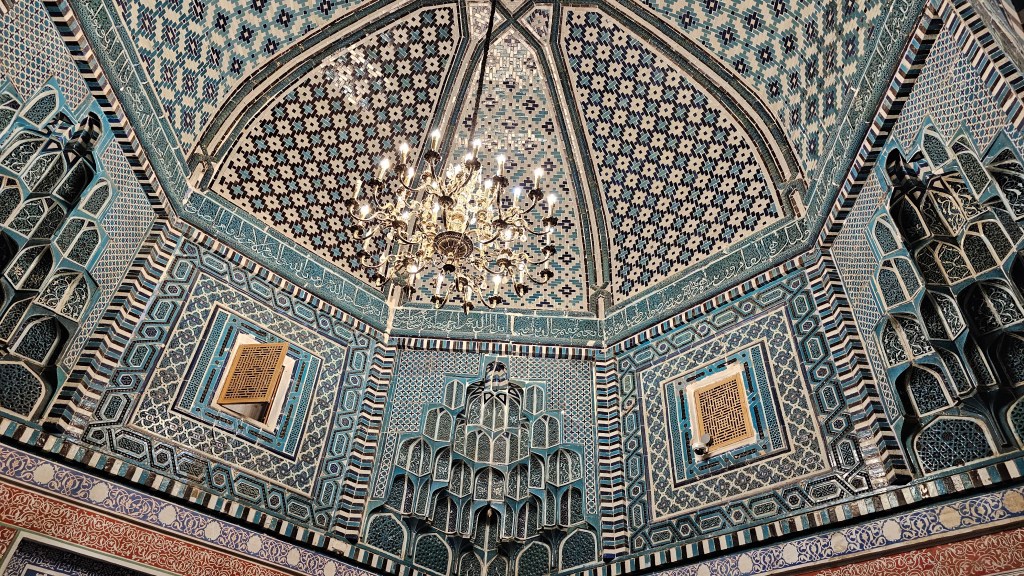
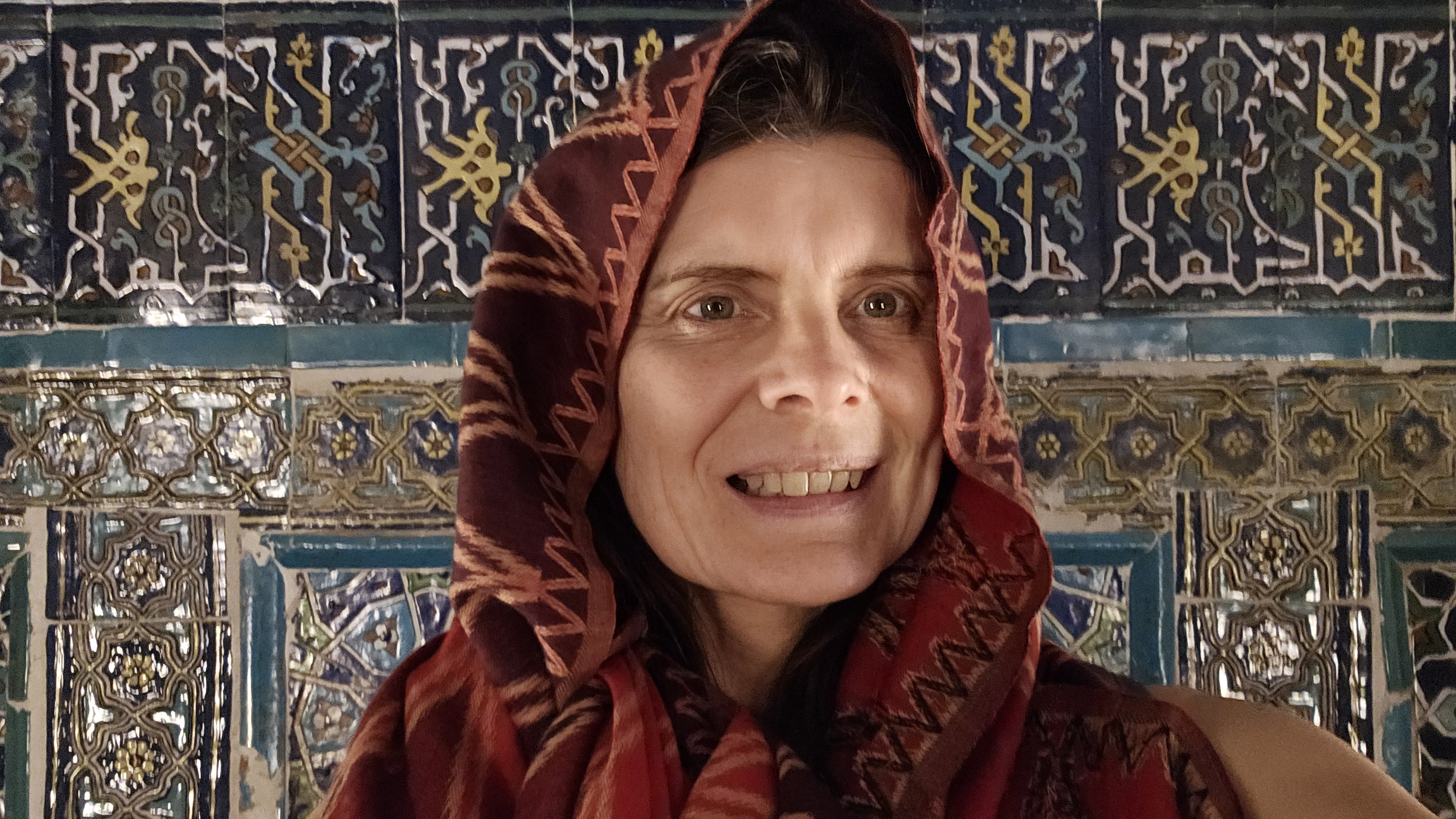
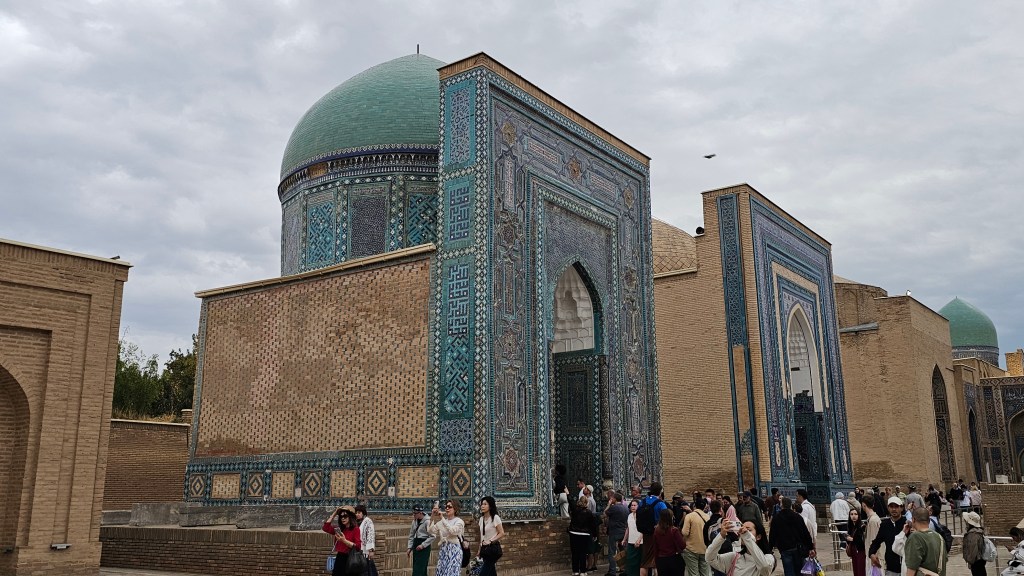
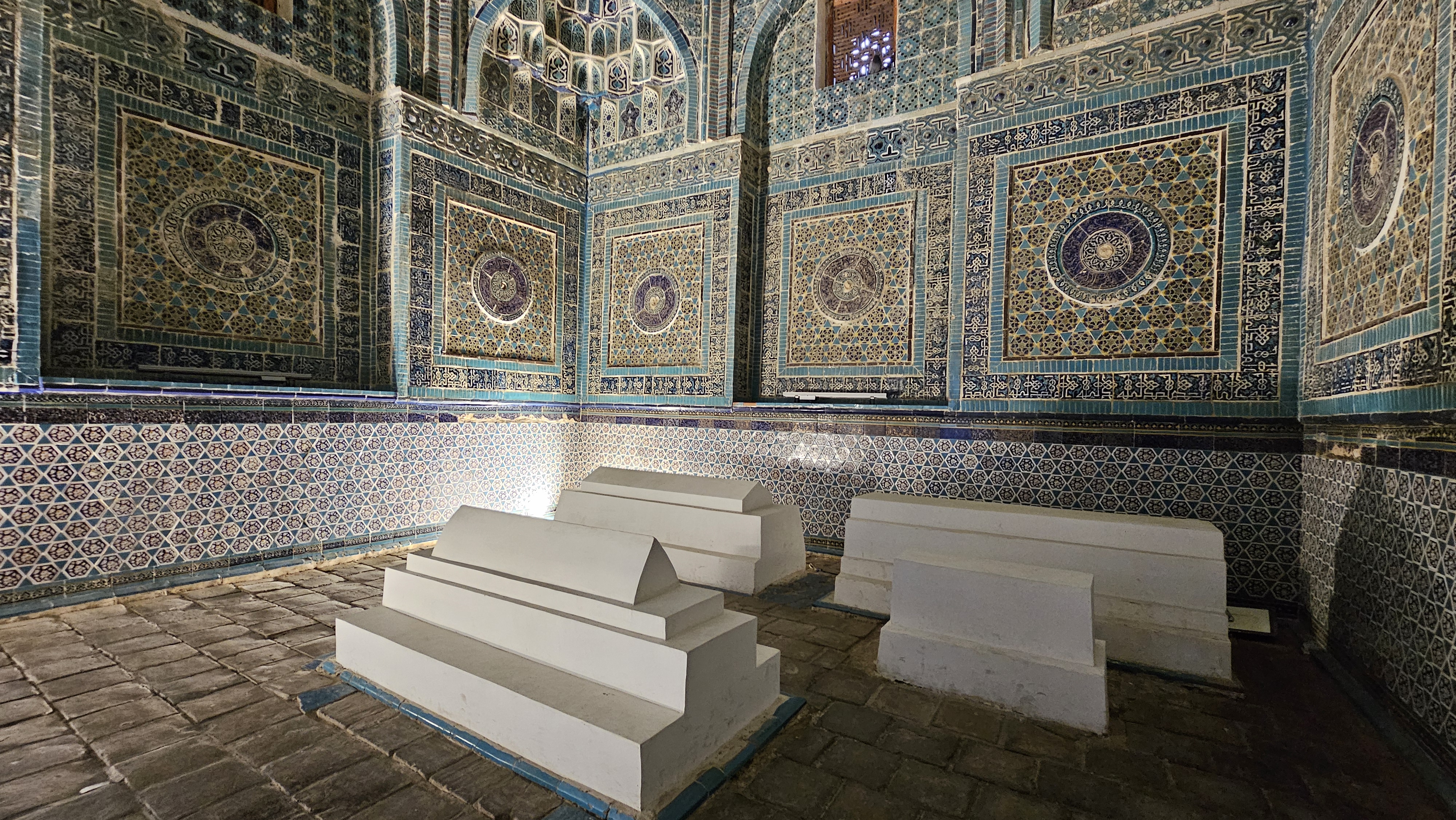
Our final stop in Samarkand was Shah-i-Zinda, which translates to “The Living King.” This is not just a single monument; it is a stunning, narrow avenue of over twenty breathtaking mausoleums and ritual buildings built along a hillside street. Walking up the historic stone steps, you are immediately surrounded by a dazzling labyrinth of deep blues, vibrant turquoises, and intricate geometric tiles.
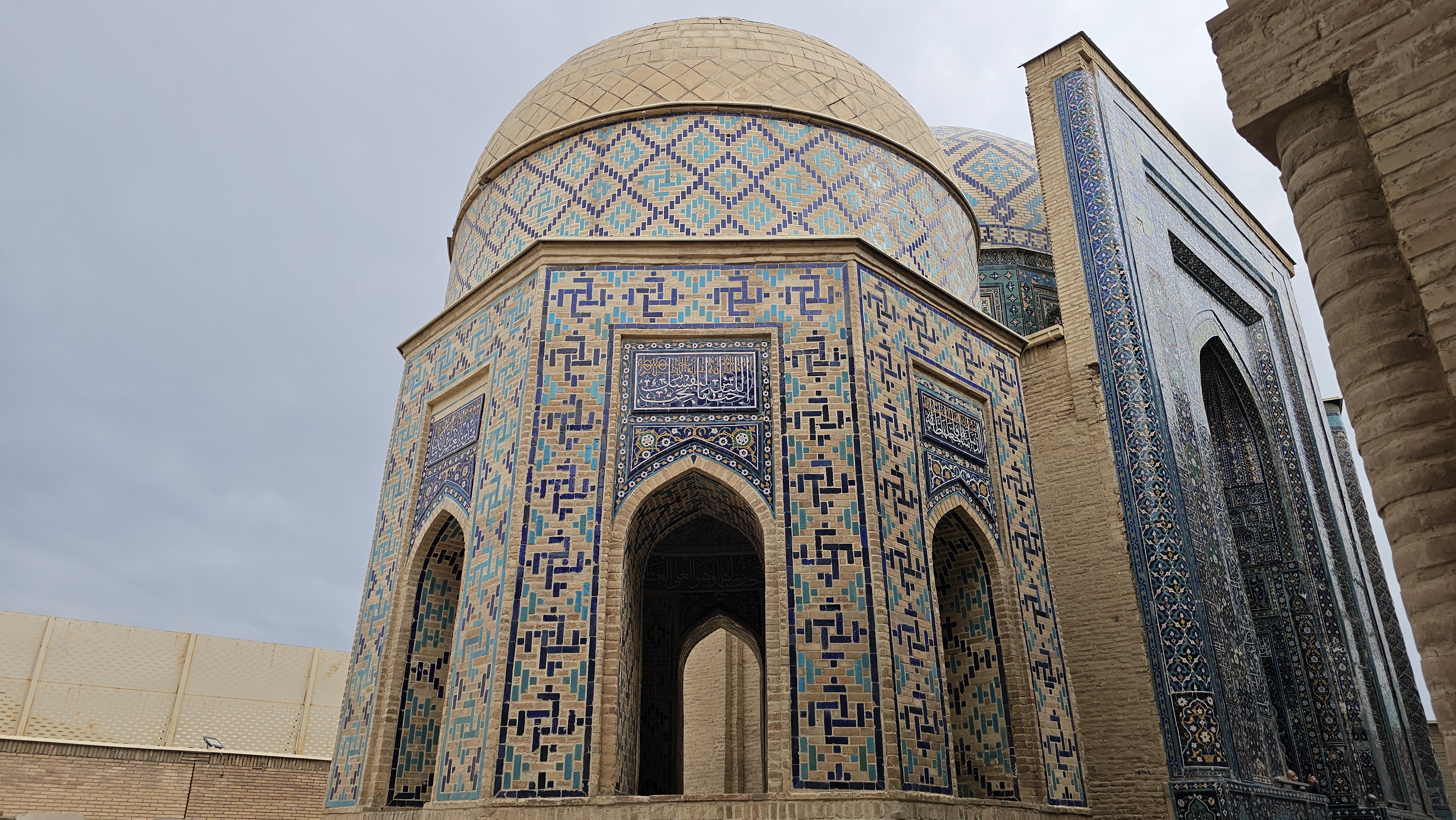
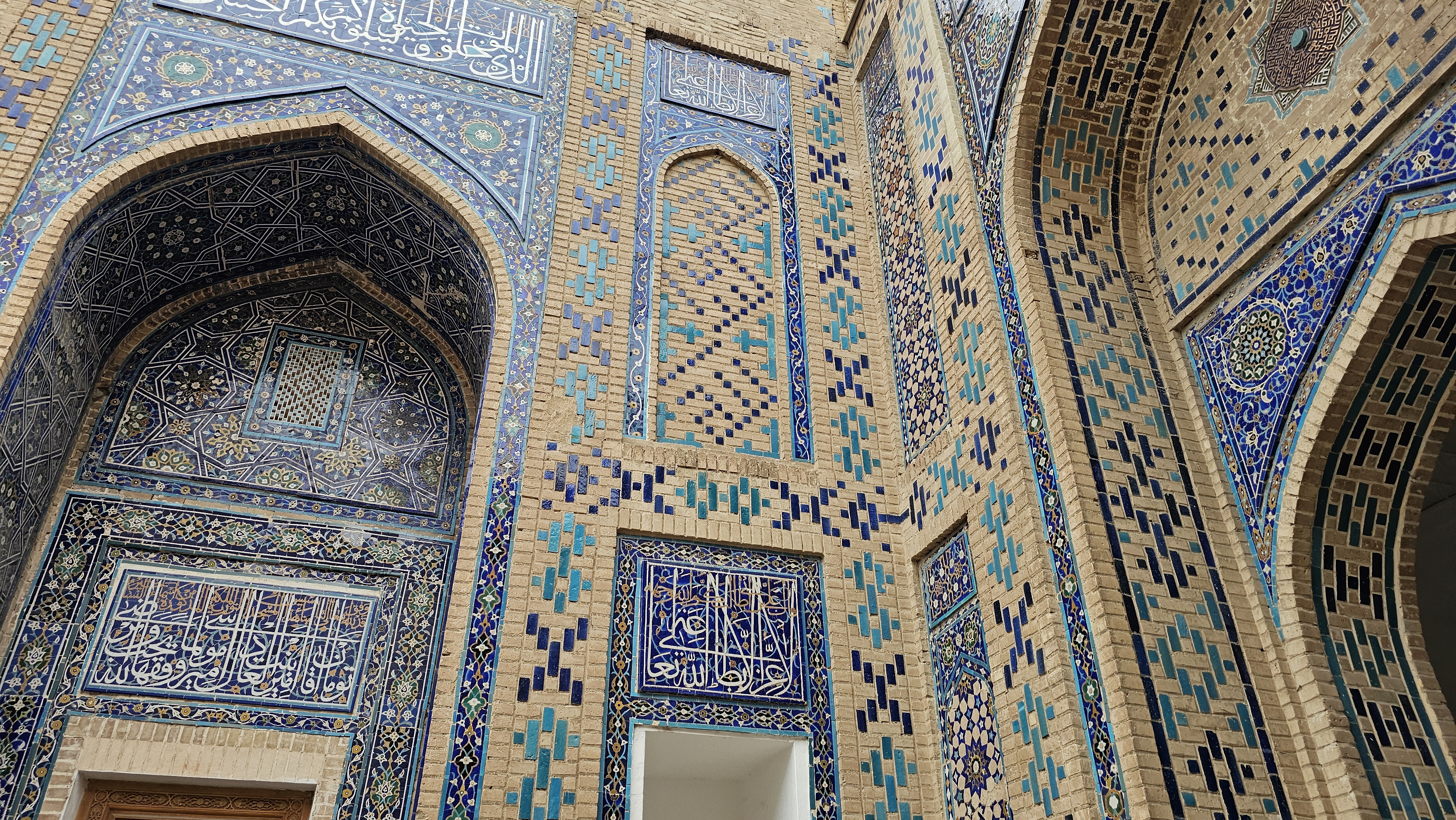
The site is deeply sacred. At the very top of the avenue lies the tomb of Kusam ibn Abbas, a cousin of the Prophet Muhammad who brought Islam to the region in the 7th century. Legend says he was attacked by pagans while praying but escaped into a well, where he still lives today—giving the complex its name.
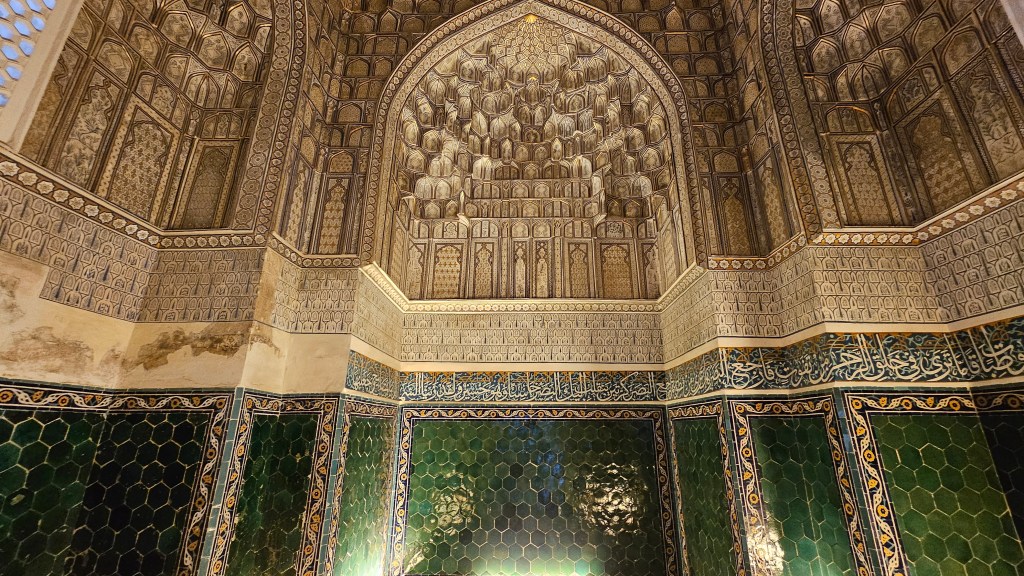
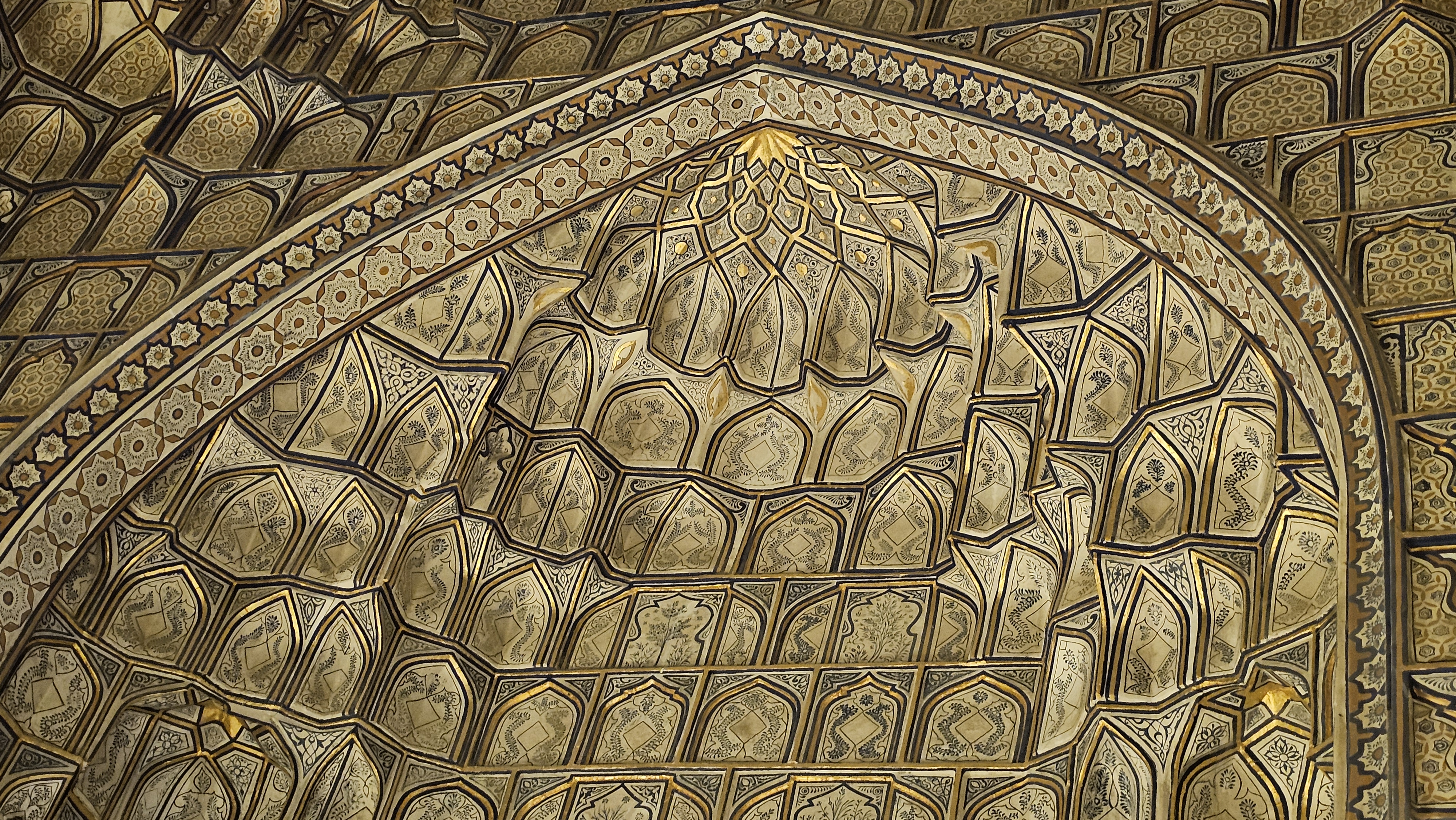
Between the 14th and 15th centuries, Amir Timur and his successors chose this holy hillside to build spectacular tombs for their female family members, favourite generals, and close nobility. Because each structure was built by a different master craftsman trying to outdo the last, Shah-i-Zinda functions as a living laboratory of Silk Road tile art. Every corner you turn reveals a more intricate patterns, making it one of the most visually stunning and photogenic spots in all of Central Asia.
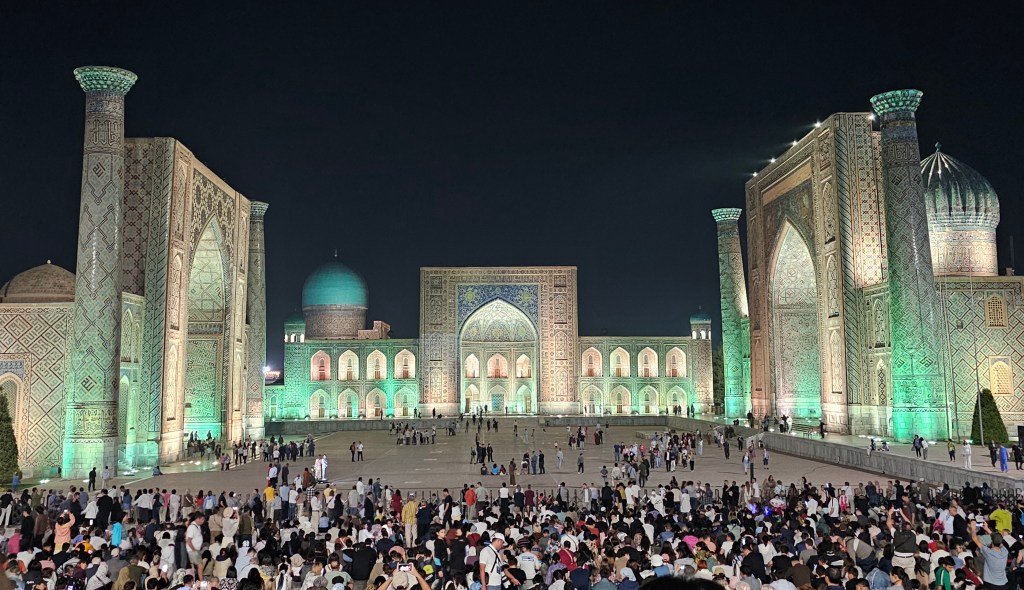
Samarkand by night
On certain nights at 9:00 pm, a spectacular light show illuminates Registan Square, and we were lucky that it coincided with our stay in Samarkand. A small sub-group of about seven of us headed over around 8:45 pm, finding a lively crowd already gathering in eager anticipation of the performance.
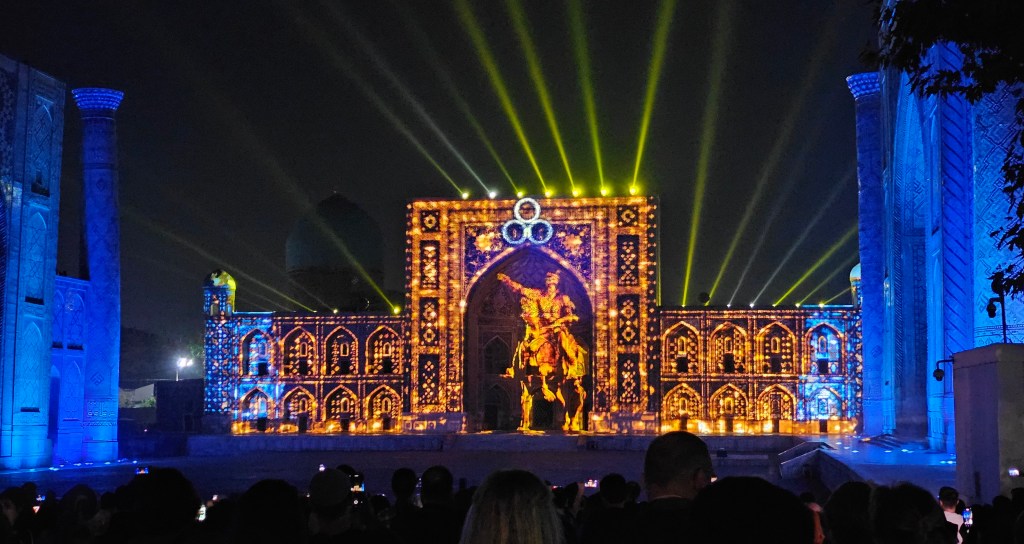
The Tilla-Kari Madrasa was the focal point and the 20 minute show took us through the fascinating history of Samarkand and the Silk Road from ancient times to present day. There was loud music and a running commentary coming from loud speakers but unfortunately we were not able to understand any of it. Thanks to the knowledge shared by Sanjar throughout the trip the visual aspect of the light show was meaningful.
Against the backdrop of the enormous madrasa the show was quite spectacular! Above is a short video clip.
Free time
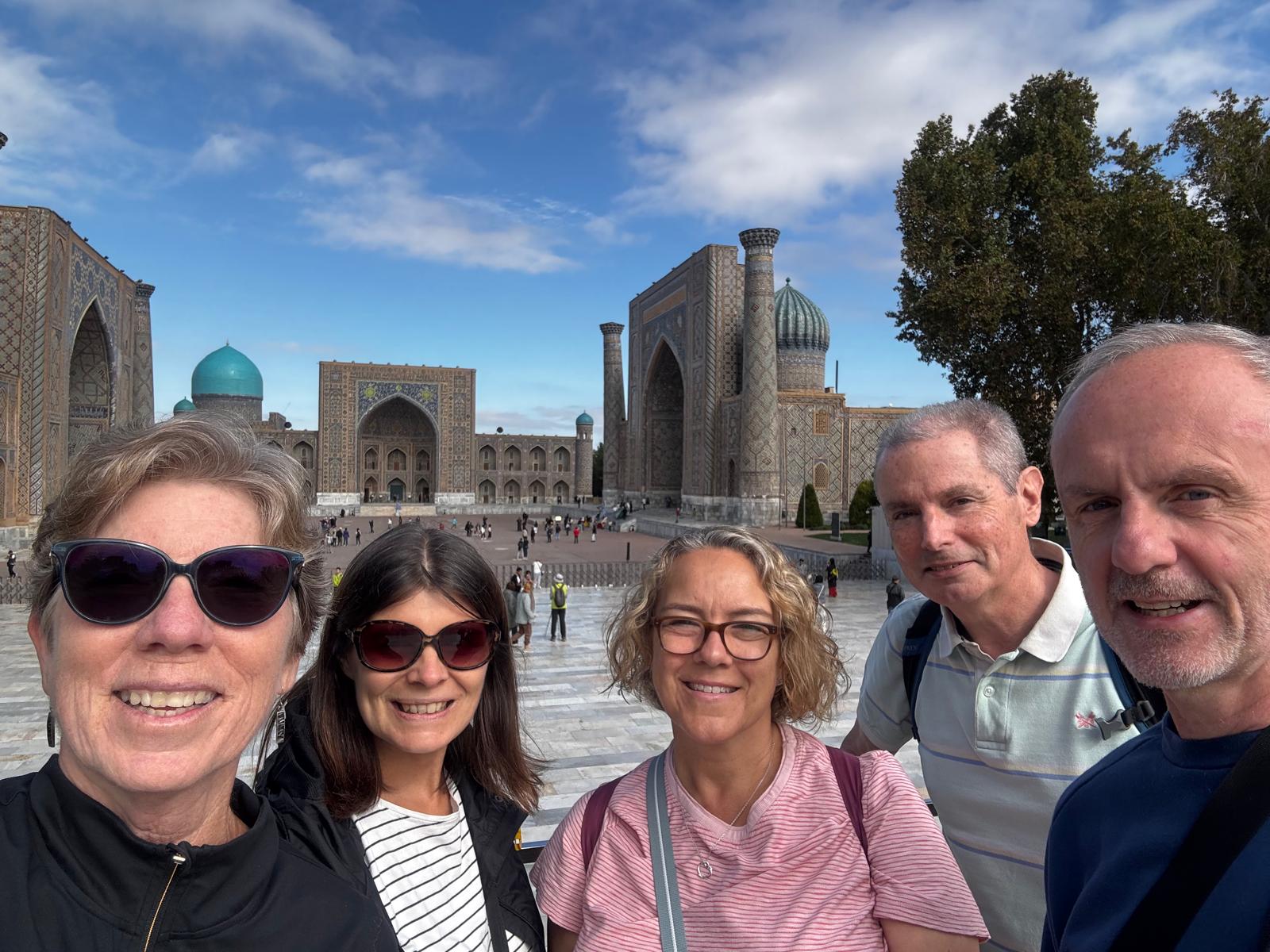
With our group transfer back to Tashkent booked for 5:00 pm, we had most of our second day in Samarkand to spend as we wished. By this point in the trip, Bridget, Marv, Richard, Dave, and I had become an established little gang. After breakfast, the five of us set off together for a relaxed, unstructured Samarkand walkabout to soak in our final hours in the city.
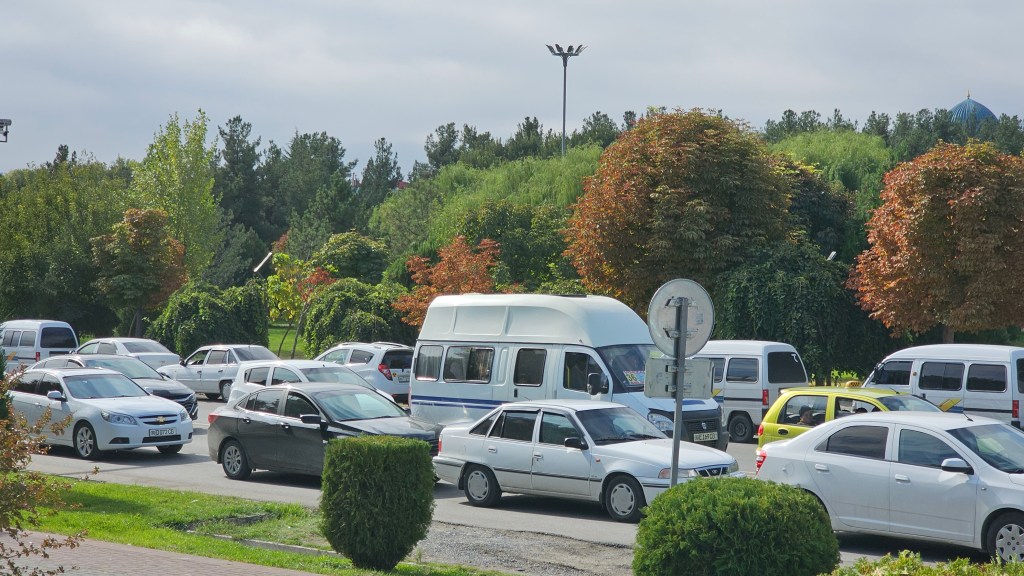
Earlier in the trip Sanjar had explained that around 90% of the traffic in Uzbekistan is white. There is a mix of geography, economics and practical design behind this!
- The Desert Heat: Summer temperatures here regularly skyrocket past 40°C (104°F) and white vehicles deflect the sun.
- The Camouflage: Central Asian desert dust is incredibly fine and light-coloured and thus blends in on a white car.
- The Factory Monopoly: For decades, high import tariffs meant locals bought domestically produced cars. General Motors teamed up with the state to build Chevrolets locally, cornering nearly the entire market. White was the cheapest, fastest option off the assembly line, creating a massive self-reinforcing resale loop that continues today!
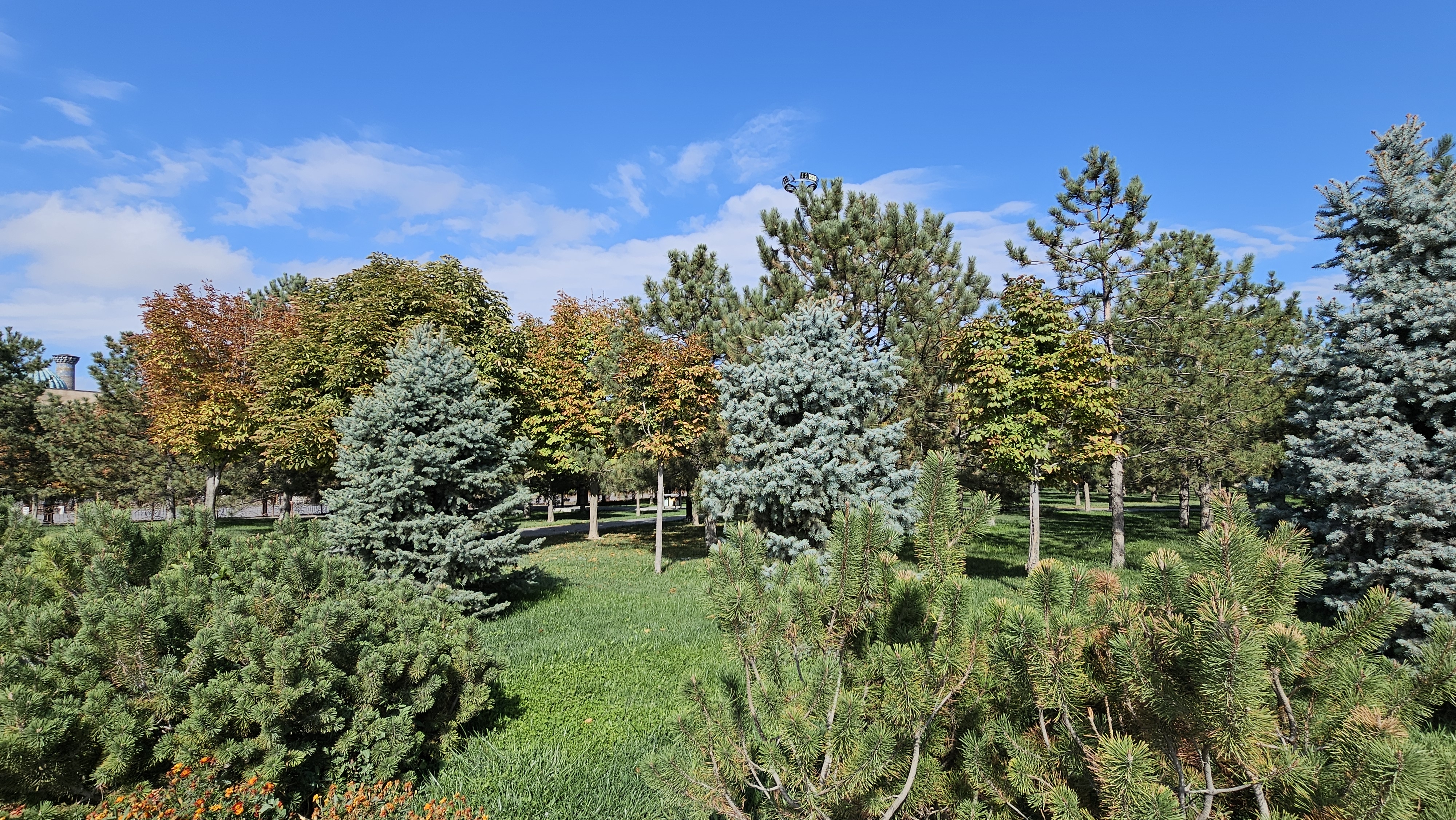
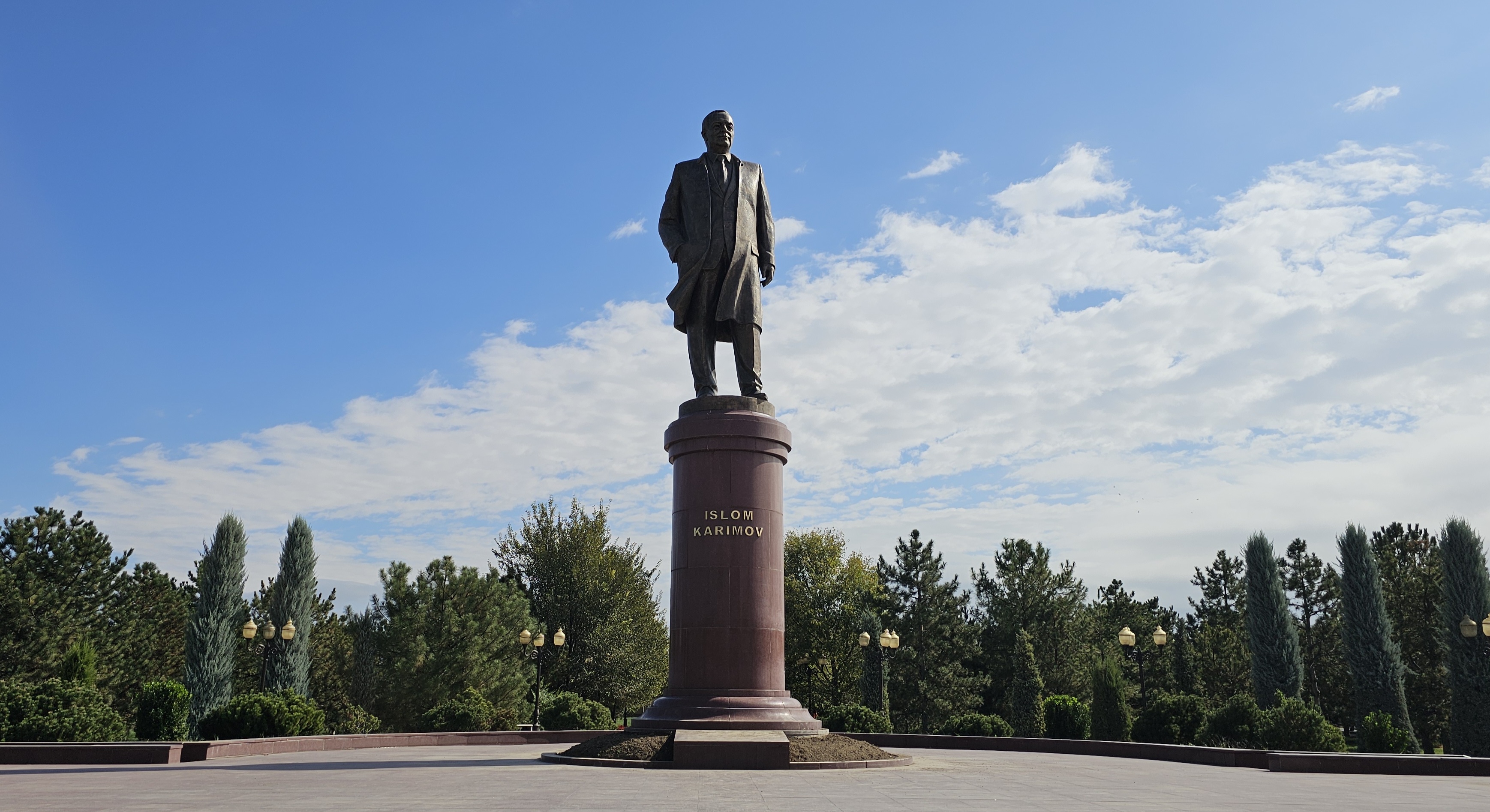
Just a short stroll from our explorations around the old town, we crossed the wide pedestrian avenue to visit the Islam Karimov Memorial Statue. Unveiled in September 2017, this grand monument is dedicated to the first president of independent Uzbekistan, who ruled the country for 25 years following the collapse of the Soviet Union until his death in 2016.
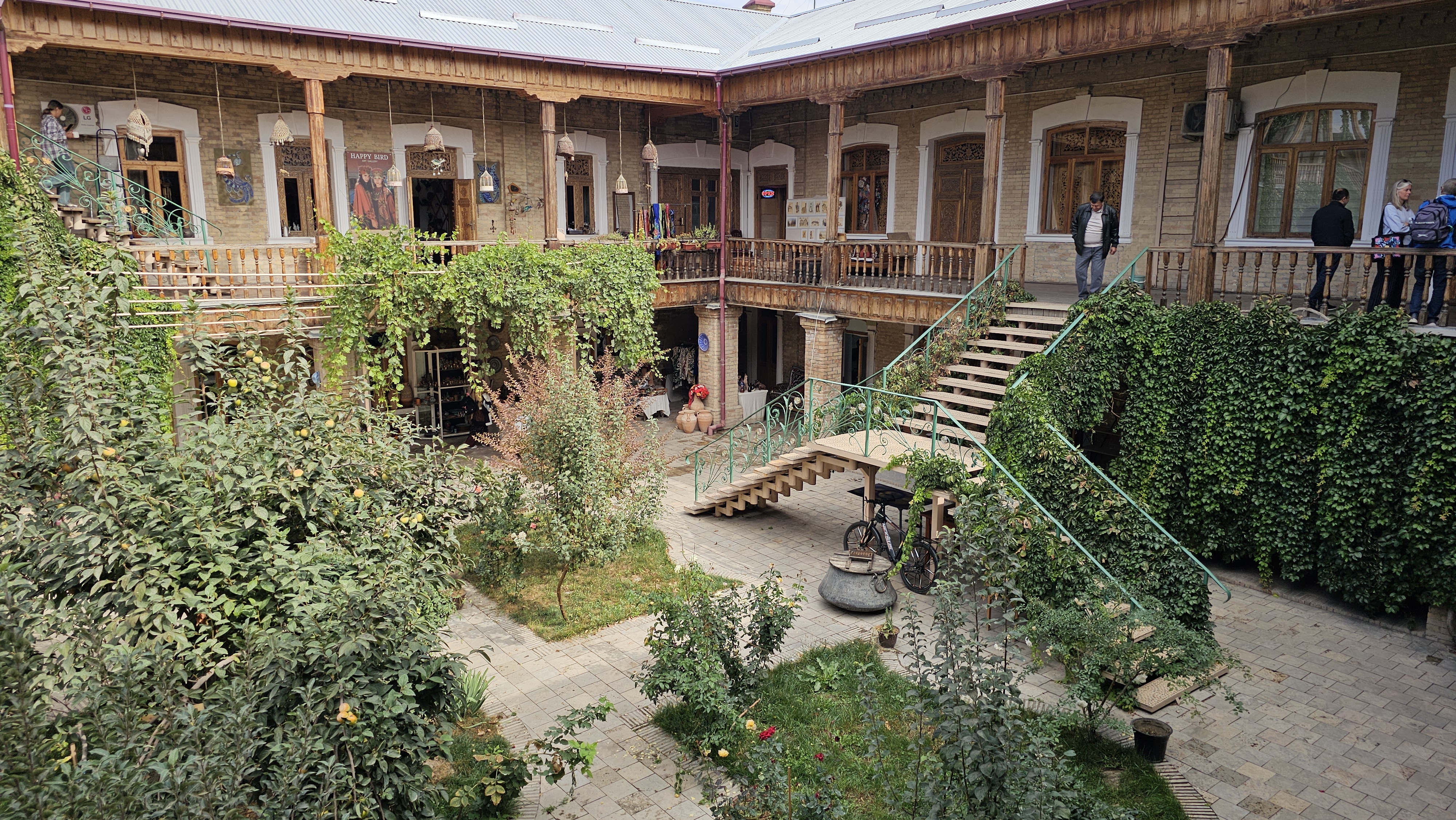
Art Gallery Happy Bird
Based in a historic caravanserai (an ancient roadside inn that was once a secure stopping place for Silk Road traders) is the ‘Art Gallery Happy Bird’ where high quality arts and textiles can be found.
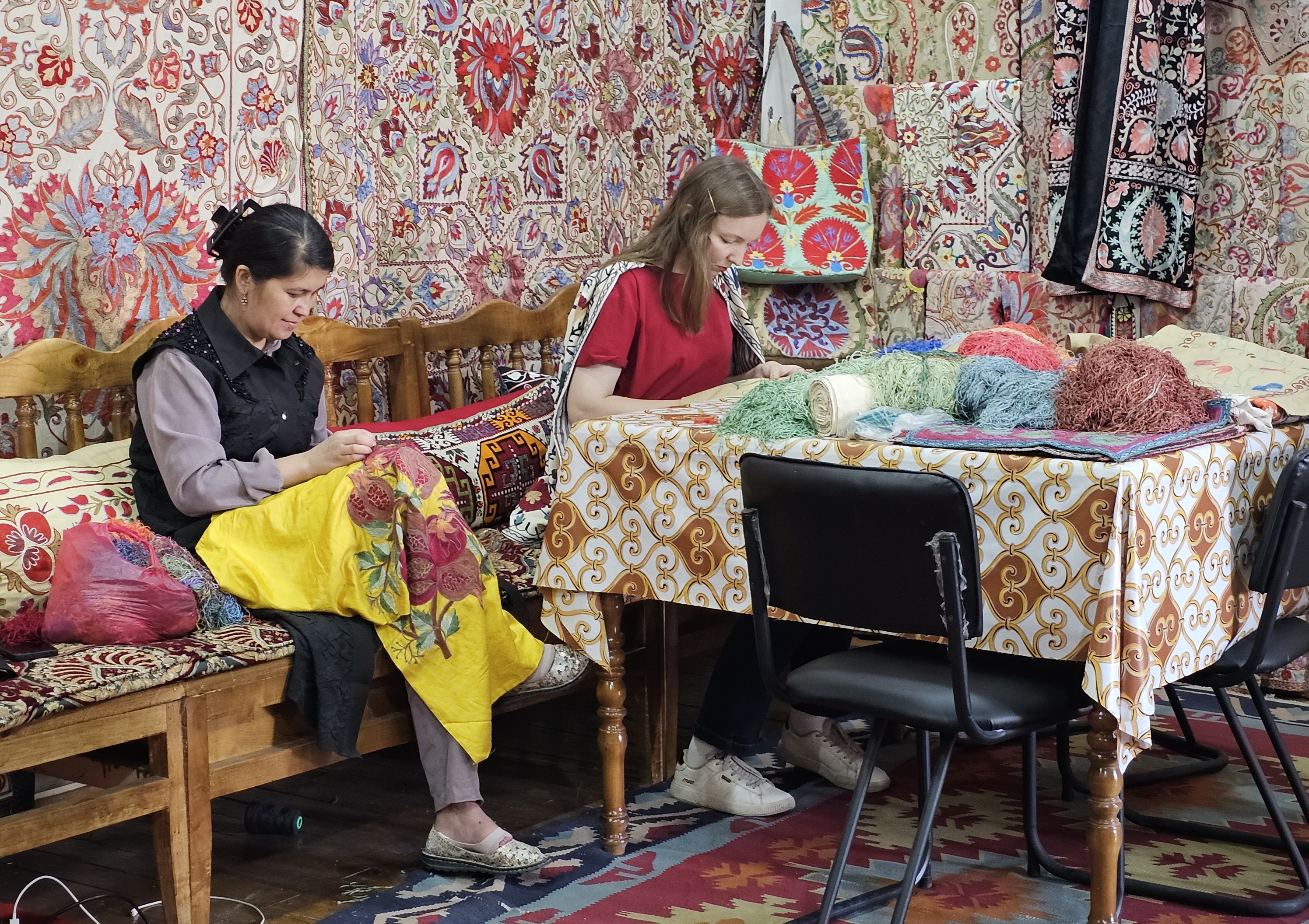
While Richard and Dave waited patiently outside, Bridget, Marv, and I had an enjoyable browse inside several of the shops, appreciating the incredible skill and countless hours of work that went into each unique bag or cushion cover or hand painted picture.
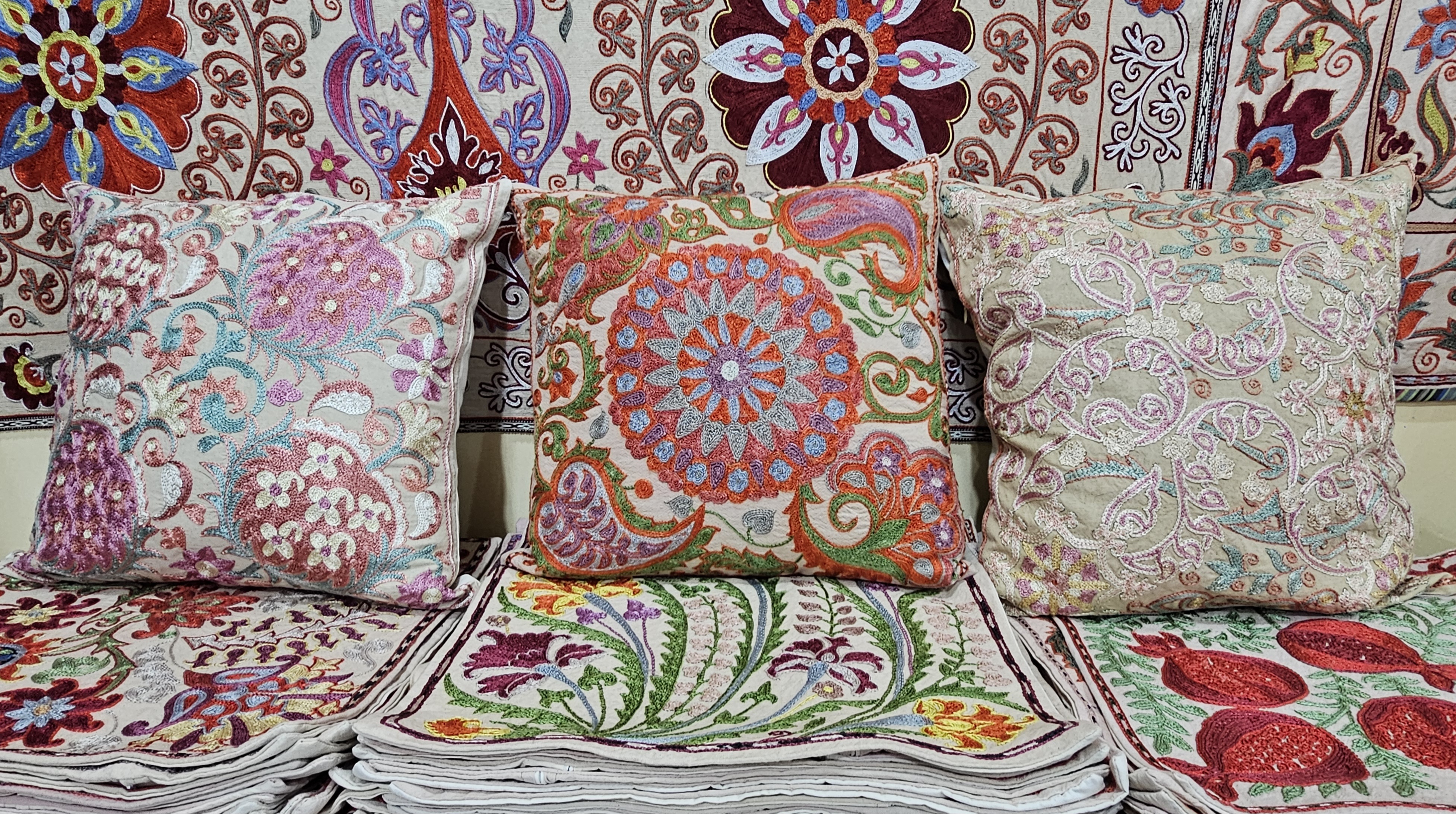
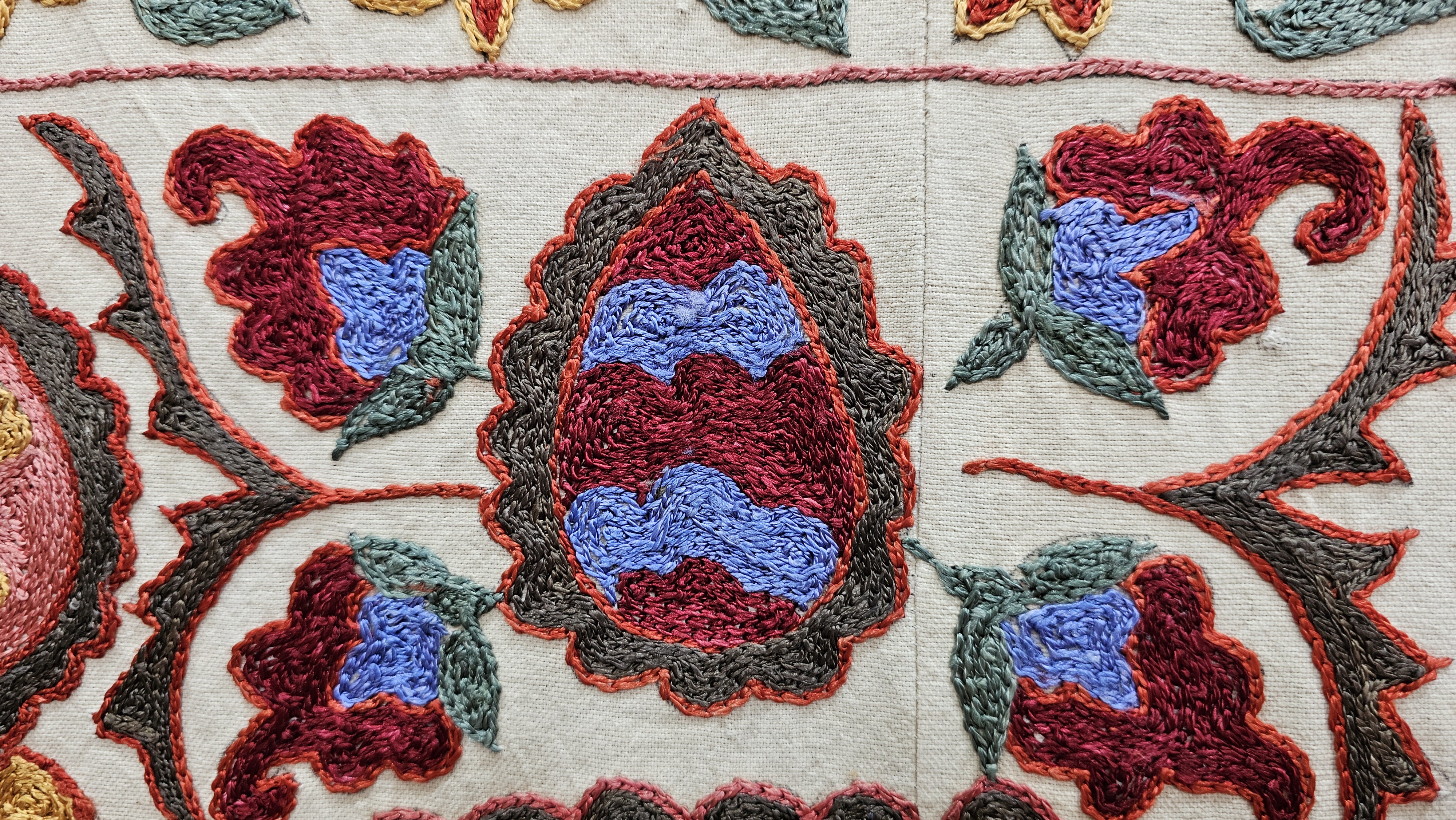
Each one of these cushion covers has been stitched by hand. Some are cotton and some are silk and they are priced according to the materials used and the amount of time spent. Understandably they were not cheap, averaging at around 70 – 100 USD each.
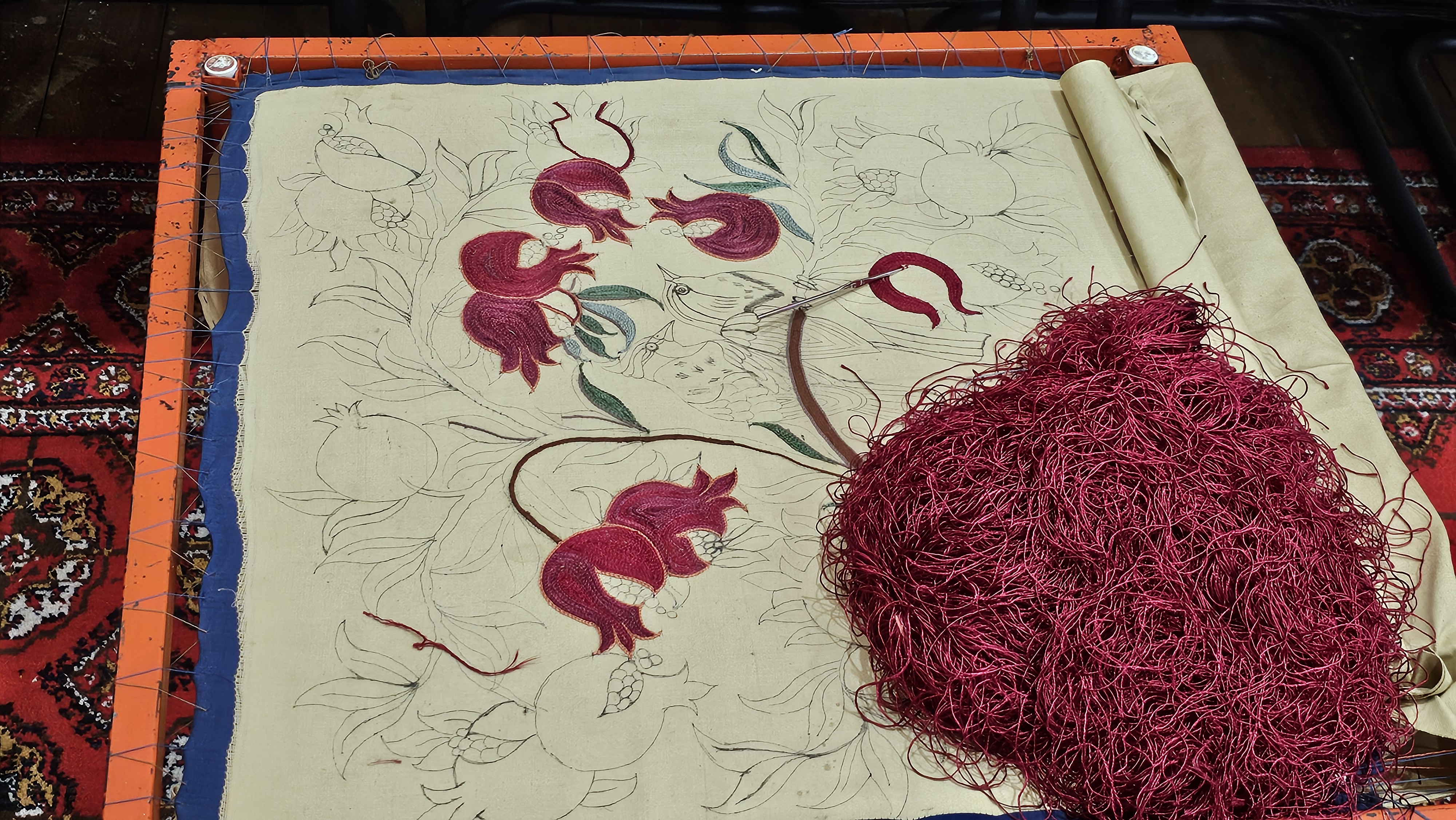
We bumped into Lucy and Sarah, two of our Explore fellow travellers and some of us (not me) did make some purchases of these amazing unique works of art.
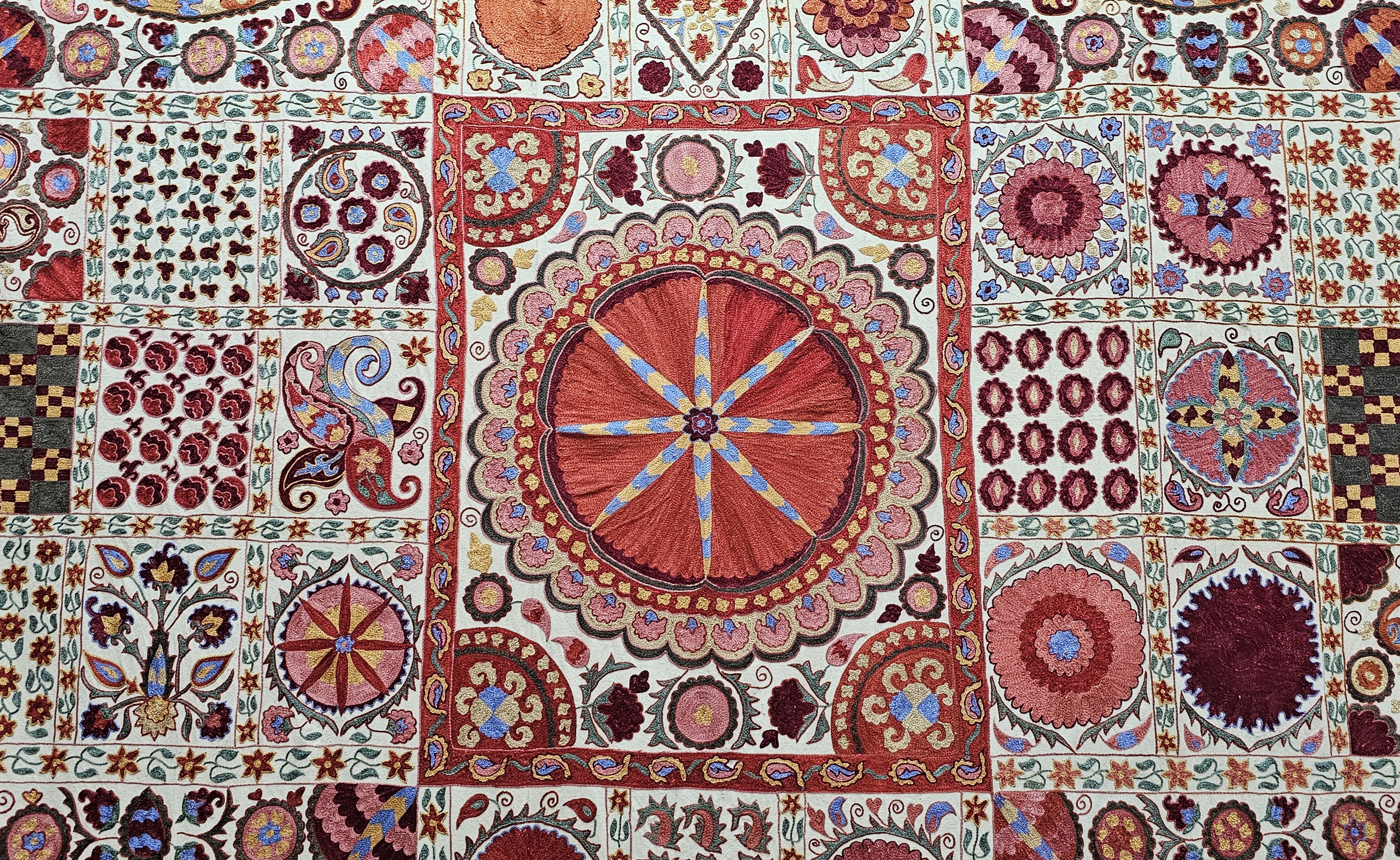
This was an incredible wall hanging, again all hand stitched.
Next it was time for the 5 of us to visit a coffee shop where we all had a coffee or a tea and a piece of baklava each.
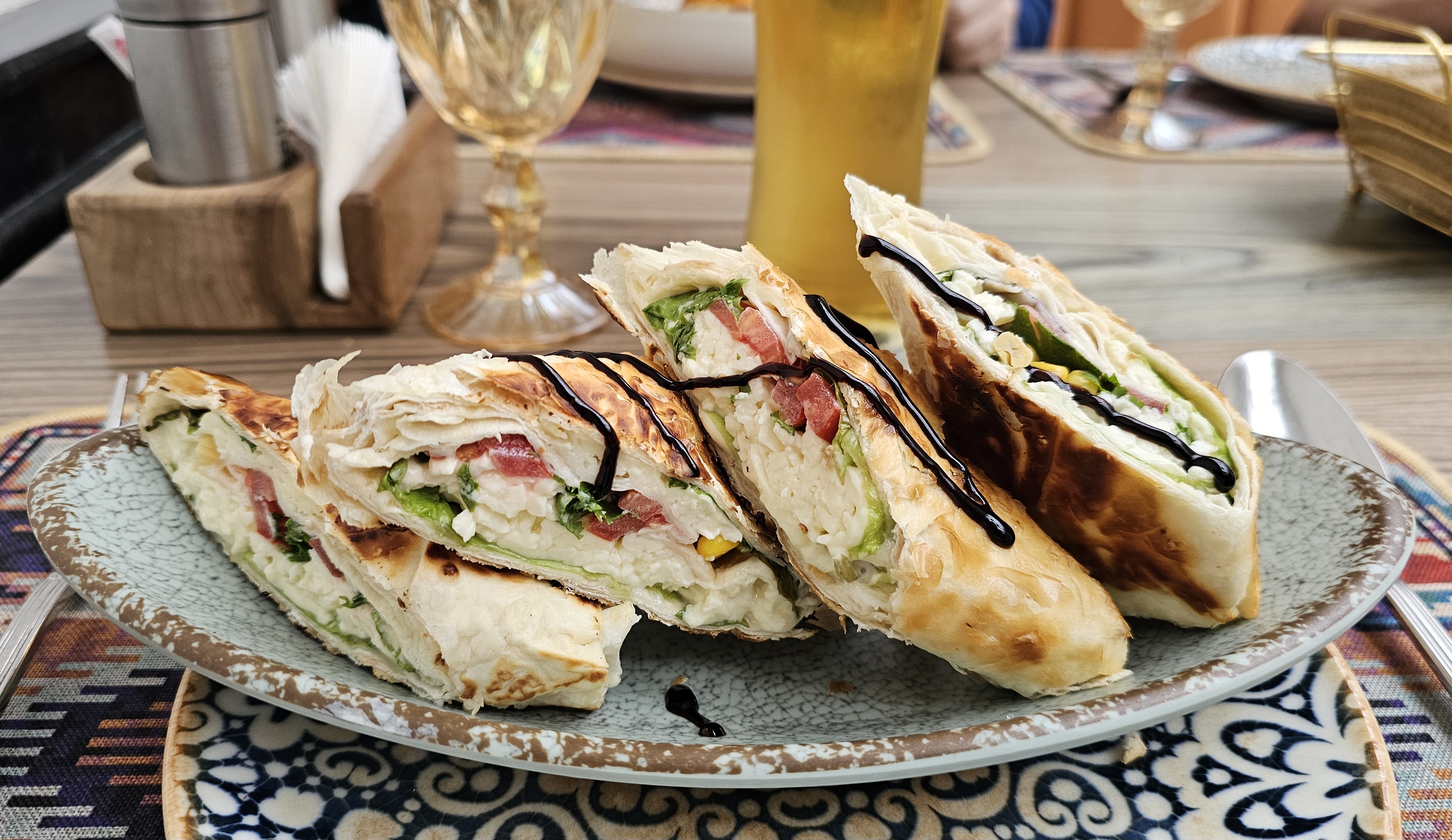
Our final lunch was spent in a restaurant called Zarqand where I had a snack called ‘Lavash with Brynza Cheese’. Lavash is a thin, soft flatbread and brynza cheese is a soft crumbly cheese made from sheep’s milk.
Evening meals
Our first meal in Samarkand was a group dinner at the Old Havuz where, amongst other things, Bridget and I shared a delicious crispy eggplant salad and ‘samsa’ (samosa). We sat in a covered area of the large courtyard with its fountain in the middle and music in the background. The food and the vibrant ambiance were good but quite a few of the menu items were unavailable.
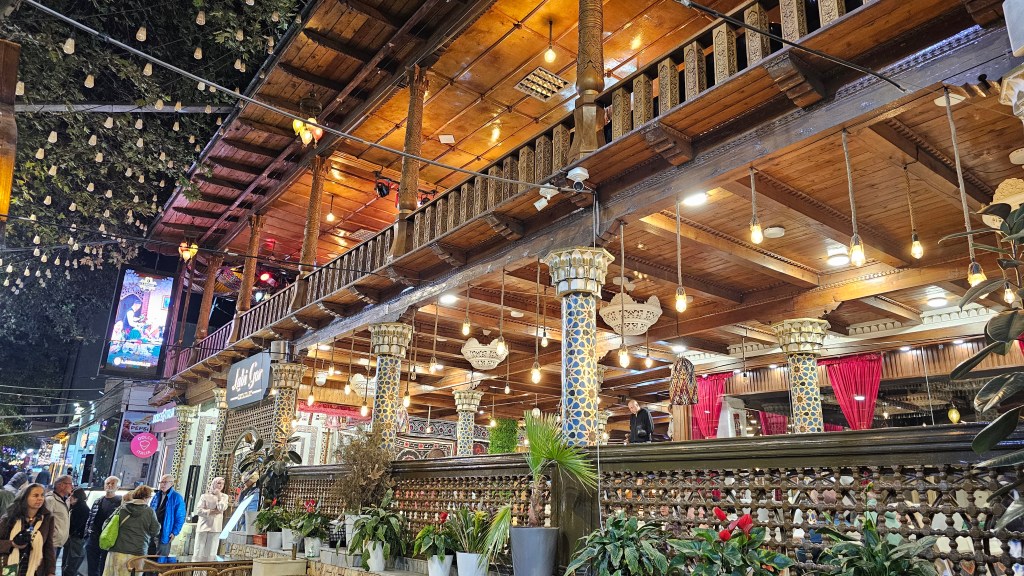
Our second meal was in Labi G’or where this time, 8 of our Explore group had dinner together. So far on the trip the bread has been a little disappointing but tonight we were given some fresh warm local bread which was the best of trip. Having developed a taste for this fabulous dry red wine, tonight I shared another bottle of Georgian Saperavi with Marvilynne, Richard and Dave 🍷Similar to the previous night Bridget and I shared a warm deep fried aubergine salad for our starter and I had traditional plov for main again.
Overall, we had two enjoyable and memorable evening meals during our time in Samarkand.
Accommodation
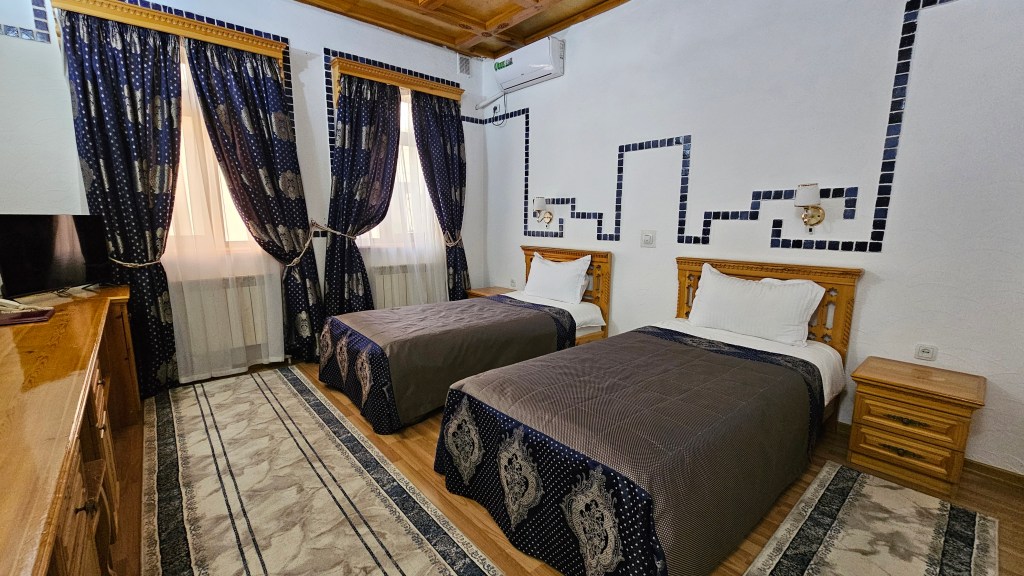
We had a comfortable stay in the centrally located Malika Prime hotel. Everything was great about our room: the beds were comfortable, the shower was powerful, hot and consistent, there was a hairdryer, a kettle, AC etc. And the breakfast was tasty.
Transfer to Tashkent
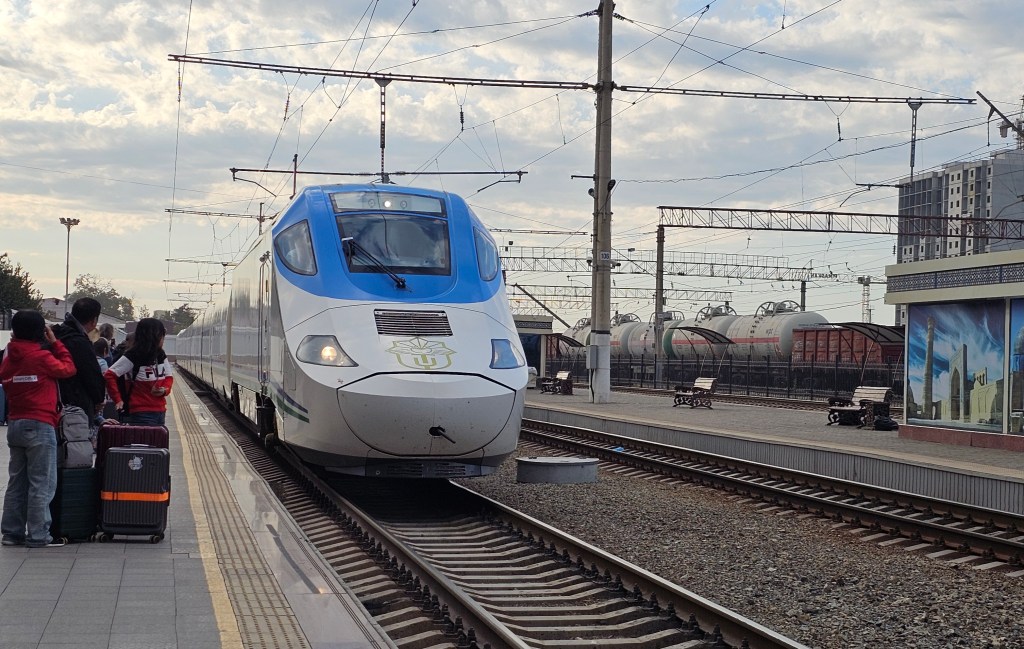
Sadly our time in Uzbekistan was starting to draw to a close. Our Explore group said goodbye to our bus driver as he dropped us at Samarkand train station ready for our bullet train to end the trip back in Tashkent.
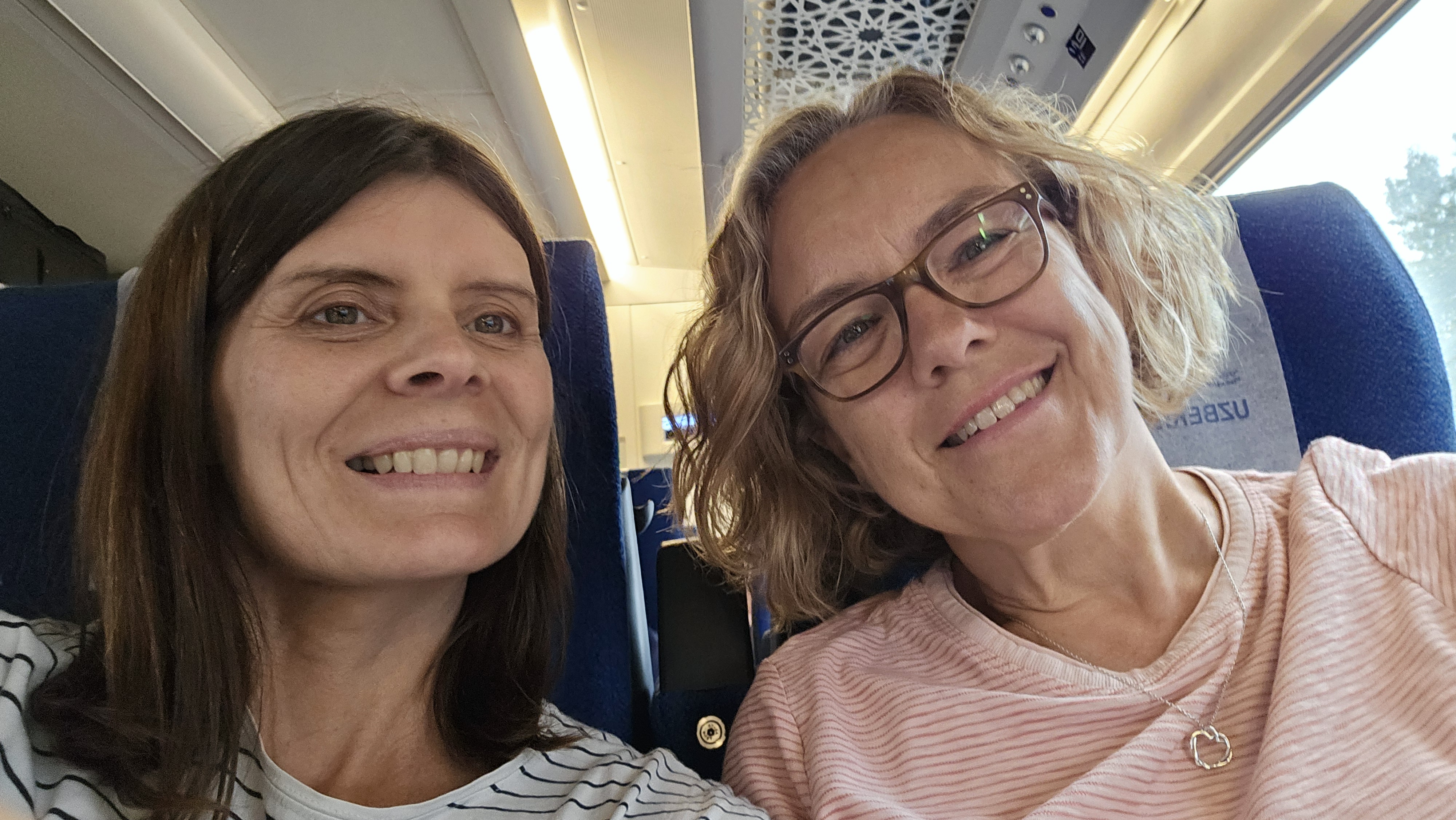
The bullet train wasn’t as much of a bullet as my Shinkansen experience in Japan but it enabled us to travel between the two cities in a couple of hours.
Back at the quality Hotel Inspira-S in Tashkent we had one final farewell dinner with the group and said goodbye to everyone before we all went our separate ways the following morning.
Summary
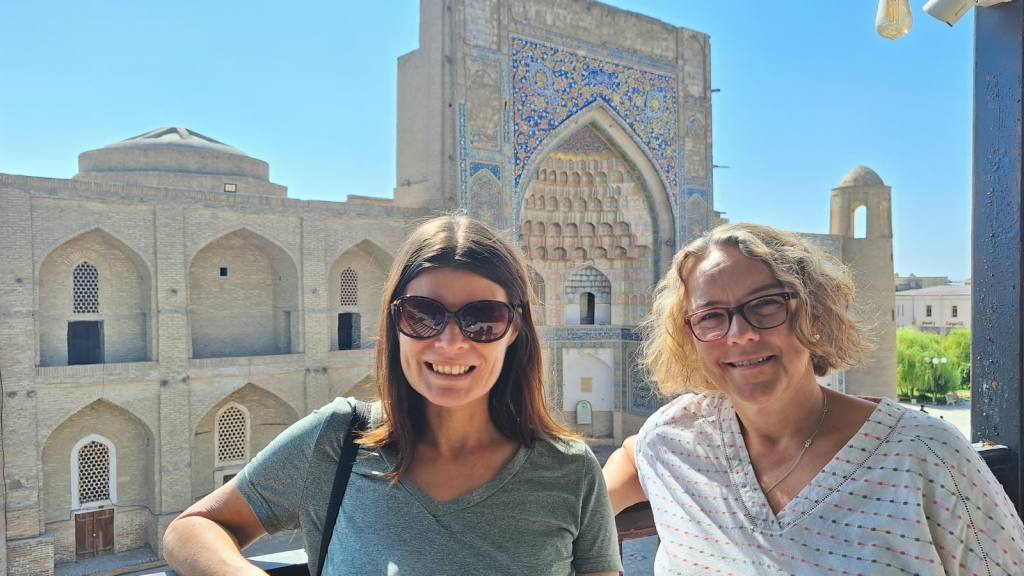
This marks the final post of another fantastic adventure! Because Uzbekistan hasn’t been completely overrun by mass tourism yet, the entire trip retained a rare, authentic charm.
The itinerary was spot on. It allowed Bridget and me to experience three completely distinct Silk Road cities, a refreshing retreat into the mountains for our hike, and the pristine, modern vibes of the capital, Tashkent. The overall pace was excellent, too, with plenty of built-in free time at each destination to explore independently at our own leisure.
The weather was mostly perfect throughout the tour with an average mid 20’s temperature and very little rain. It was slightly disappointing that it was cloudy during our Shaki-Zinda visit meaning the ‘blue avenue’ was less shimmering than it might have been but now I am being picky!
I can’t say enough good things about our guide, Sanjar. He balanced masterful leadership and organizational logistics with an incredible depth of knowledge and perfect English. Best of all, his sharp mind and quick wit meant everything was delivered with a brilliant sense of humor, making him an absolute joy to travel with.
In the absence of decent local wine, Sarbast, the Uzbekistan beer, was a good substitute for much of the week.
Similar to wine, food is not quite in the league of France or Italy however it was interesting to have discovered the main staples of plov (meat, rice and vegetables) and manti (steamed dumplings).
As a country, Uzbekistan felt very safe and I would happily travel there with confidence as a 50 something solo female.
Bridget and I made some lovely new friends which further enhanced our trip 🙂
Now sadly it is back to the UK and back to work with no more trips planned for 2026 😫

